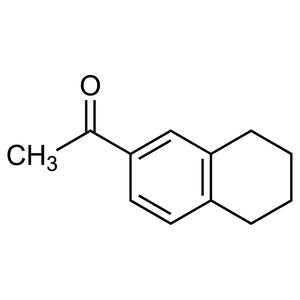
TCI M3863 is 6-Methyl-1,2,3,4-tetrahydronaphthalene, a bicyclic hydrocarbon that is a tetralin derivative bearing a methyl group at the six position of its aromatic ring. The tetralin framework itself consists of one benzene ring fused to a saturated cyclohexane ring, so the molecule presents an aromatic face that is reactive toward electrophilic substitution together with an aliphatic face that can be oxidized at the benzylic positions. In the laboratory, this compound serves as a non-heterocyclic building block and as a model compound for studying benzylic reactivity and regioselectivity patterns in multiply substituted aromatic systems.
The properties that make this material a preferred choice are its rigid, lipophilic, and electron-rich carbon skeleton. The methyl group is electron-donating, so it activates the aromatic ring and directs substitution toward particular positions, giving researchers a dependable means of testing regiochemical hypotheses. The four benzylic positions on the saturated ring are weak points that are readily attacked by oxidants and radical reagents, which is why the compound is frequently used to prepare tetralones, tetralols, or halogenated derivatives. Its strongly non-polar character also shapes how it is dissolved, extracted, and purified.
In Indonesian laboratories, this building block is typically found in university and institutional organic synthesis groups, in research units working on methodology development, and in analytical laboratories that require a well-defined hydrocarbon substrate. It is normally handled in small, carefully measured quantities under a fume hood as part of multi-step synthetic routes, reactivity studies, or the preparation of reference materials, where a predictable and well-characterized starting structure matters more than bulk volume.
Related TCI products
- TCI T0107 119-64-2 1,2,3,4-Tetrahydronaphthalene
- TCI D0585 447-53-0 1,2-Dihydronaphthalene
- TCI D0088 612-17-9 1,4-Dihydronaphthalene
- TCI T4149 53440-12-3 1,2,3,4-Tetrahydronaphthalene-2-carboxylic Acid
- TCI T3763 530-91-6 1,2,3,4-Tetrahydronaphthalen-2-ol
- TCI T2903 1914-65-4 1,2,3,4-Tetrahydronaphthalene-1-carboxylic Acid
- Non-heterocyclic building block in multi-step organic synthesis, where its rigid fused-ring framework provides a defined carbon skeleton onto which further functional groups can be installed.
- Benzylic oxidation studies, since the four benzylic positions on the saturated ring are readily attacked by oxidants to give tetralone and tetralol derivatives for further work.
- Regioselectivity investigations in electrophilic aromatic substitution, because the electron-donating methyl group activates the ring and directs incoming electrophiles to predictable positions.
- Radical reaction methodology, as the weak benzylic carbon-hydrogen bonds make this compound a convenient substrate for probing hydrogen atom abstraction and halogenation pathways.
- Preparation of halogenated tetralin derivatives, where the combination of an activated aromatic ring and reactive benzylic sites supports several distinct substitution outcomes for comparison.
| Brand | TCI |
|---|---|
| CAS number | 1680-51-9 |
| Molecular formula | — |
| Purity | — |
| Category | Chemistry > Building Blocks > Non-Heterocyclic Building Blocks |
| Pack sizes | available in standard TCI research-scale packaging; please confirm the currently offered size when ordering |
| Physical form | — |
| Storage | keep in a tightly closed original container in a cool, well-ventilated place away from ignition sources |
- Chemical name: 6-Methyl-1,2,3,4-tetrahydronaphthalene
Store this material in its tightly closed original container in a cool, dry, and well-ventilated area, away from heat, sparks, open flames, and strong oxidizing agents. Non-polar hydrocarbons of this type are best kept in chemically compatible glass or manufacturer-supplied containers with secure closures, protected from direct sunlight. Handle all transfers inside a functioning fume hood, wearing safety goggles, a laboratory coat, and chemically resistant gloves. Avoid inhaling vapours and prevent contact with skin and eyes. Keep containers closed when not in use, label any working aliquots clearly, and consult the manufacturer's safety data sheet before first use and before disposal, which should follow local chemical waste regulations.
—
Produk Terkait
-
1,2,3,4-Tetrahydronaphthalene TCI T0107
Regular price From Rp 477.750,00Regular price -
1,2-Dihydronaphthalene TCI D0585
Regular price From Rp 928.200,00Regular price -
1,4-Dihydronaphthalene TCI D0088
Regular price From Rp 1.749.300,00Regular price -
1,2,3,4-Tetrahydronaphthalene-2-carboxylicAcid TCI T4149
Regular price From Rp 2.359.350,00Regular price -
1,2,3,4-Tetrahydronaphthalen-2-ol TCI T3763
Regular price Rp 2.889.600,00Regular price -
1,2,3,4-Tetrahydronaphthalene-1-carboxylicAcid TCI T2903
Regular price From Rp 1.565.550,00Regular price -
5,6,7,8-Tetrahydronaphthalene-1-carboxylicAcid TCI T2672
Regular price From Rp 3.498.600,00Regular price -
1-(5,6,7,8-Tetrahydronaphthalen-2-yl)ethan-1-one TCI A3692
Regular price Rp 2.359.350,00Regular price