

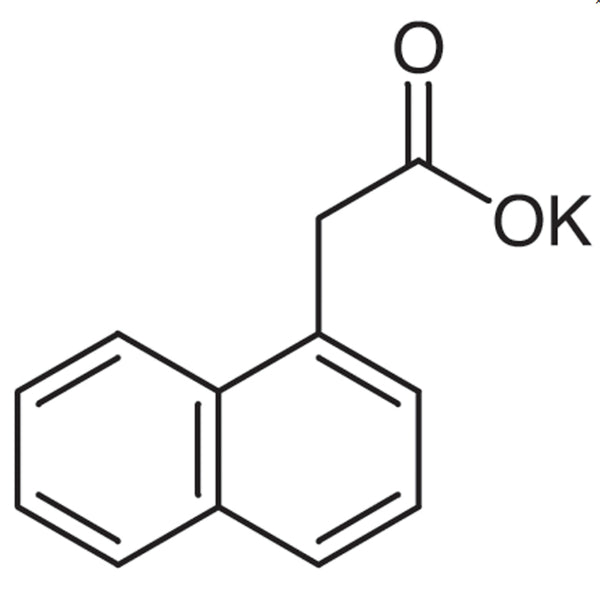
Potassium 1-Naphthaleneacetate (KNAA), with the CAS number 15165-79-4, is a chemical compound widely utilized in the field of plant biotechnology. As a growth regulator, KNAA plays a crucial role in laboratory settings by influencing plant development and growth management. It is commonly used to stimulate root formation, enhance vegetative growth, and support cloning processes. Its application extends to genetic modification research and the development of high-yield plant varieties, making it an essential tool for researchers in life sciences.
KNAA is valued for its chemical stability and solubility in organic solvents such as ethyl acetate and ethanol. These properties facilitate its dissolution and use in various biotechnology experiments, ensuring consistency and reliability in experimental outcomes. Additionally, its relatively high safety profile in laboratory environments allows for controlled dosing and application, reducing risks associated with chemical handling. This combination of stability, solubility, and safety makes KNAA a preferred choice for both academic and industrial research.
In Indonesian laboratories, KNAA is extensively used by researchers and educational institutions. Its role in plant biotechnology aligns with the country’s growing focus on agricultural innovation and sustainable development. KNAA supports advanced research in plant genetics and biotechnology, contributing to the development of improved crop varieties and efficient agricultural practices. Its availability through suppliers like AMI Scientific ensures that Indonesian laboratories have access to this essential compound for their research needs.
TCI brochures (PDF)
- Synthetic Auxin and Selective Binding to Modified Receptor 2025-05-26 · p. 2
- Plant Hormones 2025-01-30 · p. 1
- Agrochemical Ingredients for Research and Experimental Use 2026-01-08 · p. 7
- Plant Research Reagents 2026-02-24 · p. 13
- Reagents for Biological Research 2025-03-11 · p. 55
- Plant Growth Regulation: KNAA is used to control and enhance plant growth, making it ideal for studies on vegetative development and root stimulation.
- Cloning Techniques: It supports the cloning process by promoting cell division and tissue regeneration, essential for plant propagation research.
- Genetic Modification Studies: KNAA is a key component in experiments involving genetic modification, aiding in the development of improved plant varieties.
- Root Induction Experiments: Its ability to stimulate root formation makes it a preferred choice for researchers working on plant tissue culture and propagation.
- Agricultural Biotechnology Research: KNAA is widely used in research aimed at improving crop yield and resilience, supporting Indonesia’s agricultural innovation goals.
| Brand | TCI |
|---|---|
| CAS number | 15165-79-4 |
| Molecular formula | — |
| Purity | — |
| Category | Life Science > Molecular Biology > Plant Biotechnology |
| Pack sizes | Available in various quantities suitable for laboratory use |
| Physical form | Solid powder |
| Storage | Store in a cool, dry place away from direct sunlight |
KNAA should be stored in a cool, dry environment, away from direct sunlight and sources of heat. It is recommended to use airtight containers to prevent moisture absorption and contamination. Due to its chemical stability, KNAA does not require refrigeration but should be kept in a secure location to avoid accidental exposure. Laboratory personnel should wear appropriate personal protective equipment when handling the compound to ensure safety. KNAA is non-toxic and easy to manage, making it suitable for routine use in research settings. Proper storage and handling procedures help maintain the integrity of the compound and ensure safe laboratory practices.
—
Product Categories
Produk Terkait
-
Sodium1-Naphthaleneacetate TCI N0007
Regular price From Rp 1.220.100,00Regular price -
1-NaphthaleneaceticAcid TCI N0005
Regular price From Rp 769.650,00Regular price -
Methyl1-Naphthaleneacetate TCI N0570
Regular price Rp 1.829.100,00Regular price -
Ethyl1-Naphthaleneacetate TCI N0554
Regular price Rp 2.757.300,00Regular price -
2-NaphthaleneaceticAcid TCI N0352
Regular price From Rp 1.298.850,00Regular price -
7-Methoxy-1-naphthaleneaceticAcid TCI M2888
Regular price From Rp 689.850,00Regular price -
Adenine TCI A0149
Regular price From Rp 1.696.800,00Regular price -
trans-Zeatin TCI Z0012
Regular price Rp 6.520.500,00Regular price


