

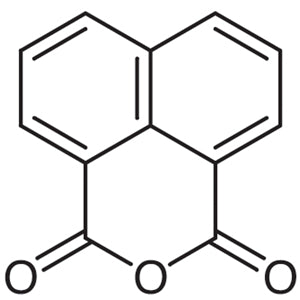
1,8-Naphthalic Anhydride is a cyclic acid anhydride formed from two neighbouring carboxyl groups at the peri positions of the naphthalene skeleton. In the laboratory, this material is a classic building block for the preparation of naphthalimide derivatives, compounds obtained by reacting it with primary amines. The reaction proceeds relatively simply, often requiring only heating in a suitable solvent, and yields products with a rigid framework and attractive optical properties. For this reason, the compound has become a favourite starting point for researchers assembling fluorescent molecules, molecular sensors, and functional organic materials built around an extensively conjugated aromatic core.
The properties that make it a widely preferred choice are the selective reactivity of the anhydride group towards primary amines, the conjugated aromatic framework that confers characteristic absorption and emission behaviour, and the stability of the solid under ordinary storage conditions. The peri-fused structure gives rise to a six-membered imide ring that is highly stable both thermally and chemically, so that derivative products withstand fairly demanding processing conditions. In addition, certain positions on the naphthalene ring remain open for further modification, allowing researchers to tune the electronic and photophysical character of the resulting derivatives.
In Indonesian laboratories, this building block is typically used in synthetic organic chemistry and materials chemistry groups at universities and research institutes. It commonly appears in work on fluorescent probes and molecular sensors, in the preparation of conjugated aromatic intermediates, and in teaching and research laboratories that carry out condensation reactions with primary amines. Its straightforward reaction conditions and stable solid form make it practical for routine bench-scale preparations as well as for exploratory work on functional organic materials.
- Synthesis of naphthalimide derivatives: reaction with primary amines proceeds simply, often by heating in a suitable solvent, giving rigid products in a single condensation step.
- Development of fluorescent molecules: the extensively conjugated aromatic framework provides characteristic absorption and emission behaviour that researchers rely on when designing luminescent compounds.
- Preparation of molecular sensors: the selective reactivity towards primary amines lets researchers attach recognition units while retaining the photophysical core of the naphthalimide scaffold.
- Functional organic materials research: the thermally and chemically stable six-membered imide ring allows derivative products to withstand fairly demanding processing conditions during material fabrication.
- Building-block chemistry for further modification: certain positions on the naphthalene ring remain open, allowing systematic structural variation of the conjugated aromatic skeleton by synthetic chemists.
| Brand | TCI |
|---|---|
| CAS number | 81-84-5 |
| Molecular formula | — |
| Purity | — |
| Category | Chemistry > Building Blocks > Non-Heterocyclic Building Blocks |
| Pack sizes | available in the standard catalogue pack sizes offered for this item |
| Physical form | — |
| Storage | stable as a solid under ordinary storage conditions |
- Product Code: N0022
Store the material in a tightly closed original container, kept dry and protected from moisture, since acid anhydrides are sensitive to hydrolysis. A cool, dry, well-ventilated chemical store away from direct sunlight is appropriate; the solid is stable under ordinary storage conditions. Handle the powder in a fume hood to avoid raising dust, and use standard laboratory personal protective equipment including gloves, safety goggles, and a laboratory coat. Keep the container away from primary amines and other incompatible reagents, close it promptly after weighing, and consult the manufacturer's safety data sheet before use and disposal.
—
Produk Terkait
-
4-Bromo-1,8-naphthalicAnhydride TCI B0858
Regular price Rp 769.650,00Regular price -
1,2-NaphthalicAnhydride TCI N0583
Regular price From Rp 11.103.750,00Regular price -
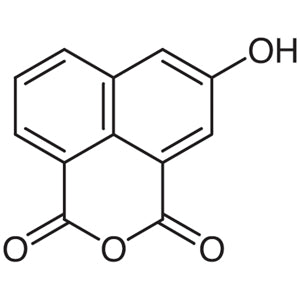
3-Hydroxy-1,8-naphthalicAnhydride TCI H0278
Regular price Rp 6.599.250,00Regular price -
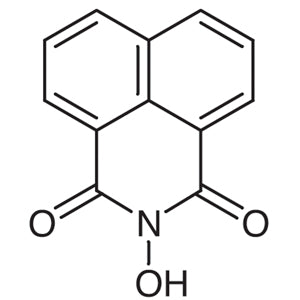
N-Hydroxy-1,8-naphthalimide TCI H1040
Regular price From Rp 928.200,00Regular price -
ValericAnhydride TCI V0006
Regular price From Rp 875.700,00Regular price -
3-BromophthalicAnhydride TCI B4061
Regular price From Rp 1.246.350,00Regular price -
Bicyclo[2.2.2]oct-5-ene-2,3-dicarboxylicAnhydride TCI B3038
Regular price Rp 3.605.700,00Regular price -
ButylsuccinicAnhydride TCI B2742
Regular price From Rp 5.274.150,00Regular price




![6708-37-8 Bicyclo[2.2.2]oct-5-ene-2,3-dicarboxylic Anhydride - AMI Scientific](http://amiscientific.com/cdn/shop/files/TCI2510B3038.jpg?v=1767089273&width=533)
