TCI N0040 1,4-Naphthoquinone with CAS number 130-15-4 is an aromatic quinone compound consisting of a naphthalene ring bearing two carbonyl groups at the one and four positions. It ranks among the most important quinones in organic chemistry because it functions simultaneously as a dienophile in Diels-Alder reactions, a Michael acceptor in nucleophilic addition, and a redox mediator in electrochemical experiments. In the laboratory, this material serves as a starting point for the synthesis of anthraquinone derivatives, vitamin K-like compounds, and a wide range of bioactive molecules investigated for antimicrobial and antioxidant activity.
The characteristics that make this compound so highly valued are its electron-poor conjugated quinone system, which renders it strongly reactive toward dienes and nucleophiles, together with its ability to undergo reversible reduction-oxidation cycling to the corresponding hydroquinone. The crystalline solid is yellow and readily recognizable, dissolving in many organic solvents while showing limited solubility in water. The compound also sublimes easily, a property that is useful for purification but that demands genuinely tightly sealed containers. Maintained purity strongly determines the success of cycloaddition reactions, because oxidation products can interfere with the intended transformation.
In Indonesian laboratories, 1,4-naphthoquinone is typically used in organic synthesis research groups at universities and in institutional research centres, where it supports coursework in advanced organic chemistry as well as postgraduate and thesis-level projects. It is equally at home in electrochemistry work, where its reversible redox behaviour makes it a convenient model system, and in natural-product-oriented laboratories building quinone scaffolds for biological screening. Careful stock management matters in warm, humid local conditions, where sublimation and container integrity deserve routine attention.
Related TCI products
- TCI H0286 481-39-0 5-Hydroxy-1,4-naphthoquinone
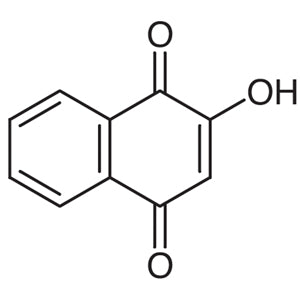
- TCI H0285 83-72-7 2-Hydroxy-1,4-naphthoquinone
- TCI D2421 14918-69-5 2,3-Dichloro-5,8-dihydroxy-1,4-naphthoquinone
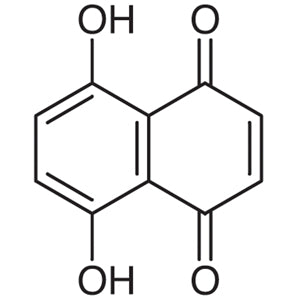
- TCI D2070 475-38-7 5,8-Dihydroxy-1,4-naphthoquinone
- TCI D0384 117-80-6 2,3-Dichloro-1,4-naphthoquinone
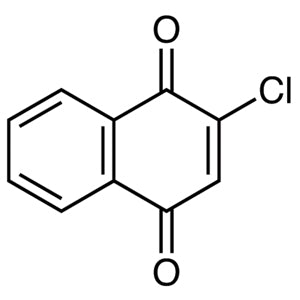
- TCI C2721 1010-60-2 2-Chloro-1,4-naphthoquinone
- Diels-Alder cycloaddition chemistry: the electron-poor conjugated quinone system makes this compound an excellent dienophile, reacting readily with dienes to build fused polycyclic frameworks under straightforward laboratory conditions.
- Michael addition reactions: the activated carbonyl-conjugated double bond accepts a broad range of nucleophiles, allowing chemists to introduce diverse substituents onto the quinone core with good control.
- Synthesis of anthraquinone derivatives: the naphthoquinone skeleton serves as a direct structural precursor, shortening synthetic routes toward anthraquinone targets compared with building the ring system from simpler starting materials.
- Electrochemical redox studies: reversible reduction to the hydroquinone and reoxidation back to the quinone makes this compound a convenient and well-behaved redox mediator for voltammetry and related electrochemical experiments.
- Bioactive molecule research: it provides the starting scaffold for preparing vitamin K-like compounds and other quinone derivatives that research groups screen for antimicrobial and antioxidant activity.
| Brand | TCI |
|---|---|
| CAS number | 130-15-4 |
| Molecular formula | — |
| Purity | — |
| Category | Chemistry > Building Blocks > Non-Heterocyclic Building Blocks |
| Pack sizes | available in standard TCI research packaging; please confirm the size required when ordering |
| Physical form | yellow crystalline solid, soluble in many organic solvents, limited solubility in water |
| Storage | keep in a tightly sealed container, as the compound sublimes readily |
- Chemical name: 1,4-Naphthoquinone (catalogue code N0040)
Store 1,4-naphthoquinone in a tightly closed container kept in a cool, dry place away from direct sunlight and heat sources, since the compound sublimes readily and loose closures lead to gradual loss of material and contamination of the surrounding storage area. Amber glass bottles with well-fitting caps are suitable, and secondary containment is advisable for longer-term storage. Handle the solid inside a fume hood using gloves, safety goggles, and a laboratory coat, avoiding the generation of dust and any contact with skin or eyes. Keep the material separated from strong reducing agents and strong bases, and weigh out only what is needed so that the bulk container is reopened as seldom as possible. Because oxidation products can compromise cycloaddition results, protect stock from prolonged air exposure and check the appearance of the solid before critical work.
—
Produk Terkait
-
5-Hydroxy-1,4-naphthoquinone TCI H0286
Regular price From Rp 1.749.300,00Regular price -
2-Hydroxy-1,4-naphthoquinone TCI H0285
Regular price From Rp 1.538.250,00Regular price -
2,3-Dichloro-5,8-dihydroxy-1,4-naphthoquinone TCI D2421
Regular price From Rp 3.498.600,00Regular price -
5,8-Dihydroxy-1,4-naphthoquinone TCI D2070
Regular price Rp 10.705.800,00Regular price -
2,3-Dichloro-1,4-naphthoquinone TCI D0384
Regular price From Rp 505.050,00Regular price -
2-Chloro-1,4-naphthoquinone TCI C2721
Regular price Rp 2.439.150,00Regular price -
2-Amino-3-chloro-1,4-naphthoquinone TCI A1288
Regular price From Rp 1.060.500,00Regular price -
Sodium1,2-Naphthoquinone-4-sulfonate TCI N0043
Regular price From Rp 664.650,00Regular price