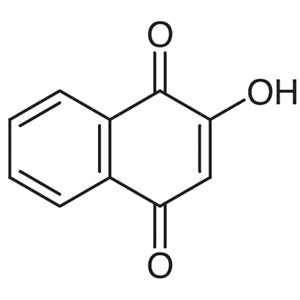
2-Hydroxy-1,4-naphthoquinone is a chemical compound widely used in laboratory settings for its versatility in organic synthesis and chemical reactions. As a key building block in the field of chemistry, it serves as a foundational material for the development of various bioactive compounds and functional materials. Its aromatic structure enables it to participate in multiple reaction pathways, making it a valuable resource for researchers in both academic and industrial environments. This compound is particularly useful in the synthesis of phenolic derivatives, anthocyanins, and other compounds with significant biological and chemical properties.
The compound’s stability and controlled reactivity make it a preferred choice for laboratory applications. It exhibits solubility in organic solvents such as ethyl acetate and acetone, which simplifies processing and separation techniques in synthetic workflows. Its molecular structure allows for predictable chemical behavior, enabling chemists to design and execute complex reactions with greater precision. Additionally, its availability in various packaging formats supports its use across different experimental scales, from small-scale research to larger production processes.
In Indonesian laboratories, 2-Hydroxy-1,4-naphthoquinone is commonly used in pharmaceutical and organic chemistry research. It plays a crucial role in the synthesis of bioactive compounds and the development of new pharmaceutical products. Many research institutions and universities in Indonesia rely on this compound for experiments involving the creation of active pharmaceutical ingredients and the exploration of novel chemical structures.
Related TCI products
- TCI D2421 14918-69-5 2,3-Dichloro-5,8-dihydroxy-1,4-naphthoquinone
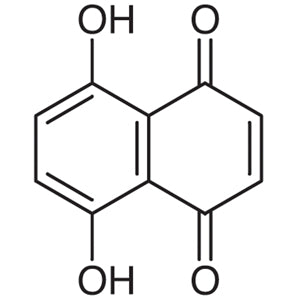
- TCI D2070 475-38-7 5,8-Dihydroxy-1,4-naphthoquinone
- TCI H0286 481-39-0 5-Hydroxy-1,4-naphthoquinone
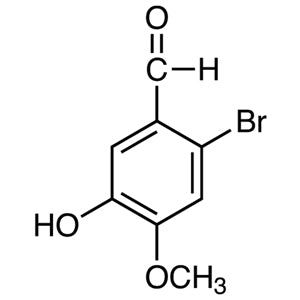
- TCI B4681 2973-59-3 2-Bromo-5-hydroxy-4-methoxybenzaldehyde
- TCI H1578 39604-68-7 2'-Hydroxy-4',6'-dimethoxy-2-(4-methoxyphenyl)acetophenone
- TCI H0592 617-73-2 2-Hydroxy-n-octanoic Acid
- Organic synthesis of bioactive compounds due to its aromatic structure and reactivity.
- Development of pharmaceutical products as a precursor for phenolic derivatives and anthocyanins.
- Research in biochemistry for the study of natural products and their chemical properties.
- Material science applications in the creation of functional materials with specific chemical properties.
- Educational use in chemistry laboratories for teaching synthetic methods and reaction mechanisms.
| Brand | TCI |
|---|---|
| CAS number | 83-72-7 |
| Molecular formula | — |
| Purity | — |
| Category | Chemistry > Building Blocks > Non-Heterocyclic Building Blocks |
| Pack sizes | Available in various sizes to suit different experimental needs |
| Physical form | Solid |
| Storage | Store in a cool, dry place away from light and moisture |
This compound should be stored in a cool, dry place, away from direct light and moisture to maintain its chemical integrity. It is recommended to use airtight containers to prevent exposure to air and humidity, which could affect its stability. Due to its reactivity, it should be handled with appropriate laboratory safety measures, including the use of personal protective equipment such as gloves and safety goggles. It is advisable to store it in a well-ventilated area to minimize any potential risks associated with its chemical properties. Proper labeling of storage containers is essential to ensure safe handling and prevent accidental use.
—
Product Categories
- Building BlocksNon-Heterocyclic Building BlocksCarbonyl Compounds [Non-Heterocyclic Building Blocks]
- Building BlocksNon-Heterocyclic Building BlocksOxygen Compounds [Non-Heterocyclic Building Blocks]
- Stains and Dyes (for Research and Experimental Use)Dye Intermediates (for Research and Experimental Use)
- Pharmaceutical Development and Drug Discovery Research ReagentsBuilding Blocks for Pharmaceutical Ingredients (for Research and Experimental Use)
Produk Terkait
-
2,3-Dichloro-5,8-dihydroxy-1,4-naphthoquinone TCI D2421
Regular price From Rp 3.498.600,00Regular price -
5,8-Dihydroxy-1,4-naphthoquinone TCI D2070
Regular price Rp 10.705.800,00Regular price -
5-Hydroxy-1,4-naphthoquinone TCI H0286
Regular price From Rp 1.749.300,00Regular price -
2-Bromo-5-hydroxy-4-methoxybenzaldehyde TCI B4681
Regular price Rp 4.293.450,00Regular price -
2'-Hydroxy-4',6'-dimethoxy-2-(4-methoxyphenyl)acetophenone TCI H1578
Regular price From Rp 1.776.600,00Regular price -
2-Hydroxy-n-octanoicAcid TCI H0592
Regular price Rp 3.100.650,00Regular price -
3-Hydroxy-N-(2-naphthyl)-2-naphthamide TCI H0319
Regular price Rp 2.094.750,00Regular price -
3-Hydroxy-2'-methyl-2-naphthanilide TCI H0315
Regular price From Rp 1.087.800,00Regular price