

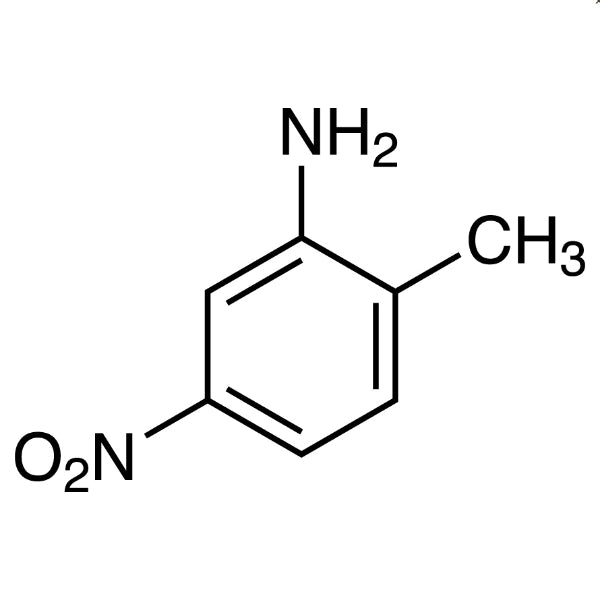
2-Methyl-5-nitroaniline is a chemical compound widely used as a foundational building block in organic chemistry laboratories. It serves as a key intermediate in the synthesis of complex organic molecules, particularly in the development of pharmaceuticals and industrial chemicals. Its aromatic structure, combined with nitro and methyl substituents, allows for versatile chemical reactions such as reduction, substitution, and nucleophilic attacks. This makes it an essential material for chemists working on a variety of synthetic pathways. Due to its reactivity and functional versatility, it is frequently used in both academic and industrial research settings.
The compound is known for its solubility in common organic solvents like ethyl acetate and ethanol, which facilitates its use in various reaction conditions. Its stability under controlled laboratory conditions further enhances its reliability as a reagent. The reactivity of 2-Methyl-5-nitroaniline enables it to participate in a wide range of chemical transformations, making it a preferred choice for synthetic chemists. Its chemical properties allow for predictable and reproducible results, which are crucial in both research and development applications.
In Indonesian laboratories, 2-Methyl-5-nitroaniline is commonly used in organic chemistry research, chemical development, and educational settings. It is a staple in pharmaceutical and industrial chemistry studies, supporting the creation of new compounds and materials. Many research institutions and universities in Indonesia rely on this compound for their experimental work, particularly in drug discovery and chemical synthesis projects. Its availability and reliability make it a trusted reagent in the Indonesian scientific community.
- Organic synthesis projects benefit from 2-Methyl-5-nitroaniline due to its reactivity and structural versatility, enabling the creation of complex molecules.
- Pharmaceutical research utilizes this compound as a starting material for the development of new drugs, leveraging its chemical properties for targeted synthesis.
- Industrial chemical production relies on this reagent for the synthesis of functional compounds used in various manufacturing processes.
- Educational institutions use it to teach fundamental organic chemistry concepts, providing students with hands-on experience in synthetic techniques.
- Research laboratories incorporate it into their workflows for the development of novel materials and compounds in both academic and applied settings.
| Brand | TCI |
|---|---|
| CAS number | 99-55-8 |
| Molecular formula | — |
| Purity | — |
| Category | Chemistry > Building Blocks > Non-Heterocyclic Building Blocks |
| Pack sizes | Available in standard laboratory quantities |
| Physical form | Solid |
| Storage | Store in a cool, dry place away from direct sunlight |
2-Methyl-5-nitroaniline should be stored in a cool, dry environment, away from direct sunlight and sources of heat. It is best kept in a sealed container made of glass or inert plastic to prevent contamination and maintain chemical integrity. Due to its reactivity, it should be handled with care using appropriate personal protective equipment, such as gloves and safety goggles. It is recommended to store it in a well-ventilated area to minimize exposure to vapors. Proper labeling and storage conditions are essential to ensure safety and prevent accidental reactions. Always follow standard laboratory safety protocols when working with this compound.
—
Produk Terkait
-
2-Iodo-4-nitroaniline TCI I0878
Regular price From Rp 1.246.350,00Regular price -
4-Bromo-3-nitroaniline TCI B4876
Regular price From Rp 637.350,00Regular price -
2-Bromo-4-nitroaniline TCI B4873
Regular price From Rp 1.220.100,00Regular price -
4-Bromo-2-methyl-6-nitroaniline TCI B3730
Regular price From Rp 717.150,00Regular price -
4-Bromo-2-nitroaniline TCI B3033
Regular price From Rp 689.850,00Regular price -
2-Bromo-6-chloro-4-nitroaniline TCI B1771
Regular price Rp 477.750,00Regular price -
2-Bromo-4,6-dinitroaniline TCI B0814
Regular price From Rp 717.150,00Regular price -
2-Methyl-4-nitroaniline TCI N0529
Regular price Rp 1.644.300,00Regular price


