

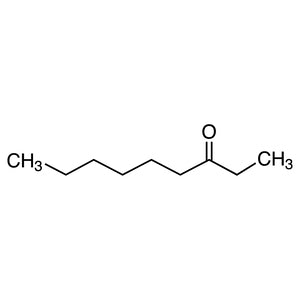
3-Nonanone is an organic compound widely used in various chemical reactions within laboratory settings. As a key building block in organic chemistry, it plays a vital role in the synthesis of complex molecules, including heterocyclic and aromatic compounds. Its versatility makes it a valuable tool for researchers and students alike, enabling the creation of a wide range of chemical structures through substitution, oxidation, and reduction reactions. This compound is essential for advancing synthetic pathways and exploring new chemical transformations in both academic and industrial research environments.
3-Nonanone is known for its stable chemical properties and moderate reactivity, which make it a preferred choice for laboratory use. It is a colorless liquid with a mild, characteristic odor, and it does not react spontaneously under normal conditions. These attributes contribute to its safety and ease of handling, allowing it to be used in a variety of experimental setups without the need for excessive protective measures. Its stability also ensures consistent results across different experiments, making it a reliable component in chemical synthesis processes.
In Indonesian laboratories, 3-Nonanone is highly relevant for scientific research, particularly in the fields of organic chemistry and compound synthesis. It is commonly used by researchers and students to meet the needs of experiments that require a stable and readily available building block. Its presence in laboratory supplies supports the development of new chemical compounds and contributes to the advancement of scientific knowledge in the region.
- Heterocyclic Compound Synthesis: 3-Nonanone is ideal for creating complex ring structures due to its stable and reactive nature.
- Aromatic Compound Production: It serves as a precursor in reactions that form aromatic systems, enhancing synthetic flexibility.
- Oxidation and Reduction Reactions: Its moderate reactivity allows it to participate in redox processes without excessive side reactions.
- Substitution Reactions: It is commonly used in substitution reactions to introduce functional groups into organic molecules.
- Organic Synthesis Education: It is widely used in academic settings to teach fundamental principles of chemical synthesis and reaction mechanisms.
| Brand | TCI |
|---|---|
| CAS number | 925-78-0 |
| Molecular formula | — |
| Purity | — |
| Category | Chemistry > Building Blocks > Non-Heterocyclic Building Blocks |
| Pack sizes | Available in standard laboratory quantities |
| Physical form | Colorless liquid |
| Storage | Store in a cool, dry place away from direct sunlight |
3-Nonanone should be stored in a cool, dry place away from direct sunlight to maintain its stability and prevent degradation. It is recommended to use airtight containers made of glass or high-density polyethylene to minimize exposure to air and moisture. Due to its moderate reactivity, it should be handled with standard laboratory precautions, including the use of gloves and proper ventilation. While it is not highly volatile, it is advisable to work in a fume hood when performing reactions involving this compound. Its non-spontaneous nature reduces the risk of accidental reactions, making it a safe and reliable choice for routine laboratory use.
—
Produk Terkait
-
4-Nonanone TCI N0427
Regular price Rp 1.908.900,00Regular price -
5-Nonanone TCI N0294
Regular price From Rp 1.273.650,00Regular price -
2-Nonanone TCI N0293
Regular price From Rp 743.400,00Regular price -
trans-2-Pentenal TCI P1790
Regular price From Rp 1.140.300,00Regular price -
3-Octanone TCI O0122
Regular price From Rp 848.400,00Regular price -
2-Methylbutyraldehyde TCI M0166
Regular price Rp 557.550,00Regular price -
trans-2-Hexenal TCI H0345
Regular price From Rp 1.035.300,00Regular price -
3-Ethyltoluene TCI E0185
Regular price From Rp 1.644.300,00Regular price


