

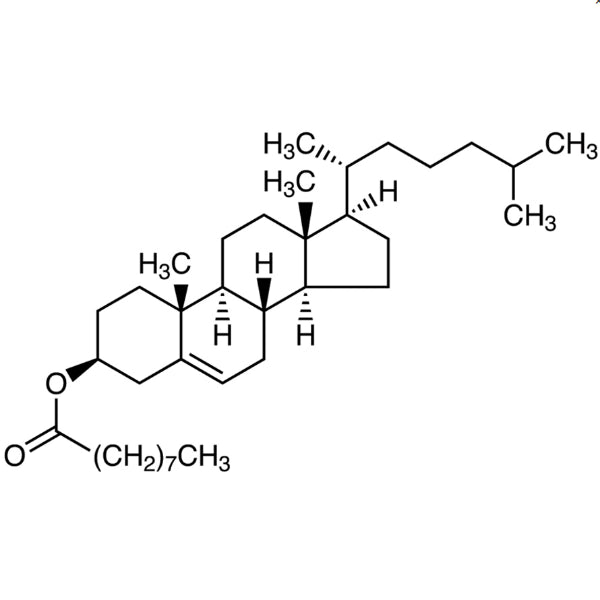
TCI N0347 1182-66-7 Cholesterol Pelargonate is a chemical compound widely used in scientific experiments, particularly in the fields of material science and technology. This compound plays a crucial role in laboratory settings where researchers are exploring the properties of liquid crystal (LC) materials and electronic materials. Its molecular structure is unique, allowing it to be a key component in the synthesis of complex compounds and in the formulation of materials with specific optical properties. Due to its versatility, it is often employed in advanced research projects that require precise chemical interactions and controlled reactivity.
The chemical stability and reactivity of Cholesterol Pelargonate make it a preferred choice for various experimental applications. It can interact with other compounds under specific conditions, enabling the development of new materials with tailored properties. Its stability ensures that it maintains its chemical integrity during experiments, which is essential for accurate and reproducible results. Additionally, its melting point and solubility characteristics allow it to be used in a wide range of synthesis and characterization techniques, making it a valuable resource in modern laboratories.
In Indonesian laboratories, Cholesterol Pelargonate is commonly used in material science research, especially in the development of electronic and liquid crystal materials. Its availability and effectiveness in meeting the needs of experiments that require specialized compounds make it a popular choice among researchers. It supports the advancement of scientific knowledge by providing a reliable and functional chemical component for various experimental setups.
TCI brochures (PDF)
- Liquid Crystal Materials 2026-04-01 · p. 10
- Lipids 2025-12-17 · p. 11
- Liquid Crystal Material Development: This compound is ideal for creating LC materials due to its molecular structure and optical properties, enabling the design of advanced display technologies and optical devices.
- Electronic Material Synthesis: It serves as a building block for synthesizing complex electronic materials, contributing to the development of high-performance components in semiconductor and optoelectronic applications.
- Optical Material Formulation: Its unique chemical properties allow it to be incorporated into formulations that require specific optical characteristics, such as light modulation and polarization control.
- Chemical Reaction Studies: The compound’s reactivity under controlled conditions makes it suitable for studying chemical interactions and reaction mechanisms in material science research.
- Material Characterization Experiments: Its solubility and melting point properties make it compatible with various analytical techniques used to study material behavior and performance.
| Brand | TCI |
|---|---|
| CAS number | 1182-66-7 |
| Molecular formula | — |
| Purity | — |
| Category | Materials Science > Electronic Materials > Liquid Crystal (LC) Materials |
| Pack sizes | — |
| Physical form | — |
| Storage | — |
Cholesterol Pelargonate should be stored in a cool, dry place away from direct sunlight and sources of heat. It is recommended to keep the compound in a sealed container to prevent moisture absorption and contamination. Due to its chemical stability, it does not require special refrigeration, but it should be handled with care to avoid exposure to incompatible substances. In laboratory settings, it is important to ensure proper ventilation when working with this compound to minimize inhalation risks. Always follow standard safety protocols when handling chemical substances to maintain a safe working environment.
—
Product Categories
Produk Terkait
-
CholesterolPropionate TCI C0676
Regular price From Rp 2.518.950,00Regular priceRp 1.776.600,00Sale price From Rp 2.518.950,00 -
CholesterolMyristate TCI C0675
Regular price From Rp 2.147.250,00Regular priceRp 1.517.250,00Sale price From Rp 2.147.250,00 -
CholesterolHexanoate TCI C0673
Regular price Rp 4.028.850,00Regular priceRp 2.832.900,00Sale price Rp 4.028.850,00 -
CholesterolButyrate TCI C0668
Regular price Rp 2.995.650,00Regular priceRp 2.094.750,00Sale price Rp 2.995.650,00 -
CholesterolLaurate TCI C0620
Regular price Rp 4.054.050,00Regular priceRp 2.850.750,00Sale price Rp 4.054.050,00 -
CholesterolDecanoate TCI C0618
Regular price Rp 1.829.100,00Regular priceRp 1.294.650,00Sale price Rp 1.829.100,00 -
CholesterolOleate TCI C0559
Regular price Rp 2.969.400,00Regular priceRp 2.075.850,00Sale price Rp 2.969.400,00 -
Cholesteroln-Octanoate TCI C0334
Regular price From Rp 1.033.200,00Regular priceRp 738.150,00Sale price From Rp 1.033.200,00


