

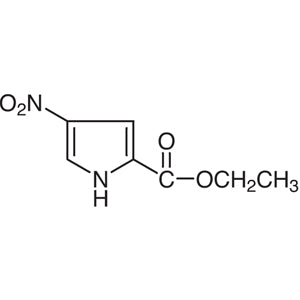
Ethyl 4-Nitropyrrole-2-carboxylate is a chemical compound widely used in organic synthesis reactions, particularly in the development of heterocyclic compounds. Its complex structure, consisting of a pyrrole ring and a carboxylate group, makes it a valuable building block for creating new chemical entities with diverse applications in pharmacology and industry. In laboratory settings, this compound serves as a key reagent for synthesizing bioactive molecules, including pharmaceuticals and organic chemicals. Its versatility allows it to participate in various chemical reactions, such as substitution and cyclization, making it a preferred choice for organic chemists and pharmacologists.
The compound is chemically stable under certain conditions, though it is highly sensitive to moisture and air exposure. This sensitivity necessitates careful handling and storage to maintain its integrity. Its ability to undergo multiple reaction pathways enhances its utility in synthetic chemistry, enabling researchers to explore a wide range of chemical transformations. The compound’s structural complexity also allows for the design of novel compounds with tailored properties, supporting innovation in both academic and industrial research.
In Indonesian laboratories, Ethyl 4-Nitropyrrole-2-carboxylate is commonly used by chemists and pharmacologists for the development of new compounds with potential medical and industrial applications. Its role in synthesizing bioactive molecules makes it an essential component in research focused on drug discovery and chemical innovation. The compound is frequently employed in studies aimed at creating new therapeutic agents and functional materials, contributing to the advancement of scientific knowledge and practical applications.
Related TCI products
- TCI N0509 5930-93-8 4-Nitropyrrole-2-carboxylic Acid
- TCI N0502 5930-94-9 3-Nitropyrrole
- TCI B5501 147804-30-6 tert-Butyl 1-Oxa-6-azaspiro[2.5]octane-6-carboxylate
- TCI B5385 114214-49-2 tert-Butyl 6-Oxa-3-azabicyclo[3.1.0]hexane-3-carboxylate
- TCI B5248 122684-34-8 tert-Butyl 3-Carbamoylpyrrolidine-1-carboxylate
- TCI B5032 1041026-70-3 tert-Butyl 2,6-Diazaspiro[3.3]heptane-2-carboxylate
- Organic synthesis of heterocyclic compounds due to its pyrrole and carboxylate functional groups, enabling the creation of complex molecular structures.
- Development of pharmaceuticals and bioactive molecules as a key intermediate in the synthesis of drug candidates with therapeutic potential.
- Research in chemical engineering for the production of industrial chemicals with specific functional properties.
- Investigation of reaction mechanisms in organic chemistry, particularly in substitution and cyclization reactions.
- Support for academic research in medicinal chemistry, focusing on the design and synthesis of novel compounds for drug discovery.
| Brand | TCI |
|---|---|
| CAS number | 5930-92-7 |
| Molecular formula | — |
| Purity | — |
| Category | Chemistry > Building Blocks > Heterocyclic Building Blocks |
| Pack sizes | — |
| Physical form | — |
| Storage | Requires protection from moisture and air exposure |
Ethyl 4-Nitropyrrole-2-carboxylate should be stored in a cool, dry place away from moisture and air exposure to maintain its chemical integrity. It is recommended to use airtight containers made of glass or inert materials to prevent contamination and degradation. Due to its sensitivity, the compound should be handled in a controlled environment with proper ventilation to minimize exposure. Laboratory personnel should wear appropriate personal protective equipment, such as gloves and safety goggles, when working with this material. Storage conditions should be monitored regularly to ensure optimal preservation and safety. The compound should not be stored near incompatible substances to avoid potential chemical interactions. Proper labeling and documentation are essential for safe handling and use in laboratory settings.
—
Produk Terkait
-
4-Nitropyrrole-2-carboxylicAcid TCI N0509
Regular price From Rp 1.220.100,00Regular price -
3-Nitropyrrole TCI N0502
Regular price From Rp 7.023.450,00Regular price -
tert-Butyl1-Oxa-6-azaspiro[2.5]octane-6-carboxylate TCI B5501
Regular price From Rp 3.021.900,00Regular price -
tert-Butyl6-Oxa-3-azabicyclo[3.1.0]hexane-3-carboxylate TCI B5385
Regular price From Rp 689.850,00Regular price -
tert-Butyl3-Carbamoylpyrrolidine-1-carboxylate TCI B5248
Regular price From Rp 1.060.500,00Regular price -
tert-Butyl2,6-Diazaspiro[3.3]heptane-2-carboxylate TCI B5032
Regular price Rp 3.232.950,00Regular price -
tert-Butyl4-[4-(4,4,5,5-Tetramethyl-1,3,2-dioxaborolan-2-yl)pyrazol-1-yl]piperidine-1-carboxylate TCI B5002
Regular price From Rp 1.696.800,00Regular price -
tert-Butyl3-(Aminomethyl)azetidine-1-carboxylate TCI B4271
Regular price From Rp 2.809.800,00Regular price


![147804-30-6 tert-Butyl 1-Oxa-6-azaspiro[2.5]octane-6-carboxylate - AMI Scientific](http://amiscientific.com/cdn/shop/files/TCI2510B5501_08674994-ba62-46fc-acd1-54c812460ed8.jpg?v=1767862194&width=533)
![114214-49-2 tert-Butyl 6-Oxa-3-azabicyclo[3.1.0]hexane-3-carboxylate - AMI Scientific](http://amiscientific.com/cdn/shop/files/TCI2510B5385_5494a0f2-ca27-4c7c-b2aa-345805a88f08.jpg?v=1767861794&width=533)

![1041026-70-3 tert-Butyl 2,6-Diazaspiro[3.3]heptane-2-carboxylate - AMI Scientific](http://amiscientific.com/cdn/shop/files/TCI2510B5032.jpg?v=1767091949&width=533)
![877399-74-1 tert-Butyl 4-[4-(4,4,5,5-Tetramethyl-1,3,2-dioxaborolan-2-yl)pyrazol-1-yl]piperidine-1-carboxylate - AMI Scientific](http://amiscientific.com/cdn/shop/files/TCI2510B5002_79e00c7c-6778-4604-beae-188e01d7ad50.jpg?v=1767854889&width=533)
