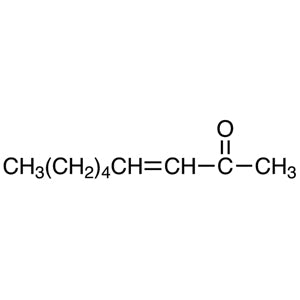
3-Nonen-2-one is an organic compound widely used in microbiological research, particularly in the study of quorum sensing. This compound plays a crucial role in laboratory settings by facilitating microbial communication through its unique molecular structure. It enables interactions with microbial signaling systems, making it a key component in understanding bacterial behavior and environmental responses. In research environments, it is often employed as a building block for the synthesis of other compounds or as a regulatory agent in biochemical experiments. Its versatility in supporting various experimental protocols makes it an essential tool for scientists working on microbial interactions and signaling pathways.
The chemical properties of 3-Nonen-2-one, including its solubility in organic solvents and stability under controlled conditions, make it a preferred choice for laboratory use. These characteristics ensure consistent performance in experiments, which is vital for reliable scientific results. Its molecular structure allows for precise interactions with microbial systems, enhancing the accuracy of quorum sensing studies. Additionally, its compatibility with a range of reagents and experimental setups further reinforces its value in both basic and applied research.
In Indonesian laboratories, 3-Nonen-2-one is commonly utilized in microbial communication studies, antibiotic development, and environmental response research. It is an integral part of experiments aimed at understanding bacterial interactions and their impact on ecological and clinical settings. Its availability and reliability make it a go-to compound for researchers seeking to explore microbial signaling mechanisms in depth.
- Quorum Sensing Research: This compound is ideal for studying microbial communication as it interacts with bacterial signaling systems, helping to understand how bacteria coordinate their behavior.
- Antibiotic Development: It serves as a key reagent in the synthesis of compounds that may inhibit microbial growth, aiding in the development of new antimicrobial agents.
- Environmental Microbiology: Its use in experiments examining microbial responses to environmental changes helps researchers assess how bacteria adapt to different conditions.
- Biochemical Assays: The compound's solubility and stability make it suitable for use in various biochemical experiments, including enzyme activity and reaction kinetics studies.
- Molecular Biology Studies: It is frequently employed in experiments that explore the molecular mechanisms underlying microbial interactions and signaling pathways.
| Brand | TCI |
|---|---|
| CAS number | 14309-57-0 |
| Molecular formula | — |
| Purity | — |
| Category | Life Science > Microbiology > Quorum Sensing Research |
| Pack sizes | Available in various quantities as per supplier specifications |
| Physical form | Liquid |
| Storage | Store in a cool, dry place away from direct sunlight |
3-Nonen-2-one should be stored in a cool, dry environment, away from direct sunlight and sources of heat. It is recommended to use airtight containers made of glass or high-density polyethylene to prevent contamination and evaporation. Due to its organic nature, it is important to handle the compound with appropriate personal protective equipment, such as gloves and safety goggles, to avoid skin contact or inhalation. Ensure that storage areas are well-ventilated to minimize exposure risks. Regular monitoring of storage conditions is essential to maintain the compound's stability and effectiveness in laboratory applications. Always follow standard safety protocols when working with organic solvents to ensure a safe and controlled environment.
—
Produk Terkait
-
8-Nonen-1-ol TCI N0650
Regular price From Rp 4.743.900,00Regular priceRp 3.316.950,00Sale price From Rp 4.743.900,00 -
cis-3-Nonen-1-ol TCI N0588
Regular price From Rp 2.757.300,00Regular priceRp 1.927.800,00Sale price From Rp 2.757.300,00 -
trans-2-Nonen-1-ol TCI N0587
Regular price Rp 3.817.800,00Regular priceRp 2.669.100,00Sale price Rp 3.817.800,00 -
cis-2-Nonen-1-ol TCI N0586
Regular price Rp 3.738.000,00Regular priceRp 2.613.450,00Sale price Rp 3.738.000,00 -
cis-6-Nonen-1-ol TCI N0469
Regular price Rp 1.590.750,00Regular priceRp 1.111.950,00Sale price Rp 1.590.750,00 -
D-(-)-Arabinose TCI A0513
Regular price From Rp 1.192.800,00Regular priceRp 849.450,00Sale price From Rp 1.192.800,00 -
trans-2-Undecenal TCI U0046
Regular price From Rp 795.900,00Regular priceRp 556.500,00Sale price From Rp 795.900,00 -
ThioridazineHydrochloride TCI T3102
Regular price Rp 2.730.000,00Regular priceRp 1.924.650,00Sale price Rp 2.730.000,00