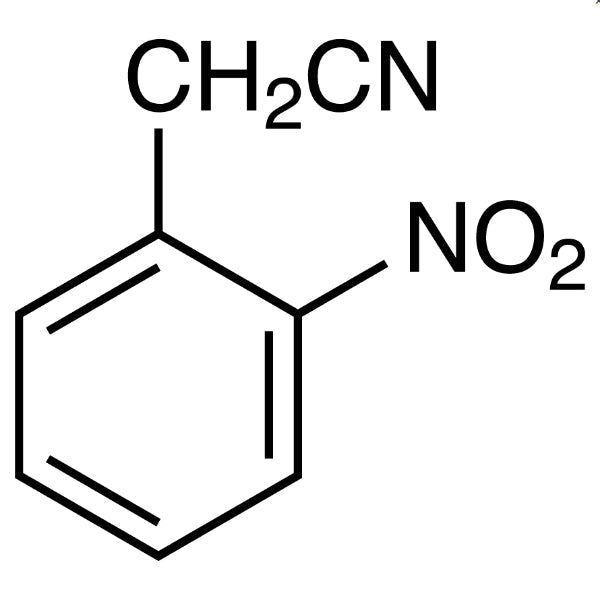
2-Nitrobenzyl Cyanide, also known as 2-nitrophenylacetonitrile, is an aromatic compound. It has a nitro group in the ortho position and a cyanomethyl side chain on the benzene ring. AMI Scientific supplies this TCI product as a non-heterocyclic building block for organic synthesis. It is an important starting material for many nitrogen-containing heterocycles. In the laboratory, synthetic chemists use it to assemble more complex molecular frameworks from a simple, well-defined aromatic precursor.
The compound is useful because it has three reactive sites in one molecule. The nitro group can be reduced. The nitrile group can be hydrolysed or reduced. The methylene carbon between them is acidic. Because it sits between the nitroaryl ring and the nitrile group, a base can remove a proton from it. The resulting carbanion reacts with electrophiles in alkylation or condensation reactions. The ortho arrangement is especially valuable. Once the nitro group is reduced to an amine, that amine can react intramolecularly with the nitrile group or its derivatives to build indole or oxindole frameworks.
In Indonesia, 2-Nitrobenzyl Cyanide suits organic synthesis laboratories at universities, research institutes and pharmaceutical development teams. Researchers who study heterocyclic chemistry, medicinal chemistry or methods development can use it as a known precursor for indole-based bioactive compounds. It also works well in teaching and research settings that demonstrate carbanion chemistry, functional group interconversion and intramolecular cyclisation. The TCI brand gives laboratories a consistent source of this reagent for repeatable synthetic work.
- Indole synthesis: after the ortho nitro group is reduced to an amine, the amine can cyclise with the side chain, which makes this compound a well-known route to indole frameworks.
- Oxindole construction: the amine formed by reduction can react intramolecularly with the nitrile group or its derivatives, giving researchers a practical path to oxindole scaffolds for further study.
- Carbanion alkylation: the acidic methylene carbon between the nitroaryl ring and the nitrile group can be deprotonated with a base, and the carbanion then reacts with electrophiles to form new carbon-carbon bonds.
- Condensation reactions: the stabilised carbanion takes part in condensation reactions, so chemists can extend the side chain before reduction or cyclisation steps in a multistep synthesis.
- Precursors for bioactive compounds: its three reactive sites make it a flexible precursor for indole-based bioactive molecules explored in medicinal chemistry and pharmaceutical research laboratories.
| Brand | TCI (product code N0781) |
|---|---|
| CAS number | 610-66-2 |
| Molecular formula | — |
| Purity | — |
| Category | Chemistry > Building Blocks > Non-Heterocyclic Building Blocks |
| Pack sizes | TCI standard pack sizes; confirm the available options when ordering |
| Physical form | — |
| Storage | follow the storage conditions on the TCI label and Safety Data Sheet |
- Synonym: 2-Nitrophenylacetonitrile
Keep 2-Nitrobenzyl Cyanide in its original, tightly closed container in a cool, dry, well-ventilated place. Store it away from heat, direct sunlight, strong oxidising agents, strong bases and strong acids. Label containers clearly and keep them in a designated chemical storage area. The compound contains nitro and nitrile groups, so handle it only in a fume hood. Wear chemical-resistant gloves, safety glasses and a lab coat. Avoid breathing in dust or vapour, and avoid contact with skin and eyes. Read the TCI Safety Data Sheet before use, and dispose of residues and contaminated materials according to local hazardous-waste rules.
—
Produk Terkait
-
4-NitrobenzylCyanide TCI N0229
Regular price From Rp 928.200,00Regular price -
4-NitrobenzylAcetate TCI A0039
Regular price From Rp 1.298.850,00Regular price -
4-NitrobenzylAcetoacetate TCI N0875
Regular price From Rp 584.850,00Regular price -
2-NitrobenzylBromide TCI N0404
Regular price From Rp 1.060.500,00Regular price -
2-NitrobenzylChloride TCI N0182
Regular price From Rp 1.644.300,00Regular price -
4-NitrobenzylBromide TCI N0181
Regular price From Rp 1.353.450,00Regular price -
4-Methyl-3-nitrobenzylAlcohol TCI M2916
Regular price From Rp 1.829.100,00Regular price -
3-Methyl-4-nitrobenzylAlcohol TCI M2915
Regular price From Rp 689.850,00Regular price