

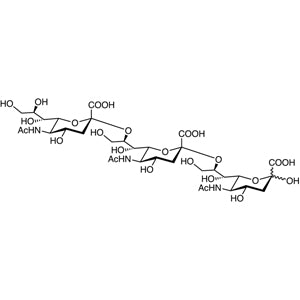
N-Acetylneuraminic Acid Trimer alpha(2-8) is a complex chemical compound widely used in chemical biology and glycoscience research. This trimeric form of N-acetylneuraminic acid is a naturally occurring glycolipid found in various biological tissues. In the laboratory, it serves as a key reagent for the synthesis of complex molecules or as a substrate in biochemical reactions. Its unique molecular structure makes it an essential tool for studying protein-glycan interactions, which are critical in understanding cellular communication and disease mechanisms.
The compound's chemical stability under specific conditions makes it a preferred choice for high-precision experiments. Its ability to bind with various biomolecules, such as proteins and lipids, enhances its utility in molecular interaction studies. This property is particularly valuable in research focusing on immune responses and disease progression. The compound's versatility allows it to be applied in diverse experimental setups, making it a reliable resource for researchers.
In Indonesian laboratories, N-Acetylneuraminic Acid Trimer alpha(2-8) is commonly used in applied research, including studies on neurodegenerative diseases and vaccine development. Its role in understanding molecular interactions and biological processes makes it a crucial component in both academic and industrial research settings. Researchers rely on its consistent performance and reliability to advance their studies in glycoscience and related fields.
Related TCI products
- TCI N1166 110935-75-6 N-Acetylneuraminic Acid Pentamer alpha(2-8)
- TCI N1165 96425-83-1 N-Acetylneuraminic Acid Tetramer alpha(2-8)
- TCI N1163 95983-78-1 N-Acetylneuraminic Acid Dimer alpha(2-8)
- TCI N0693 129865-06-1 Nonasaccharide Glc4Xyl3Gal2
- TCI I0854 6082-32-2 Isomaltopentaose
- TCI H1285 73603-40-4 Hyaluronate Hexasaccharide
- Protein-Glycan Interaction Studies: This compound is ideal for investigating how proteins interact with glycan structures, providing insights into cellular signaling and disease mechanisms.
- Biochemical Reaction Substrates: Its use as a substrate in biochemical reactions allows researchers to study enzymatic activity and metabolic pathways in controlled environments.
- Neurodegenerative Disease Research: The compound's role in studying molecular interactions makes it valuable for investigating the progression of diseases like Alzheimer's and Parkinson's.
- Vaccine Development: Its ability to bind with biomolecules is useful in the development of vaccines, particularly those targeting glycan-based antigens.
- Immune Response Analysis: Researchers use it to study how immune cells recognize and respond to glycan structures, contributing to immunological research.
| Brand | TCI |
|---|---|
| CAS number | 76152-09-5 |
| Molecular formula | — |
| Purity | — |
| Category | Chemistry > Chemical Biology > Glycoscience |
| Pack sizes | Available in standard laboratory quantities |
| Physical form | Solid powder |
| Storage | Store in a cool, dry place away from moisture and light |
This compound should be stored in a cool, dry environment, away from moisture and direct light to maintain its chemical stability. It is recommended to use airtight containers to prevent contamination and degradation. Due to its potential reactivity with moisture, it should be handled in a controlled laboratory setting with appropriate safety measures. Always ensure proper ventilation when working with the compound to minimize exposure. Regular monitoring of storage conditions is advised to ensure the integrity of the material throughout its shelf life.
—
Product Categories
Produk Terkait
-
N-AcetylneuraminicAcidPentameralpha(2-8) TCI N1166
Regular price Rp 12.534.900,00Regular price -
N-AcetylneuraminicAcidTetrameralpha(2-8) TCI N1165
Regular price Rp 9.406.950,00Regular price -
N-AcetylneuraminicAcidDimeralpha(2-8) TCI N1163
Regular price Rp 6.281.100,00Regular price -
NonasaccharideGlc4Xyl3Gal2 TCI N0693
Regular price Rp 19.053.300,00Regular price -
Isomaltopentaose TCI I0854
Regular price Rp 4.479.300,00Regular price -
HyaluronateHexasaccharide TCI H1285
Regular price From Rp 3.100.650,00Regular price -
HeptasaccharideGlc4Xyl3 TCI H1041
Regular price Rp 10.387.650,00Regular price -
ChitopentaosePentahydrochloride TCI C3678
Regular price Rp 14.150.850,00Regular price


