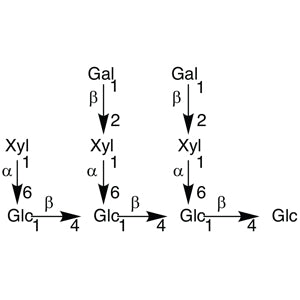
Nonasaccharide Glc4Xyl3Gal2 from TCI (product code N0693) is an oligosaccharide made of nine sugar units: four glucose, three xylose, and two galactose residues. This composition matches the repeating unit of xyloglucan, the main hemicellulose in the primary cell walls of many plants. Xyloglucan has a glucose backbone with xylose branches, and some of those xylose residues can carry galactose. Well-defined oligosaccharides like this one are therefore valuable reference materials in glycoscience and plant cell wall biology laboratories.
The main advantage of this compound is its defined structure. Natural polysaccharides are usually heterogeneous in chain length and branching pattern, which makes them hard to use in quantitative studies. An oligosaccharide with a clear, known structure lets researchers measure enzyme activity, map substrate specificity, and calibrate analytical methods more accurately. The compound can serve as a substrate or acceptor for enzymes that act on xyloglucan, such as xyloglucanases and xyloglucan endotransglycosylases. It is also useful as a standard in carbohydrate chromatography and mass spectrometry, where a consistent, identifiable molecule gives reliable reference signals.
For laboratories in Indonesia, this material fits university and research institute groups working on plant biochemistry, carbohydrate chemistry, and enzymology. Research on plant biomass, cell wall structure, and enzymes that break down or modify hemicellulose can use it to get reproducible results. Analytical laboratories that develop methods for characterising plant-derived carbohydrates may also use it as a reference compound. Its defined composition makes it suitable for teaching and advanced research projects that need a reliable model of the xyloglucan repeating unit.
TCI brochures (PDF)
- Xyloglucanase activity assays: the defined nine-sugar structure gives a consistent substrate, so enzyme activity can be measured and compared between experiments far more reliably than with heterogeneous natural polysaccharides.
- Xyloglucan endotransglycosylase studies: the compound can act as a defined acceptor molecule, helping researchers follow transglycosylation reactions and understand how these enzymes remodel plant cell wall xyloglucan.
- Substrate specificity mapping: because its glucose, xylose, and galactose composition is known, researchers can test how enzymes recognise specific branching and galactose substitution patterns in xyloglucan-type oligosaccharides.
- Carbohydrate chromatography standards: a single, structurally defined oligosaccharide gives a clear reference peak for identifying xyloglucan fragments and checking the performance of chromatographic methods for plant carbohydrates.
- Mass spectrometry calibration and identification: the known composition of four glucose, three xylose, and two galactose units provides a dependable reference for interpreting spectra of xyloglucan-derived oligosaccharides in glycomics work.
| Brand | TCI (product code N0693) |
|---|---|
| CAS number | 129865-06-1 |
| Molecular formula | — |
| Purity | — |
| Category | Chemistry > Chemical Biology > Glycoscience |
| Pack sizes | see the available options on the product page |
| Physical form | refer to the TCI label and Safety Data Sheet |
| Storage | — |
- Composition: nonasaccharide of four glucose, three xylose, and two galactose units (Glc4Xyl3Gal2)
Store this oligosaccharide under the conditions stated on the TCI label and Safety Data Sheet, keeping it in its original, tightly closed container. Protect it from moisture, heat, and direct light, because carbohydrates can absorb water from the air, which affects accurate weighing and long-term stability. Let a cooled container warm to room temperature before opening to avoid condensation. Handle the material in a clean, dry area using clean spatulas and glassware so that trace contaminants do not interfere with enzyme assays or analytical standards. Follow standard laboratory safety practice: wear gloves, a lab coat, and eye protection, avoid creating or inhaling dust, and read the Safety Data Sheet before use. Label any prepared solutions clearly with the date and concentration.
—
Product Categories
- GlycoscienceFunctional OligosaccharidesPolysaccharides [Functional Oligosaccharides]
- GlycoscienceFunctional OligosaccharidesNatural Oligosaccharides [Functional Oligosaccharides]
- GlycoscienceOligosaccharides [Glycoscience]Oligosaccharides (Other) [Glycoscience]
- GlycoscienceOligosaccharides by Component SugarGalactose [Oligosaccharides by Component Sugar]
- Biochemicals and ReagentsCarbohydrates
Produk Terkait
-
ChitosanOligosaccharides TCI C2849
Regular price From Rp 2.650.200,00Regular price -
ChitinOligosaccharides(containsN-Acetylglucosamine) TCI C2762
Regular price From Rp 2.916.900,00Regular price -
HyaluronateHexasaccharide TCI H1285
Regular price From Rp 3.100.650,00Regular price -
HeptasaccharideGlc4Xyl3 TCI H1041
Regular price Rp 10.387.650,00Regular price -
Digitonin TCI D0540
Regular price Rp 1.644.300,00Regular price -
ChitopentaosePentahydrochloride TCI C3678
Regular price Rp 14.150.850,00Regular price -
Cellopentaose TCI C2644
Regular price Rp 8.480.850,00Regular price -
HyaluronateDodecasaccharide TCI H1666
Regular price Rp 8.187.900,00Regular price