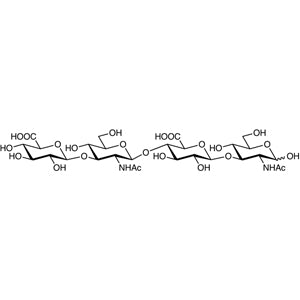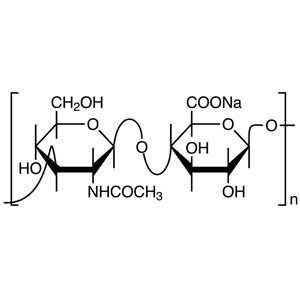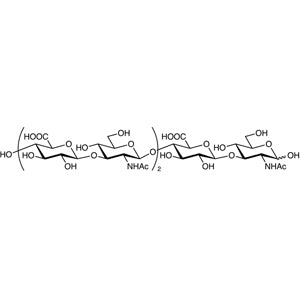
Hyaluronate Hexasaccharide is a defined fragment of hyaluronic acid composed of six sugar units, arranged as three alternating pairs of glucuronic acid and N-acetylglucosamine. A fragment of this particular length carries special significance in glycoscience because many hyaluronan receptors, including those involved in cell adhesion and immune signalling, require a minimum chain length before they can bind effectively. In the laboratory, this compound serves as a reference ligand, an analytical standard, and a tool for mapping the relationship between hyaluronan chain size and the biological activity it produces.
The characteristic that makes this material valuable is the combination of a structurally defined backbone with a chain long enough to reach across more than one binding subsite on a protein surface. Compared with tetrasaccharide fragments, the hexasaccharide generally shows higher affinity toward receptors and acts as a more representative substrate for degrading enzymes. The compound is highly soluble in water, carries a negative charge owing to its carboxylate groups, and adopts a relatively rigid chain conformation, which makes it well suited to study by NMR, mass spectrometry, and isothermal titration calorimetry.
In Indonesian laboratories, this material is typically used in university research groups, biomedical and biochemistry institutes, and analytical service units working on carbohydrate chemistry. It supports investigations into glycan–protein interaction, enzyme characterisation work, and method development where a well-defined oligosaccharide of known length is needed as a point of comparison. Its role is usually that of a reference material against which longer or shorter hyaluronan fragments are evaluated.
TCI brochures (PDF)
- Sulfated Hyaluronic Acids 2023-06-08 · p. 2
- Anti-Glycosaminoglycan Antibodies 2023-07-28 · p. 2
- Reagents for Glyco Chemistry & Biology 5th Edition · p. 105
Related TCI products
- Receptor binding studies — the six-unit chain length meets the minimum requirement of many hyaluronan receptors, allowing meaningful measurement of binding behaviour that shorter fragments cannot demonstrate.
- Analytical standard preparation — its defined structure and known chain length make it a dependable reference point for calibrating chromatographic and spectrometric methods applied to hyaluronan fragments.
- Structure–activity relationship mapping — researchers use it to correlate hyaluronan chain size with biological response, since it sits at the threshold where receptor engagement becomes effective.
- Enzyme substrate characterisation — as a more representative substrate than tetrasaccharide fragments, it supports the study of hyaluronan-degrading enzymes and their cleavage behaviour under controlled conditions.
- Biophysical interaction analysis — high water solubility, carboxylate-derived negative charge, and a rigid conformation make it suitable for NMR, mass spectrometry, and isothermal titration calorimetry experiments.
| Brand | TCI |
|---|---|
| CAS number | 73603-40-4 |
| Molecular formula | — |
| Purity | — |
| Category | Chemistry > Chemical Biology > Glycoscience |
| Pack sizes | available in the pack sizes listed by the manufacturer for this catalogue item |
| Physical form | — |
| Storage | store according to the conditions stated on the manufacturer label and certificate of analysis |
- Product code: H1285
Data from the TCI brochure
| Rumus dan BM | C42H65N3O34 = 1155.97 [73603-40-4] |
|---|---|
| Pelarut | D2O (Standar internal t-BuOH (δ 1.23); suhu pengukuran 23.1 ℃) |
Source: TCI brochure reagent_for_glyco_chemistry_&_biology_5th_ed ()
Store the material in a closed original container, kept tightly sealed and protected from moisture, since the compound is highly water soluble and readily takes up humidity from the air. Follow the storage temperature stated on the manufacturer label rather than assuming ambient conditions are acceptable. Handle the powder in a clean, dry working area and use clean, dry spatulas to avoid cross-contamination of the remaining stock. Prepare solutions with high-purity water and keep prepared solutions in appropriately labelled vials. Operators should wear standard laboratory personal protective equipment, including gloves, laboratory coat, and eye protection, and should consult the safety data sheet supplied with the product before first use.
—
Product Categories
- GlycoscienceApplications Using Glyco-materialsGlyco-utilization [Applications Using Glyco-materials]
- GlycoscienceFunctional OligosaccharidesGlycosaminoglycan [Functional Oligosaccharides]
- GlycoscienceFunctional OligosaccharidesNatural Oligosaccharides [Functional Oligosaccharides]
- GlycoscienceOligosaccharides [Glycoscience]Oligosaccharides (Other) [Glycoscience]
- GlycoscienceOligosaccharides by Component SugarGlucosamine [Oligosaccharides by Component Sugar]
- GlycoscienceOligosaccharides by Component SugarGlucuronic Acids [Oligosaccharides by Component Sugar]
- Biochemicals and ReagentsCarbohydrates
Produk Terkait
-
HyaluronateTetrasaccharide TCI H1284
Regular price From Rp 2.544.150,00Regular priceRp 1.794.450,00Sale price From Rp 2.544.150,00 -
PotassiumHyaluronatefromCockscomb TCI H0652
Regular price Rp 9.459.450,00Regular priceRp 6.630.750,00Sale price Rp 9.459.450,00 -
SodiumHyaluronatefromCockscomb TCI H0603
Regular price From Rp 2.411.850,00Regular priceRp 1.702.050,00Sale price From Rp 2.411.850,00 -
ChitosanOligosaccharides TCI C2849
Regular price From Rp 2.702.700,00Regular priceRp 1.905.750,00Sale price From Rp 2.702.700,00 -
PotassiumHyaluronatefromBacteria TCI H1808
Regular price Rp 7.287.000,00Regular priceRp 5.111.400,00Sale price Rp 7.287.000,00 -
HyaluronateDodecasaccharide TCI H1666
Regular price Rp 8.240.400,00Regular priceRp 5.778.150,00Sale price Rp 8.240.400,00 -
HyaluronateDecasaccharide TCI H1149
Regular price Rp 6.573.000,00Regular priceRp 4.611.600,00Sale price Rp 6.573.000,00 -
HyaluronateOctasaccharide TCI H1148
Regular price Rp 4.399.500,00Regular priceRp 3.092.250,00Sale price Rp 4.399.500,00