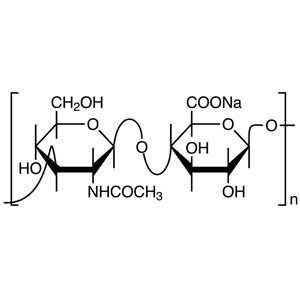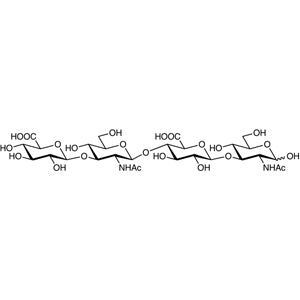
Hyaluronate Tetrasaccharide is an oligosaccharide derived from the breakdown of hyaluronic acid, composed of four sugar units arranged as two alternating pairs of glucuronic acid and N-acetylglucosamine. As a defined fragment of a naturally occurring glycosaminoglycan, it occupies an important position in glycoscience because it provides a structure of exact, known length, unlike high molecular weight hyaluronic acid, which is always a polydisperse mixture. In the laboratory, fragments of this kind are used as analytical standards, as model ligands, and as test materials in studies of carbohydrate–protein interactions.
The principal advantage of this material is structural certainty. Because the number of sugar units and their sequence are precisely known, researchers can correlate a biological response or an analytical signal directly with a specific chain length — something that is impossible to achieve with heterogeneous polymers. Hyaluronan oligosaccharides are also strongly hydrophilic and negatively charged owing to the carboxylate groups on the glucuronic acid residues, so they dissolve readily in water and in buffer solutions and are well suited to both chromatographic analysis and mass spectrometry. Short fragments such as the tetrasaccharide are known to behave differently from their long-chain counterparts, which is precisely why they are studied separately.
In Indonesian laboratories, this material is typically used in academic and institutional research settings working on glycoscience, biochemistry, and biomaterials. It serves research groups that require a reference oligosaccharide of defined length for method development, for calibrating analytical procedures, or for comparative studies against polydisperse hyaluronic acid preparations. Because only small quantities are normally required for such work, it is generally ordered as a research-scale reagent rather than in bulk.
TCI brochures (PDF)
- Sulfated Hyaluronic Acids 2023-06-08 · p. 2
- Anti-Glycosaminoglycan Antibodies 2023-07-28 · p. 2
- Reagents for Glyco Chemistry & Biology 5th Edition · p. 98
Related TCI products
- TCI H1285 73603-40-4 Hyaluronate Hexasaccharide
- TCI H0652 31799-91-4 Potassium Hyaluronate from Cockscomb
- TCI H0603 9067-32-7 Sodium Hyaluronate from Cockscomb
- TCI H1808 31799-91-4 Potassium Hyaluronate from Bacteria
- TCI H0595 9004-61-9 Hyaluronic Acid from Cockscomb
- TCI H1807 9004-61-9 Hyaluronic Acid from Bacteria
- Analytical standard preparation — the defined four-unit chain length provides a reliable reference point for calibrating chromatographic and mass spectrometric methods used in hyaluronan analysis.
- Carbohydrate–protein interaction studies — as a model ligand of exactly known structure, it allows binding behaviour to be attributed to a specific oligosaccharide length rather than to an undefined polymer population.
- Glycosaminoglycan fragment research — it supports investigations into how short hyaluronan fragments differ functionally from high molecular weight hyaluronic acid in biological systems.
- Chromatographic method development — its high water solubility and negative charge make it well suited to developing and validating separation methods for charged oligosaccharides.
- Mass spectrometry reference work — the precisely defined composition and sequence allow fragmentation patterns to be interpreted with confidence during structural characterisation studies.
| Brand | TCI |
|---|---|
| CAS number | 57282-61-8 |
| Molecular formula | — |
| Purity | — |
| Category | Chemistry > Chemical Biology > Glycoscience |
| Pack sizes | available in research-scale packaging; please refer to the current catalogue listing for available options |
| Physical form | — |
| Storage | refer to the manufacturer's stated storage conditions on the product label and certificate of analysis |
- Catalogue Number: H1284
Data from the TCI brochure
| Rumus dan berat molekul | C28H44N2O23 = 776.65 |
|---|---|
| Nomor CAS | [57282-61-8] |
| Pelarut | D2O |
| Standar internal | t-BuOH (δ 1.23) |
| Suhu pengukuran | 24.1 ℃ (NMR dalam D2O) |
Source: TCI brochure reagent_for_glyco_chemistry_&_biology_5th_ed ()
Store the material according to the storage conditions specified by the manufacturer on the product label. As with other oligosaccharide preparations, the container should be kept tightly closed and protected from moisture, since the strongly hydrophilic nature of hyaluronan fragments makes them prone to absorbing atmospheric water. Use clean, dry spatulas and glassware when handling, and allow the container to reach room temperature before opening in order to avoid condensation on the contents. Prepare solutions in purified water or an appropriate buffer, and observe standard laboratory practice: wear gloves, safety glasses, and a laboratory coat, and consult the safety data sheet before first use.
—
Product Categories
- GlycoscienceApplications Using Glyco-materialsGlyco-utilization [Applications Using Glyco-materials]
- GlycoscienceFunctional OligosaccharidesGlycosaminoglycan [Functional Oligosaccharides]
- GlycoscienceFunctional OligosaccharidesNatural Oligosaccharides [Functional Oligosaccharides]
- GlycoscienceOligosaccharides by Component SugarGlucosamine [Oligosaccharides by Component Sugar]
- GlycoscienceOligosaccharides by Component SugarGlucuronic Acids [Oligosaccharides by Component Sugar]
- GlycoscienceTetrasaccharides [Glycoscience]
- Biochemicals and ReagentsCarbohydrates
Produk Terkait
-
HyaluronateHexasaccharide TCI H1285
Regular price From Rp 3.100.650,00Regular price -
PotassiumHyaluronatefromCockscomb TCI H0652
Regular price Rp 9.406.950,00Regular price -
SodiumHyaluronatefromCockscomb TCI H0603
Regular price From Rp 2.359.350,00Regular price -
PotassiumHyaluronatefromBacteria TCI H1808
Regular price Rp 7.234.500,00Regular price -
HyaluronicAcidfromCockscomb TCI H0595
Regular price Rp 8.692.950,00Regular price -
HyaluronicAcidfromBacteria TCI H1807
Regular price Rp 6.042.750,00Regular price -
HyaluronicAcidSodiumSaltfromBacteria TCI H1791
Regular price From Rp 1.936.200,00Regular price -
HyaluronateDodecasaccharide TCI H1666
Regular price Rp 8.187.900,00Regular price