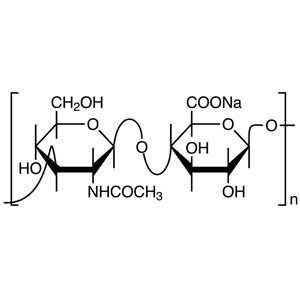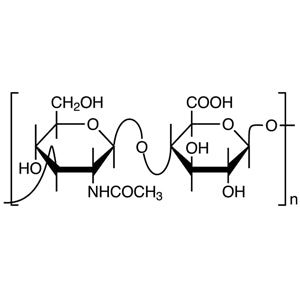
Hyaluronic Acid from Cockscomb is a naturally occurring glycosaminoglycan obtained from the comb of the rooster, built from repeating units of D-glucuronic acid and N-acetyl-D-glucosamine linked together into long, unbranched polysaccharide chains. As a biopolymer that occurs naturally in the extracellular matrix, synovial fluid, and connective tissue, this compound is an important material for research in glycoscience, matrix biology, and biomaterials development. In the laboratory it is used as an analytical reference material, as an enzyme substrate, and as a base component in hydrogel formulations and culture media.
The characteristics that make this material a preferred choice are its ability to bind very large amounts of water and to form thick solutions that behave viscoelastically even at low concentrations. The long polyanionic chain produces a distinctive rheological profile: the solution thins when shear force is applied and returns to a viscous state once that force is removed, a behaviour that underlies many biomedical applications. Its origin from the natural cockscomb source also makes it a classic reference point for researchers who want to compare fermentation-derived material against tissue-derived material.
In Indonesian laboratories, this material is typically handled in academic research groups, biomaterials laboratories, and formulation development units that work with polysaccharides and extracellular matrix components. It is weighed out in powder form, hydrated in aqueous buffer, and then used either as a comparison standard or as the starting material for a gel or solution preparation. Because it is supplied by TCI under a defined catalogue identity, it is convenient for work that needs a consistent, traceable source material across repeat experiments.
TCI brochures (PDF)
- Sulfated Hyaluronic Acids 2023-06-08 · p. 2
- Anti-Glycosaminoglycan Antibodies 2023-07-28 · p. 2
- Polysaccharides 2025-02-13 · p. 2
- Drug Delivery System (DDS) Research Reagents 2025-01-29 · p. 1
- Reagents for Glyco Chemistry & Biology 5th Edition · p. 117
- Biomaterials Research Reagents 2025-02-19 · p. 4
Related TCI products
- TCI H0652 31799-91-4 Potassium Hyaluronate from Cockscomb
- TCI H0603 9067-32-7 Sodium Hyaluronate from Cockscomb
- TCI H1807 9004-61-9 Hyaluronic Acid from Bacteria
- TCI H1791 9067-32-7 Hyaluronic Acid Sodium Salt from Bacteria
- TCI H1808 31799-91-4 Potassium Hyaluronate from Bacteria
- TCI C2395 9012-76-4 Chitosan (5-20mPa.s, 0.5% in 0.5% Acetic Acid at 20deg C)
- Glycoscience research: the repeating D-glucuronic acid and N-acetyl-D-glucosamine structure makes it a direct subject for studies of glycosaminoglycan chemistry and polysaccharide chain behaviour.
- Enzyme substrate studies: the long unbranched chain serves as a defined substrate for enzymes that act on hyaluronan, allowing degradation and activity to be followed in a controlled system.
- Hydrogel formulation development: its very high water-binding capacity and viscoelastic solution behaviour make it a practical base component when building hydrogel systems in the laboratory.
- Analytical reference work: as a material of known identity and natural origin, it functions as a reference standard when analysts characterise or compare hyaluronic acid samples.
- Matrix biology and cell culture support: because it occurs naturally in the extracellular matrix and connective tissue, it is used as a component in culture media and matrix-related experiments.
| Brand | TCI |
|---|---|
| CAS number | 9004-61-9 |
| Molecular formula | — |
| Purity | — |
| Category | Chemistry > Chemical Biology > Glycoscience |
| Pack sizes | available in the pack sizes listed by TCI for this catalogue item |
| Physical form | powder |
| Storage | follow the storage condition stated on the manufacturer's label |
- Source: natural glycosaminoglycan derived from cockscomb
Store the container in a cool, dry place, tightly closed and protected from moisture, since the material readily binds water and can take up humidity from the surrounding air. Keep it in its original container or in a clean, well-sealed glass or chemically compatible plastic vessel, clearly labelled with the product name and CAS number. Handle the powder in a clean working area, using gloves, a laboratory coat, and eye protection, and avoid generating airborne dust during weighing. Prepare aqueous solutions with clean glassware and use them according to the intended experimental protocol. Always consult the manufacturer's safety data sheet before use and follow institutional laboratory safety procedures for handling and disposal.
—
Product Categories
- Chemical BiologyGlycoscienceApplications Using Glyco-materials
- Chemical BiologyGlycoscienceEnzyme, Lectin, Antibody [Glycoscience]
- Chemical BiologyGlycoscienceFunctional Oligosaccharides
- Chemical BiologyGlycoscienceOligosaccharides by Component Sugar
- Chemical BiologyGlycosciencePolysaccharides [Glycoscience]
- GlycoscienceApplications Using Glyco-materialsGlyco-utilization [Applications Using Glyco-materials]
- GlycoscienceEnzyme, Lectin, Antibody [Glycoscience]Glycohydrases and Related Reagents [Glycoscience]
- GlycoscienceFunctional OligosaccharidesGlycosaminoglycan [Functional Oligosaccharides]
- GlycoscienceFunctional OligosaccharidesPolysaccharides [Functional Oligosaccharides]
- GlycoscienceOligosaccharides by Component SugarGlucosamine [Oligosaccharides by Component Sugar]
- GlycoscienceOligosaccharides by Component SugarGlucuronic Acids [Oligosaccharides by Component Sugar]
- GlycosciencePolysaccharides [Glycoscience]
- Biochemicals and ReagentsCarbohydrates
Produk Terkait
-
PotassiumHyaluronatefromCockscomb TCI H0652
Regular price Rp 9.459.450,00Regular priceRp 6.630.750,00Sale price Rp 9.459.450,00 -
SodiumHyaluronatefromCockscomb TCI H0603
Regular price From Rp 2.411.850,00Regular priceRp 1.702.050,00Sale price From Rp 2.411.850,00 -
HyaluronicAcidfromBacteria TCI H1807
Regular price Rp 6.095.250,00Regular priceRp 4.277.700,00Sale price Rp 6.095.250,00 -
HyaluronicAcidSodiumSaltfromBacteria TCI H1791
Regular price From Rp 1.988.700,00Regular priceRp 1.405.950,00Sale price From Rp 1.988.700,00 -
PotassiumHyaluronatefromBacteria TCI H1808
Regular price Rp 7.287.000,00Regular priceRp 5.111.400,00Sale price Rp 7.287.000,00 -
Chitosan(5-20mPa.s,0.5%in0.5%AceticAcidat20degC) TCI C2395
Regular price Rp 717.150,00Regular priceRp 516.600,00Sale price Rp 717.150,00 -
ChondroitinSulfateSodiumSalt TCI C0335
Regular price From Rp 2.121.000,00Regular priceRp 1.498.350,00Sale price From Rp 2.121.000,00 -
PectinfromCitrus TCI P0024
Regular price From Rp 637.350,00Regular priceRp 460.950,00Sale price From Rp 637.350,00