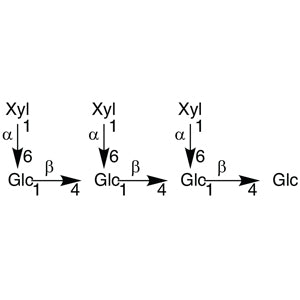
Heptasaccharide Glc4Xyl3 (TCI H1041) is a complex glycoside compound composed of four glucose units and three xylose units. This compound plays a crucial role in laboratory research, particularly in the field of chemical biology and glycoscience. It serves as a foundational building block for the synthesis of glycans, which are essential in understanding biological processes at the molecular level. Its application spans various areas, including drug development, medical diagnostics, and biomedical research, where precise molecular interactions are critical.
The compound’s molecular structure is both stable and specific, allowing for controlled chemical reactions and interactions with enzymes and proteins. Its non-toxic nature and solubility in organic solvents such as DMSO and acetone make it a versatile and safe material for laboratory use. These properties contribute to its reliability and effectiveness in a wide range of experimental setups, ensuring consistent results and reproducibility in research.
In Indonesian laboratories, Heptasaccharide Glc4Xyl3 is widely utilized in biochemical, pharmacological, and biotechnological research. Researchers often employ it to study glycan-receptor interactions, vaccine development, and other advanced biomedicine applications. Its availability and performance make it a preferred choice for scientists seeking high-precision tools in their studies.
- Glycan Synthesis Research – This compound is ideal for synthesizing complex glycans, which are vital for understanding cellular communication and disease mechanisms.
- Drug Development Studies – Its role as a building block allows researchers to design and test new therapeutic agents targeting glycan-related pathways.
- Medical Diagnostics – It supports the development of diagnostic tools that rely on specific glycan-enzyme interactions for accurate disease detection.
- Biotransformation Studies – The compound’s stability and reactivity make it suitable for experiments involving enzymatic modifications of glycan structures.
- Vaccine Development – It is used in the formulation of vaccines that require precise glycan structures for immune response activation.
| Brand | TCI |
|---|---|
| CAS number | 121591-98-8 |
| Molecular formula | — |
| Purity | — |
| Category | Chemistry > Chemical Biology > Glycoscience |
| Pack sizes | Available in various quantities as per standard laboratory supply |
| Physical form | Solid powder |
| Storage | Store at controlled room temperature, away from moisture and light |
This compound should be stored in a cool, dry place, away from direct sunlight and sources of heat. It is recommended to keep it in a tightly sealed container to prevent moisture absorption, which could affect its stability. Due to its solubility in organic solvents, it should be handled in a well-ventilated area to ensure safe exposure. Laboratory personnel should wear appropriate personal protective equipment, such as gloves and safety goggles, when handling the compound. It is not classified as hazardous under standard laboratory safety protocols, but standard chemical handling procedures should be followed to maintain a safe working environment.
—
Produk Terkait
-
TCI B5774 5,10-Bis(4,4,5,5-tetramethyl-1,3,2-dioxaborolan-2-yl)naphtho[1,2-c:5,6-c']bis([1,2,5]oxadiazole)
Regular price Rp 10.255.350,00Regular price -
Dihydroiodide TCI B6569
Regular price From Rp 1.936.200,00Regular price -
Trifluoromethanesulfonate TCI B7003
Regular price From Rp 1.936.200,00Regular price
![5,10-Bis(4,4,5,5-tetramethyl-1,3,2-dioxaborolan-2-yl)naphtho[1,2-c:5,6-c']bis([1,2,5]oxadiazole) - TCI B5774 - AMI Scientific](http://amiscientific.com/cdn/shop/files/TCI2510B5774.jpg?v=1769180228&width=533)