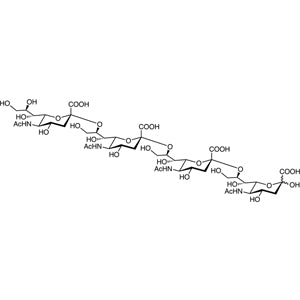
N-Acetylneuraminic Acid Tetramer alpha(2-8) is a complex chemical compound that plays a crucial role in biochemical research, particularly in the study of glycan structures and their interactions with proteins and lipids. This compound is essential for understanding molecular recognition processes and cellular communication mechanisms. In laboratory settings, it serves as a key reagent for synthesizing more complex molecules or as a substrate in enzymatic reactions. Its unique structure and functional properties make it indispensable for advanced biochemical investigations.
The compound's preference in laboratory applications stems from its specific chemical properties and structural stability under various experimental conditions. The alpha(2-8) linkage between its four N-Acetylneuraminic Acid units provides both stability and reactivity, enabling it to participate in a wide range of chemical and biochemical reactions. Its high specificity and controlled behavior in different environments make it ideal for precise and reproducible research outcomes. This makes it a favored choice for researchers working on molecular interactions and drug development.
In Indonesian laboratories, N-Acetylneuraminic Acid Tetramer alpha(2-8) is widely used in biomedical, pharmacological, and biotechnological research. It supports studies on molecular interactions, disease mechanisms, and therapeutic development. Researchers in universities and research institutions rely on this compound for its reliability and performance in complex experimental setups. Its application is critical in advancing scientific understanding and innovation in the life sciences.
- Biochemical Research: This compound is ideal for studying glycan structures and their interactions with proteins and lipids, providing insights into molecular recognition and cellular communication.
- Enzymatic Reactions: Its structural stability and reactivity make it a suitable substrate for enzymatic reactions, aiding in the study of enzyme mechanisms and catalytic processes.
- Drug Development: It is used in the synthesis of complex molecules and in the development of therapeutic agents, supporting research into novel treatments and molecular targets.
- Molecular Interaction Studies: The compound's unique structure enables precise investigation of molecular interactions, essential for understanding biological processes and disease mechanisms.
- Biotechnological Applications: It supports the development of biotechnological tools and methods, contributing to advancements in synthetic biology and molecular engineering.
| Brand | TCI |
|---|---|
| CAS number | 96425-83-1 |
| Molecular formula | — |
| Purity | — |
| Category | Chemistry > Chemical Biology > Glycoscience |
| Pack sizes | Available in various quantities as per standard laboratory supply |
| Physical form | Powder |
| Storage | Store in a cool, dry place away from light and moisture |
This compound should be stored in a cool, dry environment, away from direct light and moisture to maintain its stability and integrity. It is recommended to use airtight containers to prevent exposure to humidity and contaminants. Proper labeling of storage containers is essential for safe handling and traceability. In laboratory settings, it is important to use appropriate personal protective equipment, such as gloves and safety goggles, when handling the compound. Regular monitoring of storage conditions ensures that the compound remains in optimal condition for use in research applications. Always follow standard laboratory safety protocols to minimize risks associated with chemical handling.
—
Produk Terkait
-
TCI B5774 5,10-Bis(4,4,5,5-tetramethyl-1,3,2-dioxaborolan-2-yl)naphtho[1,2-c:5,6-c']bis([1,2,5]oxadiazole)
Regular price Rp 10.255.350,00Regular price -
Dihydroiodide TCI B6569
Regular price From Rp 1.936.200,00Regular price -
Trifluoromethanesulfonate TCI B7003
Regular price From Rp 1.936.200,00Regular price
![5,10-Bis(4,4,5,5-tetramethyl-1,3,2-dioxaborolan-2-yl)naphtho[1,2-c:5,6-c']bis([1,2,5]oxadiazole) - TCI B5774 - AMI Scientific](http://amiscientific.com/cdn/shop/files/TCI2510B5774.jpg?v=1769180228&width=533)