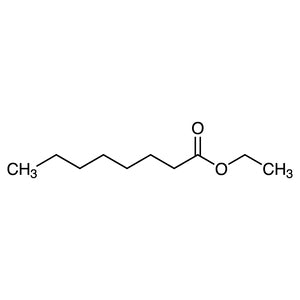
Ethyl n-Octanoate from TCI (product code O0030), also known as ethyl caprylate, is the ester of n-octanoic acid and ethanol. It is one of the best-known aroma esters in food chemistry because it is an important volatile component of wine, beer, fermented beverages and many fruits. In the laboratory, ethyl octanoate is used as a building block, as an analytical standard in aroma profiling, and as a model compound for studying medium-chain fatty acid esters. Researchers use it both for synthesis and for identifying and quantifying flavour compounds in complex food and beverage samples.
The main reason ethyl octanoate is so widely chosen is its strong relevance as an aroma marker produced by yeast metabolism during fermentation. Its volatility makes it well suited to gas chromatography, including headspace techniques and solid-phase microextraction, so analysts can detect it reliably in real samples. As an ethyl ester, it is also a simple model for the fatty acid ethyl esters studied in biodiesel research. Its simple structure makes it a clear-cut substrate for studies of enzymatic hydrolysis and esterification, where reaction progress and product formation are easy to follow and interpret.
In Indonesia, ethyl octanoate is useful to food technology and fermentation laboratories, beverage quality control laboratories, and researchers working on traditional fermented products such as tapai and tuak. These groups use it as a reference standard to build aroma profiles, compare fermentation batches, and assess how yeast strains or process conditions affect flavour development. University laboratories in chemistry, food science and bioprocess engineering also use it for teaching and research on ester chemistry, enzymatic catalysis and renewable fuel model systems.
- Aroma profiling of fermented beverages: it is a key volatile ester in wine, beer and other fermented drinks, so it works well as a reference standard for identifying and quantifying aroma compounds.
- Gas chromatography method development: its volatility suits headspace and solid-phase microextraction GC analysis, which makes it a practical compound for calibrating and validating flavour analysis methods.
- Fermentation and yeast metabolism studies: it is formed by yeast during fermentation, so it serves as a meaningful marker for comparing yeast strains, substrates and fermentation conditions.
- Biodiesel model research: as a simple fatty acid ethyl ester, it gives researchers an easy-to-handle model compound for studying the properties and behaviour of ester-based renewable fuels.
- Enzymatic hydrolysis and esterification studies: its simple structure makes it a clear substrate for measuring lipase and esterase activity and for studying ester formation and cleavage.
| Brand | TCI (product code O0030) |
|---|---|
| CAS number | 106-32-1 |
| Molecular formula | — |
| Purity | — |
| Category | Chemistry > Building Blocks > Non-Heterocyclic Building Blocks |
| Pack sizes | please check the product listing for the pack sizes currently offered |
| Physical form | liquid |
| Storage | keep tightly closed in a cool, dry, well-ventilated place away from heat and ignition sources |
Store Ethyl n-Octanoate in its original, tightly sealed container, or in a compatible chemical-resistant glass container. Keep it in a cool, dry, well-ventilated area away from direct sunlight, heat, sparks, open flames and strong oxidising agents. Because the compound is volatile, close containers promptly after use so that material and aroma are not lost and vapour does not build up in the work area. Handle it in a fume hood or a well-ventilated space, and wear suitable protective gloves, safety glasses and a laboratory coat. Avoid contact with skin and eyes and avoid breathing vapour. Label containers clearly and follow the Safety Data Sheet from the manufacturer for detailed hazard information, spill response and disposal requirements under local regulations.
—
Produk Terkait
-
TCI B5774 5,10-Bis(4,4,5,5-tetramethyl-1,3,2-dioxaborolan-2-yl)naphtho[1,2-c:5,6-c']bis([1,2,5]oxadiazole)
Regular price Rp 10.255.350,00Regular price -
Dihydroiodide TCI B6569
Regular price From Rp 1.936.200,00Regular price -
Trifluoromethanesulfonate TCI B7003
Regular price From Rp 1.936.200,00Regular price
![5,10-Bis(4,4,5,5-tetramethyl-1,3,2-dioxaborolan-2-yl)naphtho[1,2-c:5,6-c']bis([1,2,5]oxadiazole) - TCI B5774 - AMI Scientific](http://amiscientific.com/cdn/shop/files/TCI2510B5774.jpg?v=1769180228&width=533)