

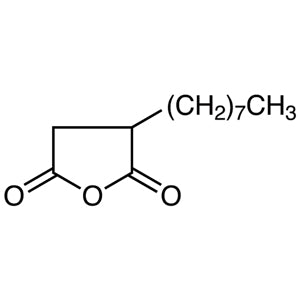
n-Octylsuccinic Anhydride from TCI is a succinic anhydride derivative that carries a straight octyl chain on its ring framework. It belongs to the alkylsuccinic anhydride family, a group of non-heterocyclic building blocks that combine a reactive cyclic anhydride group with a hydrophobic hydrocarbon tail. In the laboratory, chemists use it to add a hydrophobic segment and a carboxylic acid group to other molecules in a single step. They do this through ring-opening reactions with alcohols, amines, or the hydroxyl groups on polymers. The result is an amphiphilic derivative with both water-loving and oil-loving parts.
Researchers choose this material because ring-opening of its anhydride group is relatively clean. The reaction does not release small by-products such as water or HCl, which makes the compound practical for surface modification and esterification work. After the reaction, one free carboxyl group remains on the product. That group can carry a charge or act as an attachment point for further chemistry. The octyl chain gives a useful hydrophilic-lipophilic balance, which makes the compound interesting for emulsifier research. The approach works the same way as modifying starch and polysaccharides with alkenylsuccinic anhydrides, a method well known in the food and paper industries.
In Indonesian laboratories, n-octylsuccinic anhydride fits university research groups, polymer and materials science laboratories, and industrial R&D teams that study surface-active materials. It suits work on modifying local natural polymers such as starches and other polysaccharides, where adding hydrophobic groups can change how the material behaves in emulsions or coatings. Synthetic chemistry groups can also use it as a building block when preparing amphiphilic esters and amides for formulation research.
Related TCI products
- TCI B1613 7538-42-3 2-Buten-1-ylsuccinic Anhydride
- TCI H0616 10500-34-2 2-Hexen-1-ylsuccinic Anhydride (cis- and trans- mixture)
- TCI D0976 19780-11-1 2-Dodecen-1-ylsuccinic Anhydride (cis- and trans- mixture)
- TCI B2742 2035-76-9 Butylsuccinic Anhydride
- TCI V0006 2082-59-9 Valeric Anhydride
- TCI B4061 82-73-5 3-Bromophthalic Anhydride
- Hydrophobic modification of polysaccharides: the anhydride ring reacts with the hydroxyl groups on starch or other polysaccharides, attaching an octyl chain and a free carboxyl group without forming water or HCl as by-products.
- Emulsifier and surfactant research: the balance between the hydrophobic octyl tail and the carboxylic acid formed after ring-opening makes it a good model reagent for studying amphiphilic structures and their hydrophilic-lipophilic balance.
- Esterification of alcohols: ring-opening with alcohols gives half-ester products that keep one free carboxyl group, which can be used for later coupling, salt formation, or charge adjustment.
- Amide formation with amines: reaction with primary or secondary amines opens the anhydride to give amide-acid derivatives, which lets chemists add a hydrophobic segment and an acidic group to amine-containing molecules in one step.
- Surface modification of materials: its clean ring-opening chemistry suits the treatment of hydroxyl-bearing surfaces and polymers, adding hydrophobic character along with a carboxyl group that can serve as a later attachment point.
| Brand | TCI (product code O0049) |
|---|---|
| CAS number | 4200-92-4 |
| Molecular formula | — |
| Purity | — |
| Category | Chemistry > Building Blocks > Non-Heterocyclic Building Blocks |
| Pack sizes | see the pack sizes listed on the product page |
| Physical form | see the manufacturer's Certificate of Analysis and Safety Data Sheet |
| Storage | keep tightly closed, dry, and protected from moisture, following the manufacturer's label |
Store n-Octylsuccinic Anhydride in its original, tightly sealed container in a cool, dry, well-ventilated area, following the storage conditions on the TCI label and Safety Data Sheet. Cyclic anhydrides react with water, so protect the material from humidity and reseal the container soon after each use. In humid climates like Indonesia's, keeping it in a desiccator or a dry cabinet helps maintain its quality. Keep it away from strong bases, strong oxidizers, alcohols, and amines, except when these are used on purpose in a reaction. Wear gloves, safety glasses, and a lab coat when handling it, and work in a fume hood or a well-ventilated area. Avoid contact with skin and eyes, and avoid breathing in dust or vapor. Read the Safety Data Sheet before use and dispose of waste according to local regulations.
—
Produk Terkait
-
2-Buten-1-ylsuccinicAnhydride TCI B1613
Regular price From Rp 2.439.150,00Regular price -
2-Hexen-1-ylsuccinicAnhydride(cis-andtrans-mixture) TCI H0616
Regular price Rp 4.213.650,00Regular price -
2-Dodecen-1-ylsuccinicAnhydride(cis-andtrans-mixture) TCI D0976
Regular price From Rp 610.050,00Regular price -
ButylsuccinicAnhydride TCI B2742
Regular price From Rp 5.274.150,00Regular price -
ValericAnhydride TCI V0006
Regular price From Rp 875.700,00Regular price -
3-BromophthalicAnhydride TCI B4061
Regular price From Rp 1.246.350,00Regular price -
Bicyclo[2.2.2]oct-5-ene-2,3-dicarboxylicAnhydride TCI B3038
Regular price Rp 3.605.700,00Regular price -
4-BromophthalicAnhydride TCI B1693
Regular price From Rp 2.386.650,00Regular price




![6708-37-8 Bicyclo[2.2.2]oct-5-ene-2,3-dicarboxylic Anhydride - AMI Scientific](http://amiscientific.com/cdn/shop/files/TCI2510B3038.jpg?v=1767089273&width=533)
