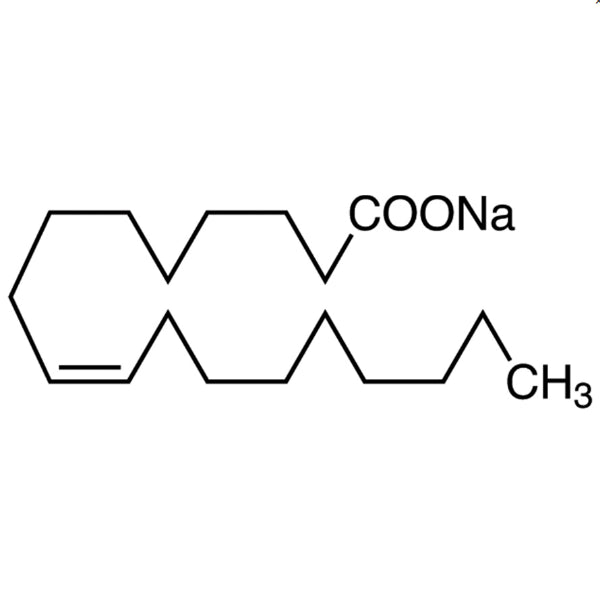
Sodium Oleate from TCI, product code O0057, is the sodium salt of oleic acid, an unsaturated fatty acid with an eighteen-carbon chain. Chemically, it is a classic soap and an anionic surfactant. Each molecule has a hydrophilic carboxylate head group and a long lipophilic hydrocarbon tail. In the laboratory, Sodium Oleate is used as an emulsifier, a dispersion stabilizer, a polymer additive, and a precursor for metal-oleate complexes, which are widely used in the synthesis of advanced materials.
Researchers choose this material because its amphiphilic structure lowers the interfacial tension between aqueous and oil phases very effectively. The cis double bond in the oleate chain keeps the chain flexible. As a result, the surfactant layer that forms on particle surfaces can arrange itself more easily and stop particles from clumping together. The carboxylate group can bind to metal ions, so Sodium Oleate also works well as a surface ligand. Because it is a salt, it is easier to weigh and dissolve in water than free oleic acid, which is a viscous liquid.
In Indonesia, Sodium Oleate is commonly used in materials science and nanotechnology laboratories at universities and research centers. Typical work includes preparing emulsions, stabilizing colloidal dispersions, formulating polymer systems, and making metal-oleate precursors for nanoparticle synthesis. Its dual role as a surfactant and a ligand makes it a practical, versatile reagent for teaching laboratories, graduate research projects, and applied materials development programs across the country.
- Emulsion preparation: its amphiphilic structure effectively lowers interfacial tension between water and oil phases, which helps form and hold stable emulsions for formulation studies.
- Colloidal dispersion stabilization: the flexible cis-unsaturated chain forms an adaptable surfactant layer on particle surfaces that keeps suspended particles from aggregating.
- Polymer additive work: as an anionic surfactant listed in the polymer additives category, it helps researchers study dispersion and interfacial behavior in polymer and macromolecule systems.
- Metal-oleate precursor synthesis: the carboxylate group binds metal ions, so it is well suited to preparing metal-oleate complexes used in advanced materials and nanoparticle synthesis.
- Nanoparticle surface functionalization: as a surface ligand, it coordinates to particle surfaces through its carboxylate head, while its hydrocarbon tail gives colloidal stability and compatibility with nonpolar media.
| Brand | TCI (product code O0057) |
|---|---|
| CAS number | 143-19-1 |
| Molecular formula | — |
| Purity | — |
| Category | Materials Science > Polymer/Macromolecule Reagents > Polymer Additives |
| Pack sizes | please check the product listing for available pack options |
| Physical form | solid sodium salt, easier to weigh than liquid oleic acid |
| Storage | keep tightly closed in a cool, dry place, following the manufacturer's label and SDS |
Store Sodium Oleate in its original tightly sealed container in a cool, dry, well-ventilated area, away from direct sunlight, moisture, and strong oxidizing agents. Close the container right after use so the material does not pick up humidity or become contaminated. Always follow the storage conditions on the TCI label and Safety Data Sheet. When handling it, wear standard laboratory protective equipment, including gloves, safety glasses, and a lab coat. Avoid creating or breathing in dust, and prevent contact with eyes and skin. Weigh the material in a clean, dry area or under local exhaust ventilation. Dispose of waste according to institutional and local chemical waste regulations.
—
Produk Terkait
-
TCI B5774 5,10-Bis(4,4,5,5-tetramethyl-1,3,2-dioxaborolan-2-yl)naphtho[1,2-c:5,6-c']bis([1,2,5]oxadiazole)
Regular price Rp 10.255.350,00Regular price -
Dihydroiodide TCI B6569
Regular price From Rp 1.936.200,00Regular price -
Trifluoromethanesulfonate TCI B7003
Regular price From Rp 1.936.200,00Regular price
![5,10-Bis(4,4,5,5-tetramethyl-1,3,2-dioxaborolan-2-yl)naphtho[1,2-c:5,6-c']bis([1,2,5]oxadiazole) - TCI B5774 - AMI Scientific](http://amiscientific.com/cdn/shop/files/TCI2510B5774.jpg?v=1769180228&width=533)