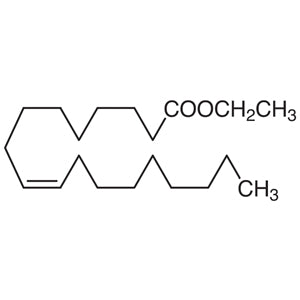
Ethyl Oleate from TCI, product code O0143, is the ethyl ester of oleic acid. Oleic acid is an eighteen-carbon monounsaturated fatty acid with a cis double bond in the middle of its chain. Ethyl Oleate is an oily liquid that belongs to the fatty acid ester class. In the laboratory it is classed as a non-heterocyclic building block, but it is used far more widely than that label suggests. It serves as a lipophilic solvent, as a reference material in lipid and biodiesel analysis, and as a model substrate for reactions at the double bond of fatty acids.
Researchers choose Ethyl Oleate mainly because it is lipophilic. It dissolves many nonpolar compounds that do not dissolve well in common laboratory solvents. For this reason, it is often studied in pharmaceutical and cosmetic formulation research as a carrier for hydrophobic active ingredients. The cis double bond in its chain gives a clear reaction site for epoxidation, hydrogenation, or metathesis. Its long hydrocarbon chain resembles the structure of natural triglycerides and esters, which makes it a representative model compound for oil and fat chemistry and helps researchers apply their results to real lipid systems.
Indonesia is the world's largest producer of vegetable oils, so Ethyl Oleate is especially relevant to oleochemical laboratories in the country. University research groups, industrial R&D teams, and quality control laboratories that work with palm oil derivatives, fatty acid esters, and biodiesel can use it as a well-defined reference and model compound. It also fits formulation laboratories that develop pharmaceutical and cosmetic products, where lipophilic carriers for hydrophobic active ingredients are studied routinely.
- Lipophilic solvent: Ethyl Oleate dissolves many nonpolar compounds that do not dissolve well in common solvents, so it is useful when working with hydrophobic substances.
- Formulation research: It is often studied as a carrier for hydrophobic active ingredients in pharmaceutical and cosmetic formulations because of its oily, lipophilic ester character.
- Lipid and biodiesel analysis: As a defined fatty acid ethyl ester, it works as a reference material when identifying and comparing ester components in lipid and biodiesel samples.
- Double-bond reaction studies: The cis double bond in the middle of the chain gives a clear reactive site for model studies of epoxidation, hydrogenation, and metathesis of unsaturated fatty acids.
- Oleochemical model compound: Its long chain resembles natural triglycerides and esters, so it is a representative substrate for research on oil and fat chemistry, including palm oil derivatives.
| Brand | TCI (product code O0143) |
|---|---|
| CAS number | 111-62-6 |
| Molecular formula | — |
| Purity | — |
| Category | Chemistry > Building Blocks > Non-Heterocyclic Building Blocks |
| Pack sizes | See the pack options listed on the product page |
| Physical form | Oily liquid (fatty acid ester) |
| Storage | Keep in a tightly closed container in a cool, dry place away from light and oxidizing agents |
Store Ethyl Oleate in its original tightly sealed container in a cool, dry, well-ventilated area, away from direct sunlight, heat sources, and strong oxidizing agents. The cis double bond in its chain can slowly oxidize when exposed to air and light, so reseal the container promptly after each use. Glass or other chemically compatible containers are suitable for transfers and working portions. Use standard laboratory precautions: wear safety glasses, chemical-resistant gloves, and a lab coat, and avoid contact with skin and eyes. Handle the material in a well-ventilated area and clean up spills quickly, because oily liquids make surfaces slippery. Always check the supplier's Safety Data Sheet for detailed hazard, storage, and disposal information before use.
—
Produk Terkait
-
TCI B5774 5,10-Bis(4,4,5,5-tetramethyl-1,3,2-dioxaborolan-2-yl)naphtho[1,2-c:5,6-c']bis([1,2,5]oxadiazole)
Regular price Rp 10.255.350,00Regular price -
Dihydroiodide TCI B6569
Regular price From Rp 1.936.200,00Regular price -
Trifluoromethanesulfonate TCI B7003
Regular price From Rp 1.936.200,00Regular price
![5,10-Bis(4,4,5,5-tetramethyl-1,3,2-dioxaborolan-2-yl)naphtho[1,2-c:5,6-c']bis([1,2,5]oxadiazole) - TCI B5774 - AMI Scientific](http://amiscientific.com/cdn/shop/files/TCI2510B5774.jpg?v=1769180228&width=533)