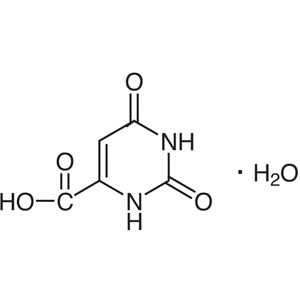
Orotic Acid Monohydrate from TCI, product code O0065, is the monohydrate form of orotic acid. Orotic acid is a carboxylic acid built on a pyrimidine core, and this framework is closely related to the nucleotide bases. In biochemistry, orotic acid is known as an intermediate in the biosynthesis of pyrimidine nucleotides, a pathway that ultimately produces uridine monophosphate. In the chemistry laboratory, the compound is classed as a heterocyclic building block. It is used to prepare pyrimidine derivatives and metal orotate salts, which makes it useful in both synthetic and biological research.
Researchers choose this compound because it combines a pyrimidinedione ring and a carboxylic acid group in one molecule. This combination allows many kinds of chemical modification and supports coordination with metal ions, so a single starting material can lead to a wide range of target structures. The monohydrate is a solid that is easy to weigh accurately on a standard laboratory balance. Its water of hydration must be included when calculating stoichiometry and molar quantities. Orotic acid's role in metabolic pathways is also well documented. For that reason it is used as a substrate or reference standard in enzyme studies and metabolite analysis, where a well-characterized compound is essential.
In Indonesia, Orotic Acid Monohydrate is useful to biochemistry and pharmacy laboratories at universities, health research institutions, and nutrition product development teams. Coordination chemistry researchers use it as a ligand to prepare and study metal orotate complexes. Analytical laboratories can use it as a reference compound when developing methods to detect pyrimidine metabolites. Teaching laboratories may also find it a clear example of how a heterocyclic building block links organic synthesis with the biochemistry of living systems.
- Synthesis of pyrimidine derivatives: the pyrimidinedione ring and carboxylic acid group give chemists several reactive sites for building new heterocyclic compounds from one convenient starting material.
- Preparation of metal orotate salts: the carboxylic acid group and ring structure can coordinate with metal ions, which makes the compound a practical precursor for making and characterizing metal orotates.
- Enzyme studies in pyrimidine biosynthesis: orotic acid is a documented intermediate in the pathway to uridine monophosphate, so it works well as a substrate for studying the enzymes involved.
- Metabolite analysis and method development: its well-established metabolic role makes it a suitable standard for calibrating and validating analytical methods that measure pyrimidine-related metabolites in biological samples.
- Nutrition and pharmaceutical research: product development teams and pharmacy laboratories can use it as a reference material when studying orotic acid and orotate-based formulations under controlled laboratory conditions.
| Brand | TCI (product code O0065) |
|---|---|
| CAS number | 50887-69-9 |
| Molecular formula | — |
| Purity | — |
| Category | Chemistry > Building Blocks > Heterocyclic Building Blocks |
| Pack sizes | as listed in the current TCI catalog; please contact AMI Scientific to confirm which sizes are available |
| Physical form | solid, monohydrate (include the water of hydration in stoichiometric calculations) |
| Storage | keep tightly closed in a cool, dry place away from moisture; follow the TCI label and Safety Data Sheet |
Store Orotic Acid Monohydrate in its original, tightly sealed container in a cool, dry, well-ventilated area, away from direct sunlight, heat sources, and incompatible materials such as strong oxidizing agents. Close the container promptly after each use to protect the material from moisture and contamination. If you transfer the material, use clean, dry, clearly labeled glass or chemically resistant plastic containers. Handle the solid with standard laboratory precautions: wear safety glasses, gloves, and a lab coat, avoid creating or breathing dust, and weigh it in a well-ventilated area or fume hood. Wash your hands after handling. Always read the TCI Safety Data Sheet for detailed hazard, first-aid, and disposal information before use.
—
Produk Terkait
-
TCI B5774 5,10-Bis(4,4,5,5-tetramethyl-1,3,2-dioxaborolan-2-yl)naphtho[1,2-c:5,6-c']bis([1,2,5]oxadiazole)
Regular price Rp 10.255.350,00Regular price -
Dihydroiodide TCI B6569
Regular price From Rp 1.936.200,00Regular price -
Trifluoromethanesulfonate TCI B7003
Regular price From Rp 1.936.200,00Regular price
![5,10-Bis(4,4,5,5-tetramethyl-1,3,2-dioxaborolan-2-yl)naphtho[1,2-c:5,6-c']bis([1,2,5]oxadiazole) - TCI B5774 - AMI Scientific](http://amiscientific.com/cdn/shop/files/TCI2510B5774.jpg?v=1769180228&width=533)