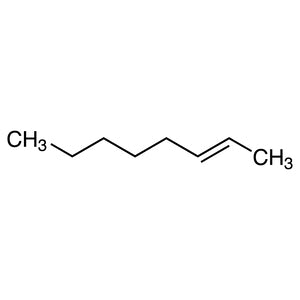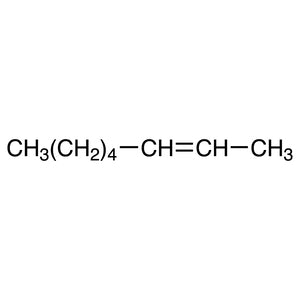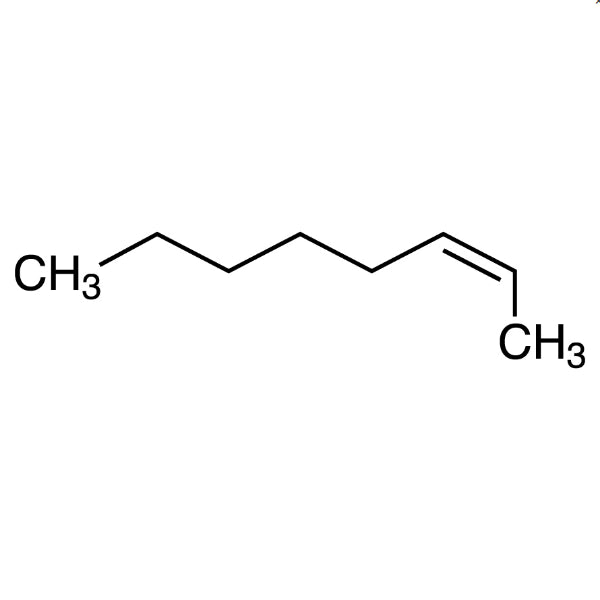

cis-2-Octene from TCI is a straight-chain, eight-carbon alkene with a double bond at the 2-position in the cis (Z) configuration. It is a volatile, flammable liquid. In the laboratory, cis-2-octene is used as an unsaturated hydrocarbon building block and as a model substrate for studying reactions at the C=C double bond. Because its geometry is well defined, it is especially useful in stereochemistry research, catalysis studies, and the development of analytical methods for mixtures of olefin isomers, where a reference compound of known configuration is needed.
Researchers choose this material because its cis configuration lets them see whether a reaction is stereospecific or stereoselective. For example, epoxidation, dihydroxylation, or cyclopropanation of cis-2-octene gives products with a specific stereochemical relationship, which can then be compared with the products from the trans isomer. As an internal alkene, it also serves as a test substrate for isomerization, metathesis, and hydroformylation. High isomeric purity matters here: if the starting material contains a mixture of isomers, selectivity data cannot be interpreted correctly. TCI's supply of a defined isomer helps make results reliable and reproducible.
In Indonesia, cis-2-octene is useful for catalysis and petrochemical laboratories studying olefin conversion, and for organic chemistry laboratories investigating reaction mechanisms and stereochemical outcomes. University research groups, government research institutes, and industrial R&D teams can use it as a model internal alkene when screening new catalysts, validating reaction conditions, or building analytical methods such as chromatographic separation of olefin isomers. It suits both teaching-oriented research and more advanced projects on selective olefin transformations.
- Stereospecificity studies: the defined cis (Z) double bond lets researchers check whether additions such as epoxidation or dihydroxylation keep the starting alkene's stereochemical relationship in the product.
- Comparison with the trans isomer: reacting cis-2-octene alongside its trans counterpart shows clearly how alkene geometry affects product stereochemistry, reaction rate, and selectivity under the same conditions.
- Catalytic isomerization and metathesis testing: as an internal alkene, it is a practical model substrate for judging how well new catalysts move or exchange double bonds in straight-chain olefins.
- Hydroformylation research: petrochemical and catalysis laboratories can use this internal olefin to study regioselectivity and conversion in carbonylation-type reactions relevant to olefin upgrading.
- Analytical method development: its known geometry makes it a useful reference compound for developing and validating separation and identification methods for mixtures of olefin isomers.
| Brand | TCI (product code O0098) |
|---|---|
| CAS number | 7642-04-8 |
| Molecular formula | — |
| Purity | — |
| Category | Chemistry > Building Blocks > Non-Heterocyclic Building Blocks |
| Pack sizes | see the available product variants on the listing |
| Physical form | volatile, flammable liquid |
| Storage | keep tightly closed in a cool, well-ventilated place away from ignition sources; follow the manufacturer's label and SDS |
cis-2-Octene is a volatile, flammable liquid, so keep it in its original tightly sealed container in a cool, dry, well-ventilated area designated for flammable materials. Keep it away from heat, sparks, open flames, and strong oxidizing agents. Handle it in a fume hood and wear suitable personal protective equipment, including safety glasses, chemical-resistant gloves, and a lab coat. Ground equipment when transferring larger volumes, and use tools that do not produce sparks. Reseal the container promptly after use to limit evaporation and help keep the isomer pure. Always check the supplier's Safety Data Sheet for specific storage temperature, hazard classification, and disposal requirements, and dispose of waste according to local regulations.
—
Produk Terkait
-
8-Bromo-1-octene TCI B3257
Regular price From Rp 3.525.900,00Regular price -
1-Octene TCI O0251
Regular price Rp 2.518.950,00Regular price -
trans-4-Octene TCI O0136
Regular price From Rp 848.400,00Regular price -
cis-4-Octene TCI O0135
Regular price From Rp 689.850,00Regular price -
trans-3-Octene TCI O0134
Regular price From Rp 1.220.100,00Regular price -
cis-3-Octene TCI O0133
Regular price Rp 12.614.700,00Regular price -
trans-2-Octene TCI O0132
Regular price From Rp 1.936.200,00Regular price -
2-Octene(cis-andtrans-mixture) TCI O0042
Regular price From Rp 1.220.100,00Regular price