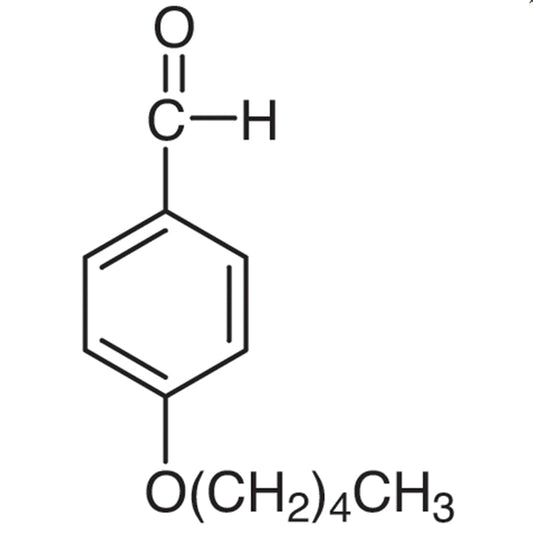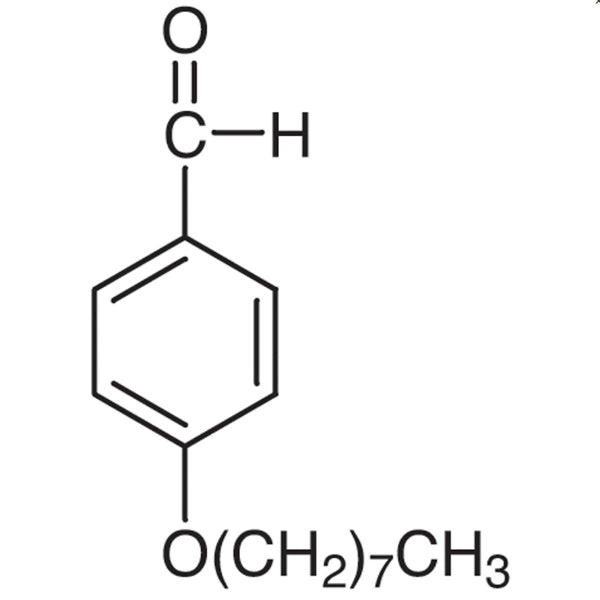
4-n-Octyloxybenzaldehyde is a chemical compound widely used in laboratory settings for the synthesis of complex organic molecules. It serves as a building block in various chemical reactions, particularly in the development of aromatic compounds with specific functional properties. Its molecular structure combines an aldehyde group with a long hydrocarbon chain, making it a versatile reagent in organic chemistry. This compound is essential for researchers aiming to create new materials or pharmaceutical compounds through controlled chemical transformations.
The compound's stability and predictable reactivity make it a preferred choice in laboratory applications. Its non-polar nature allows it to dissolve easily in organic solvents, facilitating its use in a wide range of experimental conditions. The controlled reactivity of 4-n-Octyloxybenzaldehyde ensures consistent results in synthetic processes, making it ideal for both academic and industrial research. Its ability to participate in substitution and condensation reactions further enhances its utility in chemical synthesis.
In Indonesian laboratories, 4-n-Octyloxybenzaldehyde is commonly used in organic chemistry research, especially in higher education institutions and research centers. Its availability and high quality make it a favored material for experiments requiring reliable and reproducible outcomes. Researchers in Indonesia rely on this compound for its effectiveness in creating complex chemical structures, supporting advancements in pharmaceutical and material sciences.
Related TCI products
- Organic synthesis applications benefit from 4-n-Octyloxybenzaldehyde due to its ability to participate in substitution and condensation reactions, enabling the creation of complex aromatic compounds.
- Pharmaceutical research utilizes this compound as a key building block for the development of new drug molecules, leveraging its stable chemical structure and predictable reactivity.
- Material science experiments often incorporate 4-n-Octyloxybenzaldehyde to synthesize functional polymers and advanced materials, taking advantage of its non-polar properties.
- Analytical chemistry laboratories use this compound as a reference standard for chromatographic and spectroscopic analyses, ensuring accurate identification of chemical compounds.
- Educational institutions employ 4-n-Octyloxybenzaldehyde in teaching laboratories to demonstrate fundamental organic reactions and synthetic techniques to students.
| Brand | TCI |
|---|---|
| CAS number | 24083-13-4 |
| Molecular formula | — |
| Purity | — |
| Category | Chemistry > Building Blocks > Non-Heterocyclic Building Blocks |
| Pack sizes | Available in various quantities as per supplier specifications |
| Physical form | Liquid |
| Storage | Store in a cool, dry place away from light and incompatible materials |
4-n-Octyloxybenzaldehyde should be stored in a cool, dry environment, away from direct sunlight and sources of heat. It is recommended to keep the compound in a tightly sealed container to prevent evaporation and contamination. Due to its non-polar nature, it is best stored in glass or high-density polyethylene containers to ensure chemical stability. Laboratory personnel should handle the compound with appropriate personal protective equipment, such as gloves and safety goggles, to avoid skin contact or inhalation. Proper ventilation is essential when working with this compound to minimize exposure risks. Regular monitoring of storage conditions is advised to maintain the integrity and safety of the material.
—
Produk Terkait
-
4-Heptyloxybenzaldehyde TCI H0238
Regular price Rp 4.479.300,00Regular price -
4-Benzyloxybenzaldehyde TCI B1325
Regular price Rp 1.353.450,00Regular price -
4-Amyloxybenzaldehyde TCI A0707
Regular price From Rp 1.510.950,00Regular price -
4-Octadecyloxybenzaldehyde TCI O0223
Regular price Rp 3.578.400,00Regular price -
4-Decyloxybenzaldehyde TCI D1124
Regular price From Rp 2.411.850,00Regular price -
2,4,5-Trichlorophenyl4-n-Octyloxybenzoate TCI O0230
Regular price Rp 3.419.850,00Regular price -
p-Anisaldehyde TCI A0480
Regular price From Rp 530.250,00Regular price -
4-BenzyloxybenzoicAcid TCI B1665
Regular price From Rp 1.485.750,00Regular price