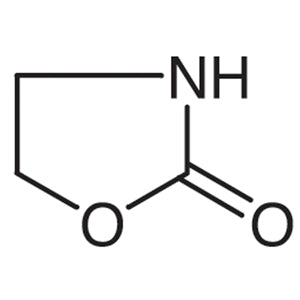
TCI O0188 2-Oxazolidone, also called 2-oxazolidinone, is a five-membered heterocyclic compound whose ring contains one oxygen atom and one nitrogen atom. The ring is a cyclic carbamate, so its carbonyl group sits between the oxygen and nitrogen atoms. In the laboratory it is an important heterocyclic building block, because the oxazolidinone framework appears in many bioactive molecules, chiral auxiliaries and functional monomers. Because it carries no substituents, it is the simplest starting point for attaching groups at the nitrogen atom and for studying cyclic carbamate chemistry.
Chemists choose this material mainly for its N–H group. That group can be alkylated, acylated or arylated, while the cyclic carbamate ring stays relatively stable under many reaction conditions. This lets researchers modify the nitrogen position selectively without breaking the core ring. The compound is polar and generally dissolves in polar solvents, so it fits easily into a range of reaction systems. Its framework is the basis of the oxazolidinone class of antibiotics and of many chiral auxiliaries. That makes the parent compound useful for teaching, method development and analogue synthesis.
In Indonesian laboratories, 2-Oxazolidone is relevant to medicinal chemistry research, where the oxazolidinone scaffold is a well-known structural motif. It also supports work on synthetic methods for N-arylation and N-acylation, where a simple, unsubstituted substrate makes results easier to interpret. University research groups, teaching laboratories and industrial R&D teams can use it as a reference substrate, as a starting material for new derivatives, or as a model compound when studying the reactivity of cyclic carbamates under different conditions.
- Medicinal chemistry research: the oxazolidinone framework underlies an important class of antibiotics, so this parent compound is a sensible starting point for building and studying structural analogues.
- N-arylation method development: the free N–H group can be arylated while the carbamate ring stays relatively stable, making the compound a clean model substrate for testing new coupling conditions.
- N-acylation and N-alkylation studies: its simple, unsubstituted structure lets researchers attach acyl or alkyl groups at nitrogen and assess reaction selectivity and efficiency without interference from other substituents.
- Chiral auxiliary research: the oxazolidinone skeleton is the basis of many chiral auxiliaries, so the parent compound helps researchers understand and design related auxiliary structures and their chemistry.
- Teaching and cyclic carbamate chemistry: as the simplest member of its class, it is well suited to demonstrating heterocyclic reactivity, carbamate stability and nitrogen functionalisation in academic laboratory courses.
| Brand | TCI (product code O0188) |
|---|---|
| CAS number | 497-25-6 |
| Molecular formula | — |
| Purity | — |
| Category | Chemistry > Building Blocks > Heterocyclic Building Blocks |
| Pack sizes | as offered by TCI for product O0188; see the product page for the available options |
| Physical form | refer to the TCI product documentation and certificate of analysis |
| Storage | keep tightly closed in a cool, dry place, following the manufacturer's label and Safety Data Sheet (SDS) |
Store 2-Oxazolidone in its original, tightly sealed container in a cool, dry, well-ventilated area, away from direct sunlight, moisture and incompatible substances such as strong oxidising agents. After each use, reseal the container promptly to limit moisture uptake and contamination. If you move material into another container, use clean, dry, chemically compatible glass or suitable plastic containers labelled with the product name, CAS number and date. Handle the compound in a fume hood or well-ventilated area while wearing appropriate personal protective equipment, including a lab coat, safety glasses and chemical-resistant gloves. Avoid creating dust, and avoid inhalation or contact with skin and eyes. Always read the TCI Safety Data Sheet before use, and dispose of waste according to institutional and local regulations.
—
Produk Terkait
-
3-Methyl-2-oxazolidone TCI M0781
Regular price From Rp 1.035.300,00Regular price -
1-Phenyl-3-pyrazolidone TCI P0153
Regular price Rp 664.650,00Regular price -
4-Methyl-1-phenyl-3-pyrazolidone TCI M1667
Regular price Rp 1.193.850,00Regular price -
2-Mercapto-5-thiazolidone TCI M0263
Regular price Rp 4.213.650,00Regular price -
3-(2-Hydroxyethyl)oxazolidin-2-one TCI H1923
Regular price From Rp 2.068.500,00Regular price -
Oxazolidine-2,4-dione TCI O0608
Regular price Rp 2.782.500,00Regular price -
3-Trimethylsilyl-2-oxazolidinone[TrimethylsilylatingReagent] TCI T1535
Regular price Rp 2.571.450,00Regular price -
3-Benzyloxazolidine TCI B1339
Regular price From Rp 1.431.150,00Regular price


![43112-38-5 3-Trimethylsilyl-2-oxazolidinone [Trimethylsilylating Reagent] - AMI Scientific](http://amiscientific.com/cdn/shop/files/TCI2510T1535.jpg?v=1767141788&width=533)