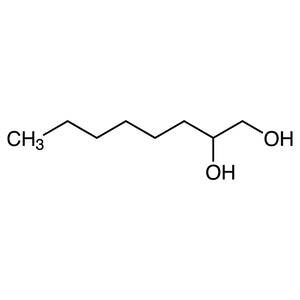
1,2-Octanediol is a chemical compound widely used in laboratory settings as a fundamental building block for various chemical reactions and molecular synthesis. This compound features two hydroxyl (-OH) groups positioned at the terminal ends of its carbon chain, which significantly enhances its reactivity. Its versatility makes it a key component in the development of complex organic molecules, enabling chemists to create esters, amides, and polymers with high precision. In research environments, 1,2-Octanediol is essential for advancing synthetic pathways and exploring new chemical transformations.
The compound’s ability to react with a variety of functional groups, such as carboxylic acids, amines, and aldehydes, makes it a preferred choice for chemists. Its high reactivity and functional versatility allow it to participate in multiple reaction types, from condensation to esterification. Additionally, its relatively high boiling point facilitates controlled heating during chemical processes, ensuring optimal reaction conditions. These properties make 1,2-Octanediol an indispensable tool in synthetic chemistry and molecular design.
In Indonesian laboratories, 1,2-Octanediol is commonly used in organic chemistry research, pharmaceutical development, and industrial chemical production. It plays a crucial role in projects that require the synthesis of complex molecules with specific structural features. Its reliability and adaptability have made it a standard material in both academic and industrial research settings across Indonesia.
- Organic synthesis projects benefit from 1,2-Octanediol due to its reactivity and ability to form esters and amides, supporting the creation of complex molecular structures.
- Pharmaceutical research utilizes this compound for the development of new drugs, as its functional groups can be modified to produce bioactive molecules.
- Polymer production relies on 1,2-Octanediol for its ability to participate in chain reactions, enabling the formation of various polymeric materials.
- Industrial chemical manufacturing employs this compound as a building block for producing specialty chemicals with specific functional properties.
- Analytical chemistry applications use 1,2-Octanediol as a standard reference material for calibrating instruments and testing reaction mechanisms.
| Brand | TCI |
|---|---|
| CAS number | 1117-86-8 |
| Molecular formula | — |
| Purity | — |
| Category | Chemistry > Building Blocks > Non-Heterocyclic Building Blocks |
| Pack sizes | Available in various quantities as per standard laboratory supply formats |
| Physical form | Liquid |
| Storage | Store in a cool, dry place away from direct sunlight and incompatible materials |
1,2-Octanediol should be stored in a cool, dry environment, away from direct sunlight and sources of heat. It is recommended to keep the compound in a tightly sealed container to prevent evaporation and contamination. Due to its reactive nature, it should be stored separately from strong oxidizing agents and acids. In laboratory settings, proper ventilation is essential when handling this compound to minimize exposure. Always use appropriate personal protective equipment, such as gloves and safety goggles, to ensure safe handling. Regular inspection of storage containers is advised to maintain the integrity of the material and prevent any potential hazards.
—
Produk Terkait
-
1,8-Octanediol TCI O0024
Regular price Rp 1.298.850,00Regular price -
(3R,6R)-3,6-Octanediol TCI O0293
Regular price Rp 2.625.000,00Regular price -
2,2,3,3,4,4,5,5,6,6,7,7-Dodecafluoro-1,8-octanediol TCI D2891
Regular price Rp 3.100.650,00Regular price -
4-Benzyloxy-1,3-butanediol TCI B3326
Regular price From Rp 2.386.650,00Regular price -
1,4-ButanediolMonomethylEther TCI B2402
Regular price From Rp 2.359.350,00Regular price -
1,2-Butanediol TCI B0804
Regular price From Rp 505.050,00Regular price -
2,3-Butanediol(mixtureofstereoisomers) TCI B0681
Regular price From Rp 717.150,00Regular price -
1,4-Butanediol TCI B0680
Regular price From Rp 477.750,00Regular price