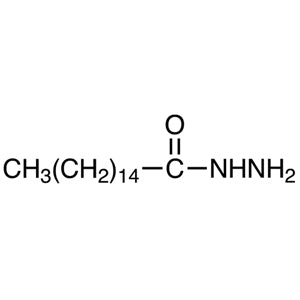
Palmitic Acid Hydrazide from TCI is a derivative of palmitic acid in which the carboxylic acid group is replaced by a hydrazide group (–CONHNH₂). The compound combines a long, hydrophobic, saturated C16 alkyl chain with a nucleophilic, reactive hydrazide end group. In synthesis laboratories it serves as a non-heterocyclic building block for preparing hydrazones, heterocycles such as oxadiazoles and triazoles, and a range of amphiphilic derivatives. It gives researchers a practical way to introduce a long fatty chain into target molecules through relatively simple reactions.
Chemists choose this compound because its hydrazide group reacts readily with aldehydes and ketones to form hydrazones under mild conditions. The same group can also be cyclized into five-membered heterocyclic rings, which are widely studied in medicinal chemistry. The C16 chain makes the molecule strongly lipophilic, so its derivatives are often investigated for surface activity, membrane permeability, or organic gel formation. Because it pairs a polar head with a nonpolar tail, the compound is also useful in designing surfactants and self-assembling materials, where the balance between hydrophilic and hydrophobic parts determines how the molecules behave.
In Indonesia, this material suits university organic chemistry and medicinal chemistry laboratories, research institutes working on lipid-based materials, and groups developing surfactants or functional molecules derived from fatty acids. It fits student research projects, thesis work, and exploratory synthesis where a reliable, well-characterized long-chain hydrazide is needed as a starting point. Laboratories studying the derivatization of natural fatty acids, including those connected to oleochemical research, can also use it as a reference building block in their synthetic routes.
- Hydrazone synthesis: the reactive hydrazide group condenses with aldehydes and ketones under mild conditions, so researchers can build lipophilic hydrazone libraries without harsh reagents or complex setups.
- Preparation of five-membered heterocycles: the hydrazide can be cyclized into oxadiazole or triazole rings, which makes it a convenient precursor for heterocyclic scaffolds studied in medicinal chemistry programs.
- Design of amphiphilic molecules: the polar hydrazide head and nonpolar C16 tail give a built-in amphiphilic structure, which suits work on new surfactants and surface-active derivatives.
- Self-assembly and organogel research: the long saturated alkyl chain promotes hydrophobic interactions, so its derivatives are good candidates for studying self-assembling materials and the formation of organic gels.
- Lipophilicity and membrane permeability studies: attaching the C16 chain to target molecules increases their lipophilicity, which lets researchers examine how fatty chains affect membrane penetration and biological activity.
| Brand | TCI (product code P0004) |
|---|---|
| CAS number | 2619-88-7 |
| Molecular formula | — |
| Purity | — |
| Category | Chemistry > Building Blocks > Non-Heterocyclic Building Blocks |
| Pack sizes | TCI standard pack sizes; please confirm the available size when ordering |
| Physical form | see the TCI product documentation and certificate of analysis |
| Storage | follow the storage conditions on the TCI label and Safety Data Sheet |
Store Palmitic Acid Hydrazide in its original, tightly closed container in a cool, dry, well-ventilated place, away from direct sunlight, heat sources, and moisture. Always follow the storage conditions on the TCI label and Safety Data Sheet. Keep it separate from strong oxidizing agents and reactive carbonyl compounds to prevent unwanted reactions. Handle it in a fume hood or well-ventilated area and wear standard personal protective equipment, including gloves, safety glasses, and a lab coat. Avoid breathing in dust and avoid contact with skin and eyes. Reseal the container promptly after use, label any portions you transfer, and dispose of waste according to institutional and local chemical safety rules.
—
Produk Terkait
-
PalmiticAcid TCI P1145
Regular price Rp 2.704.800,00Regular price -
PalmiticAnhydride TCI P0008
Regular price From Rp 2.571.450,00Regular price -
PalmiticAcid TCI P0002
Regular price From Rp 505.050,00Regular price -
Biphenyl-4-carboxylicHydrazide TCI B4350
Regular price Rp 1.644.300,00Regular price -
SalicylHydrazide TCI S0242
Regular price Rp 2.545.200,00Regular price -
StearicHydrazide TCI S0222
Regular price Rp 4.347.000,00Regular price -
PhenylaceticHydrazide TCI P2203
Regular price From Rp 1.167.600,00Regular price -
PhthalicHydrazide TCI P0354
Regular price From Rp 557.550,00Regular price