

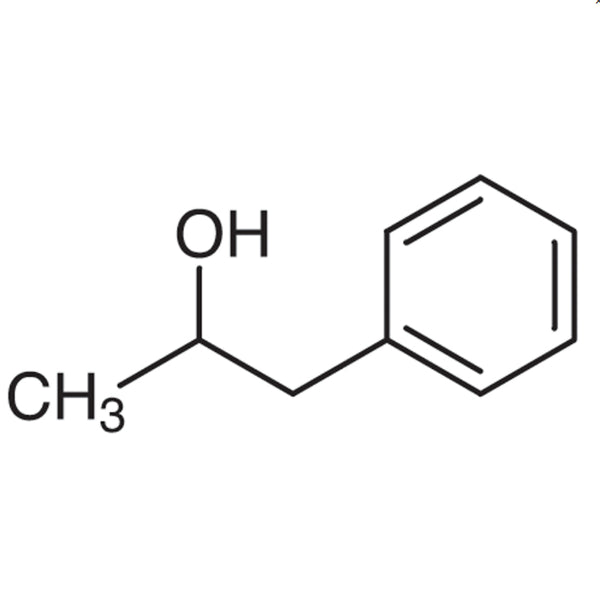
1-Phenyl-2-propanol is an organic compound widely used in chemical reactions for the synthesis of complex molecules. As a fundamental building block in organic chemistry, it plays a crucial role in laboratories where the creation of new compounds is essential. This compound is particularly valued for its ability to participate in various chemical transformations, making it a versatile reagent in synthetic processes. Its structural simplicity allows chemists to manipulate it into more complex structures, which is vital in both research and educational settings.
The compound’s chemical properties make it a preferred choice for many applications. It exhibits good reactivity and can undergo a range of reactions such as reduction, oxidation, and substitution. These characteristics enable it to be used in the development of aromatic compounds and their derivatives. Its stability under certain conditions also contributes to its reliability in laboratory experiments. The ease with which it can be modified makes it an essential component in the synthesis of pharmaceuticals and other specialized chemicals.
In Indonesian laboratories, 1-Phenyl-2-propanol is commonly used in organic chemistry research, including the synthesis of aromatic compounds, drug development, and chemical analysis. It is also frequently employed in educational institutions to teach students about molecular structures and chemical reactions. Its widespread use highlights its importance in both academic and industrial chemical applications.
Related TCI products
- TCI B5274 2077-19-2 2-(4-Bromophenyl)-2-propanol
- TCI B4657 25574-11-2 3-(4-Bromophenyl)-1-propanol
- TCI B3905 847682-00-2 1,3-Bis[(2,2-dimethyl-1,3-dioxan-5-yl)oxy]-2-propanol
- TCI B3277 4799-68-2 3-(Benzyloxy)-1-propanol
- TCI B2110 6972-79-8 1,3-Bis(benzyloxy)-2-propanol
- TCI B0864 5131-66-8 1-Butoxy-2-propanol
- Aromatic Compound Synthesis: 1-Phenyl-2-propanol is ideal for creating complex aromatic structures due to its reactivity and compatibility with various functional groups.
- Pharmaceutical Research: The compound is used in the development of new drugs as it can be modified to form bioactive molecules with specific therapeutic properties.
- Chemical Analysis: It serves as a standard reference material for analytical techniques, helping in the identification and quantification of other compounds.
- Educational Demonstrations: Its straightforward structure and predictable reactions make it suitable for teaching fundamental chemical concepts in academic settings.
- Organic Synthesis Protocols: It is a key reagent in multi-step synthesis processes, offering flexibility in reaction pathways and product formation.
| Brand | TCI |
|---|---|
| CAS number | 698-87-3 |
| Molecular formula | — |
| Purity | — |
| Category | Chemistry > Building Blocks > Non-Heterocyclic Building Blocks |
| Pack sizes | Available in various quantities as per standard laboratory supply options |
| Physical form | Liquid |
| Storage | Store in a cool, dry place away from direct sunlight and incompatible materials |
1-Phenyl-2-propanol should be stored in a cool, dry environment to maintain its stability and prevent degradation. It is recommended to keep the compound in a tightly sealed container to minimize exposure to air and moisture. Due to its reactivity, it should be stored away from strong oxidizing agents and incompatible substances. Proper labeling of storage containers is essential for safety and identification. In laboratory settings, it should be handled with appropriate personal protective equipment to ensure safe usage. Regular monitoring of storage conditions helps maintain the integrity of the compound for reliable experimental results.
—
Produk Terkait
-
2-(4-Bromophenyl)-2-propanol TCI B5274
Regular price From Rp 1.353.450,00Regular price -
3-(4-Bromophenyl)-1-propanol TCI B4657
Regular price From Rp 848.400,00Regular price -
1,3-Bis[(2,2-dimethyl-1,3-dioxan-5-yl)oxy]-2-propanol TCI B3905
Regular price Rp 3.340.050,00Regular price -
3-(Benzyloxy)-1-propanol TCI B3277
Regular price Rp 1.881.600,00Regular price -
1,3-Bis(benzyloxy)-2-propanol TCI B2110
Regular price From Rp 1.881.600,00Regular price -
1-Butoxy-2-propanol TCI B0864
Regular price From Rp 477.750,00Regular price -
3-Bromo-1-propanol TCI B0641
Regular price From Rp 2.491.650,00Regular price -
1-Bromo-2-propanol(containsca.20%2-Bromo-1-propanol)(stabilizedwithMgO) TCI B0640
Regular price Rp 2.306.850,00Regular price


![847682-00-2 1,3-Bis[(2,2-dimethyl-1,3-dioxan-5-yl)oxy]-2-propanol - AMI Scientific](http://amiscientific.com/cdn/shop/files/TCI2510B3905.jpg?v=1768815545&width=533)


