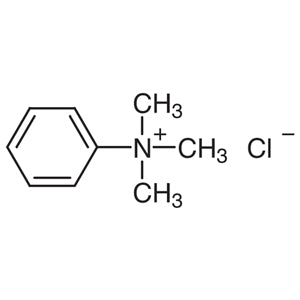
Trimethylphenylammonium Chloride (TCI P0244), with CAS number 138-24-9, is a chemical compound widely used as a phase transfer catalyst in laboratory settings. This reagent plays a crucial role in facilitating chemical reactions that require the transfer of ions between different phases, such as from an organic phase to an aqueous phase. Its unique ionic structure enables efficient interfacial interactions, making it particularly valuable in reactions that demand non-aqueous conditions. This compound is essential for enhancing reaction efficiency and reducing the time required for complex synthetic processes.
One of the key properties that make Trimethylphenylammonium Chloride a preferred choice is its ability to improve the efficiency of chemical reactions by promoting the transfer of ions across phases. It is chemically stable under various conditions, which ensures consistent performance across different experimental setups. Additionally, its non-corrosive nature and relative safety in normal use make it a reliable option for laboratory applications. These characteristics contribute to its widespread use in both academic and industrial research environments.
In Indonesian laboratories, Trimethylphenylammonium Chloride is commonly employed in organic chemistry and complex compound synthesis. It is particularly useful in reactions involving both polar and non-polar substrates. Its versatility and effectiveness make it a valuable tool for researchers and educators in higher education institutions and research centers. The compound supports a wide range of experimental needs, from basic research to advanced synthetic processes.
Related TCI products
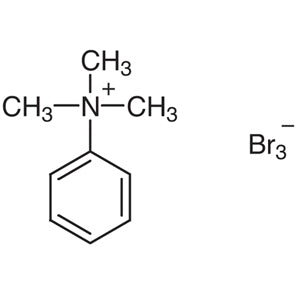
- TCI P0928 4207-56-1 Trimethylphenylammonium Tribromide
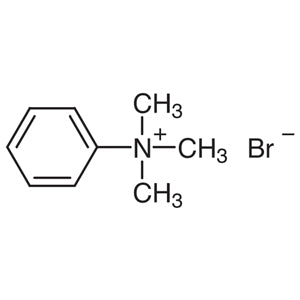
- TCI P0243 16056-11-4 Trimethylphenylammonium Bromide
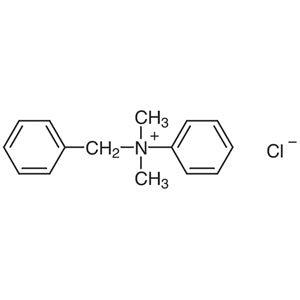
- TCI B0416 3204-68-0 Benzyldimethylphenylammonium Chloride
- TCI A0208 139-08-2 Benzyldimethyltetradecylammonium Chloride
- TCI T4175 1516-27-4 N,N,N-Trimethylprop-2-en-1-aminium Chloride
- TCI T2873 56375-79-2 Tributylmethylammonium Chloride (ca. 75% in water)
- Organic chemistry reactions benefit from Trimethylphenylammonium Chloride due to its ability to enhance phase transfer efficiency, enabling reactions that require non-aqueous conditions.
- Complex compound synthesis relies on this catalyst to facilitate the transfer of ions between organic and aqueous phases, accelerating reaction rates and improving yield.
- Catalytic research applications use this reagent to study phase transfer mechanisms and their impact on reaction kinetics in various chemical systems.
- Industrial-scale chemical processes incorporate this compound to improve the efficiency of large-scale reactions that require interfacial interactions.
- Educational laboratories utilize Trimethylphenylammonium Chloride to demonstrate phase transfer catalysis and its role in modern synthetic chemistry.
| Brand | TCI |
|---|---|
| CAS number | 138-24-9 |
| Molecular formula | — |
| Purity | — |
| Category | Chemistry > Synthetic Reagents > Phase Transfer Catalysts |
| Pack sizes | Available in various quantities as per standard laboratory supply options |
| Physical form | Solid powder |
| Storage | Store in a cool, dry place away from moisture and direct sunlight |
Trimethylphenylammonium Chloride should be stored in a cool, dry environment to maintain its chemical stability and prevent degradation. It is recommended to keep the compound in airtight containers to minimize exposure to moisture and air. Proper labeling of storage containers is essential for safe handling and easy identification. While it is generally considered non-corrosive, it is advisable to use appropriate personal protective equipment, such as gloves and safety goggles, when handling the material. The compound should be stored away from incompatible substances to ensure safety in the laboratory. Regular inspection of storage conditions is recommended to ensure optimal preservation of the reagent.
—
Produk Terkait
-
TrimethylphenylammoniumTribromide TCI P0928
Regular price From Rp 1.829.100,00Regular price -
TrimethylphenylammoniumBromide TCI P0243
Regular price From Rp 795.900,00Regular price -
BenzyldimethylphenylammoniumChloride TCI B0416
Regular price Rp 3.207.750,00Regular price -
BenzyldimethyltetradecylammoniumChloride TCI A0208
Regular price From Rp 610.050,00Regular price -
N,N,N-Trimethylprop-2-en-1-aminiumChloride TCI T4175
Regular price From Rp 1.485.750,00Regular price -
TributylmethylammoniumChloride(ca.75%inwater) TCI T2873
Regular price From Rp 848.400,00Regular price -
TetrapropylammoniumChloride TCI T2106
Regular price Rp 1.856.400,00Regular price -
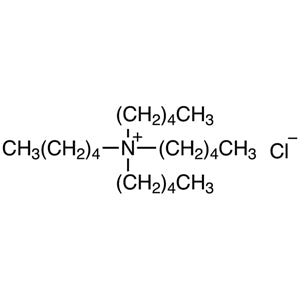
TetraamylammoniumChloride TCI T1433
Regular price From Rp 3.498.600,00Regular price