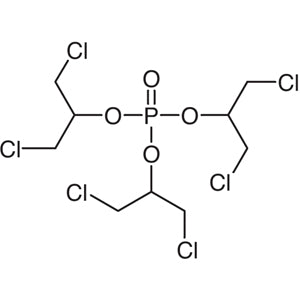
Tris(1,3-dichloro-2-propyl) Phosphate (TCI P0269), with CAS number 13674-87-8, is a chemical compound widely used in scientific and industrial applications. It plays a crucial role in laboratory settings, particularly in the development of battery materials. This compound is commonly used as a battery additive, contributing to the optimization of battery performance and stability. Its unique chemical structure makes it a valuable tool in materials science research, especially in the field of energy storage. Due to its versatility, it is a key component in various experimental processes that require controlled chemical behavior.
One of the main reasons for its popularity is its chemical stability and resistance to reactions under normal conditions. This makes it ideal for use in environments where chemical consistency is essential. Additionally, it exhibits good thermal and moisture resistance, allowing it to maintain its properties across a range of environmental conditions. These characteristics ensure that it remains effective in both standard and challenging laboratory settings. Its reliability and predictable behavior make it a trusted choice for researchers and technicians.
In Indonesian laboratories, Tris(1,3-dichloro-2-propyl) Phosphate is frequently used in battery material research, especially in the development of advanced energy storage solutions. It is also employed in studies related to electrical materials and energy systems. Its availability and consistent performance make it a preferred option for both academic and industrial research in Indonesia. Researchers rely on its properties to achieve accurate and reproducible results in their experiments.
TCI brochures (PDF)
- Phosphate Ester-type Electrolyte Additives 2025-10-28 · p. 1
- Lithium Battery Research Reagents 2026-06-04 · p. 2
- Battery Research Reagents 2026-09-18 · p. 6
- Polymer Additives 2026-04-16 · p. 4
- Battery Additive Development: This compound is ideal for formulating additives that enhance battery performance and stability, supporting research in energy storage solutions.
- Electrical Material Research: Its chemical stability makes it suitable for studies involving electrical materials, where consistent behavior is critical.
- Thermal Stability Testing: The compound’s resistance to heat allows it to be used in experiments assessing material performance under varying temperature conditions.
- Moisture Resistance Analysis: Its ability to maintain properties in humid environments makes it useful for testing materials in diverse environmental conditions.
- Material Compatibility Studies: It is used to evaluate how different materials interact, ensuring compatibility in complex chemical systems.
| Brand | TCI |
|---|---|
| CAS number | 13674-87-8 |
| Molecular formula | — |
| Purity | — |
| Category | Materials Science > Battery Materials > Battery Additives |
| Pack sizes | Available in various sizes as per supplier specifications |
| Physical form | Liquid |
| Storage | Store in a cool, dry place away from direct sunlight |
Tris(1,3-dichloro-2-propyl) Phosphate should be stored in a cool, dry location away from direct sunlight to maintain its chemical stability. It is recommended to use airtight containers to prevent exposure to moisture and air, which could affect its properties over time. In a laboratory setting, it should be handled with appropriate personal protective equipment, such as gloves and safety goggles, to ensure safety during use. The compound is non-reactive under normal conditions, but it is still important to store it separately from incompatible materials. Proper labeling and storage practices help maintain a safe and efficient laboratory environment.
—
Product Categories
- Battery MaterialsBattery Additives [Battery Materials]Phosphate Esters [Battery Additives]
- Electronic MaterialsBattery MaterialsBattery Additives [Battery Materials]
- Polymer/Macromolecule ReagentsPolymer AdditivesFlame Retardants [Polymer Additives]
- Polymer/Macromolecule ReagentsPolymer AdditivesPlasticizers [Polymer Additives]
Produk Terkait
-
Tris(2-chloroethyl)Phosphate TCI T3447
Regular price From Rp 582.750,00Regular priceRp 423.150,00Sale price From Rp 582.750,00 -
Tri-o-cresylPhosphate TCI P1331
Regular price From Rp 742.350,00Regular priceRp 534.450,00Sale price From Rp 742.350,00 -
Tris(2-ethylhexyl)Phosphate TCI P1022
Regular price From Rp 530.250,00Regular priceRp 386.400,00Sale price From Rp 530.250,00 -
TricresylPhosphate(mixtureofisomers) TCI P0273
Regular price Rp 530.250,00Regular priceRp 386.400,00Sale price Rp 530.250,00 -
TriphenylPhosphate TCI P0272
Regular price From Rp 557.550,00Regular priceRp 405.300,00Sale price From Rp 557.550,00 -
TriethylPhosphate TCI P0270
Regular price From Rp 557.550,00Regular priceRp 405.300,00Sale price From Rp 557.550,00 -
CresylDiphenylPhosphate(mixtureofanalogue) TCI P0259
Regular price From Rp 822.150,00Regular priceRp 590.100,00Sale price From Rp 822.150,00 -
Tri-p-cresylPhosphate TCI T2209
Regular price From Rp 1.643.250,00Regular priceRp 1.164.450,00Sale price From Rp 1.643.250,00