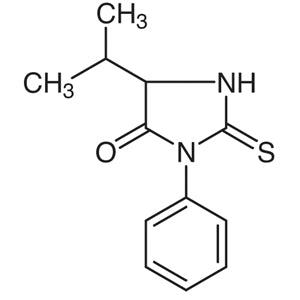
Phenylthiohydantoin-valine (TCI P0379 4333-20-4) is a chemical compound widely used in laboratory settings for its unique structural properties. It belongs to the category of heterocyclic building blocks, making it a valuable component in the synthesis of complex organic molecules. This compound is particularly significant in the field of medicinal chemistry due to its ability to participate in various chemical reactions, including substitution and bond formation. Its molecular structure combines elements of hydantoin and valine, providing a versatile platform for the development of bioactive compounds.
The compound is known for its chemical stability under controlled conditions, which makes it suitable for use in a variety of synthetic processes. However, it is sensitive to moisture and air exposure, requiring careful handling and storage to maintain its integrity. Its reactivity with different functional groups allows it to be a key reagent in the design of new pharmaceuticals and organic compounds. This versatility and chemical behavior make it a preferred choice for researchers working on drug discovery and molecular synthesis.
In Indonesian laboratories, Phenylthiohydantoin-valine is commonly used in organic chemistry and pharmacological research. It plays a crucial role in the development of new compounds with potential applications in healthcare and biotechnology. Researchers in universities and research institutions rely on this compound to explore its properties and applications in the creation of novel therapeutic agents. Its presence in laboratory workflows underscores its importance in advancing scientific research in Indonesia.
TCI brochures (PDF)
- Amino Acids and Peptide Synthesis Reagents 2025-08-14 · p. 22
Related TCI products
- TCI P0756 4333-22-6 Phenylthiohydantoin-norleucine
- TCI P0731 182153-75-9 Phenylthiohydantoin-arginine Hydrochloride
- TCI P0729 4333-21-5 Phenylthiohydantoin-proline
- TCI P0625 29635-94-7 Phenylthiohydantoin-(Nepsilon-phenylthiocarbamyl)-lysine
- TCI P0378 5789-24-2 Phenylthiohydantoin-tryptophan
- TCI P0376 2010-15-3 Phenylthiohydantoin-glycine
- Organic synthesis applications benefit from Phenylthiohydantoin-valine due to its ability to participate in substitution reactions and form new molecular bonds, making it ideal for creating complex heterocyclic structures.
- Pharmacological research utilizes this compound to develop bioactive molecules, as its structural features enable interaction with various biological targets and pathways.
- Drug discovery projects often incorporate this reagent to explore its potential in synthesizing compounds with therapeutic properties, supporting the development of new pharmaceuticals.
- Molecular modeling studies use Phenylthiohydantoin-valine as a building block to simulate and predict the behavior of complex organic molecules in different chemical environments.
- Analytical chemistry applications leverage its unique chemical properties to study reaction mechanisms and structural changes in synthetic processes.
| Brand | TCI |
|---|---|
| CAS number | 4333-20-4 |
| Molecular formula | — |
| Purity | — |
| Category | Chemistry > Building Blocks > Heterocyclic Building Blocks |
| Pack sizes | Available in various quantities as per standard laboratory supply formats |
| Physical form | Solid, typically in crystalline or powder form |
| Storage | Requires storage in a dry, cool, and well-ventilated area away from moisture and air exposure |
Phenylthiohydantoin-valine should be stored in a dry, cool, and well-ventilated environment to prevent moisture absorption and degradation. It is recommended to use airtight containers made of materials such as glass or high-density polyethylene to minimize exposure to air. This compound is sensitive to humidity, so maintaining a controlled storage environment is essential for preserving its chemical integrity. Laboratory personnel should handle the compound with care, using appropriate personal protective equipment to avoid direct contact. Proper labeling and storage conditions are critical to ensuring its effectiveness in research applications. Regular monitoring of storage conditions helps maintain the compound's stability and usability in laboratory settings.
—
Product Categories
Produk Terkait
-
Phenylthiohydantoin-norleucine TCI P0756
Regular price Rp 689.850,00Regular price -
Phenylthiohydantoin-arginineHydrochloride TCI P0731
Regular price Rp 1.273.650,00Regular price -
Phenylthiohydantoin-proline TCI P0729
Regular price Rp 584.850,00Regular price -
Phenylthiohydantoin-(Nepsilon-phenylthiocarbamyl)-lysine TCI P0625
Regular price From Rp 743.400,00Regular price -
Phenylthiohydantoin-tryptophan TCI P0378
Regular price From Rp 1.140.300,00Regular price -
Phenylthiohydantoin-glycine TCI P0376
Regular price Rp 1.115.100,00Regular price -
Phenylthiohydantoin-tyrosine TCI P0368
Regular price From Rp 505.050,00Regular price -
Phenylthiohydantoin-phenylalanine TCI P0367
Regular price From Rp 505.050,00Regular price