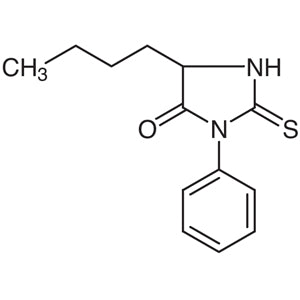
Phenylthiohydantoin-norleucine is a chemical compound widely used in laboratory settings for the synthesis of complex molecules. It belongs to the category of heterocyclic building blocks, which are essential in the creation of compounds with intricate molecular structures. This compound plays a crucial role in various chemical reactions, particularly in substitution and bond formation processes. Its versatility makes it a valuable tool for researchers aiming to develop new chemical entities with specific functional properties.
The compound is known for its chemical stability, making it suitable for use in enzymatic and other chemical reactions. Its molecular structure allows for high specificity, which is essential in reactions requiring precise control. This characteristic makes it a preferred choice for applications that demand accuracy and reproducibility. The compound’s ability to interact with proteins and enzymes also enhances its utility in biochemical and pharmacological research.
In Indonesian laboratories, Phenylthiohydantoin-norleucine is commonly used in organic chemistry research, especially in the synthesis of heterocyclic compounds. It is also frequently employed in pharmaceutical and biochemical studies due to its potential for interacting with biological targets. Its role in laboratory research is significant, supporting advancements in both academic and industrial chemical applications.
TCI brochures (PDF)
- Amino Acids and Peptide Synthesis Reagents 2025-08-14 · p. 23
Related TCI products
- TCI P0731 182153-75-9 Phenylthiohydantoin-arginine Hydrochloride
- TCI P0729 4333-21-5 Phenylthiohydantoin-proline
- TCI P0379 4333-20-4 Phenylthiohydantoin-valine
- TCI P0376 2010-15-3 Phenylthiohydantoin-glycine
- TCI P0368 4332-95-0 Phenylthiohydantoin-tyrosine
- TCI P0364 5624-13-5 Phenylthiohydantoin-aspartic Acid
- Organic synthesis of heterocyclic compounds due to its structural versatility and reactivity in forming complex molecular frameworks.
- Enzymatic reaction substrates because of its stability and compatibility with biological systems, enabling precise biochemical interactions.
- Pharmaceutical research applications where the compound's ability to interact with proteins and enzymes is critical for drug development.
- Biochemical studies involving the investigation of enzyme mechanisms and substrate specificity in controlled environments.
- Structural analysis and modification of complex molecules in synthetic chemistry, supporting the creation of novel chemical entities.
| Brand | TCI |
|---|---|
| CAS number | 4333-22-6 |
| Molecular formula | — |
| Purity | — |
| Category | Chemistry > Building Blocks > Heterocyclic Building Blocks |
| Pack sizes | Available in various quantities as per standard laboratory supply standards |
| Physical form | Solid powder |
| Storage | Store in a cool, dry place away from light and moisture |
Phenylthiohydantoin-norleucine should be stored in a cool, dry environment, away from direct sunlight and sources of moisture. It is recommended to keep the compound in a tightly sealed container to prevent exposure to air and humidity. Due to its chemical stability, it does not require refrigeration but should be protected from extreme temperature fluctuations. When handling, it is advisable to use appropriate personal protective equipment such as gloves and safety goggles to ensure safety. The compound is generally non-hazardous under normal laboratory conditions, but standard chemical handling procedures should be followed to maintain a safe working environment.
—
Product Categories
Produk Terkait
-
Phenylthiohydantoin-arginineHydrochloride TCI P0731
Regular price Rp 1.273.650,00Regular price -
Phenylthiohydantoin-proline TCI P0729
Regular price Rp 584.850,00Regular price -
Phenylthiohydantoin-valine TCI P0379
Regular price Rp 637.350,00Regular price -
Phenylthiohydantoin-glycine TCI P0376
Regular price Rp 1.115.100,00Regular price -
Phenylthiohydantoin-tyrosine TCI P0368
Regular price From Rp 505.050,00Regular price -
Phenylthiohydantoin-asparticAcid TCI P0364
Regular price From Rp 505.050,00Regular price -
Phenylthiohydantoin-(Nepsilon-phenylthiocarbamyl)-lysine TCI P0625
Regular price From Rp 743.400,00Regular price -
Phenylthiohydantoin-tryptophan TCI P0378
Regular price From Rp 1.140.300,00Regular price