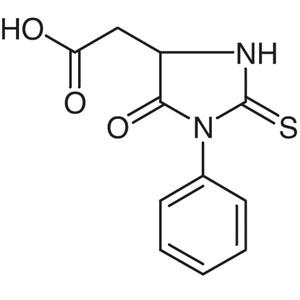
Phenylthiohydantoin-(Nε-phenylthiocarbamyl)-lysine from TCI is a derivative of the amino acid lysine in its phenylthiohydantoin (PTH) form. Its side chain, the epsilon amino group, has also reacted to form a phenylthiocarbamyl group. This type of compound forms when a lysine residue is cleaved from the N-terminus of a peptide during Edman degradation, which uses phenyl isothiocyanate. In biochemistry and protein analysis laboratories, it serves as a reference standard for identifying lysine residues when determining amino acid sequences.
Laboratories choose this compound because it has the same form as the derivative that lysine actually produces during Edman sequencing. In lysine, the side-chain amino group also reacts with phenyl isothiocyanate, so the resulting derivative differs from the PTH derivatives of other amino acids. With a pure standard of this exact derivative, analysts can match retention times and absorption profiles in liquid chromatography precisely. The phenyl-bearing hydantoin ring structure also gives enough ultraviolet absorption for spectrophotometric detection, which makes it well suited to routine chromatographic identification workflows.
In Indonesia, this material is relevant to biochemistry, biotechnology, and proteomics laboratories at universities and research institutions that study protein structure and peptide sequences. Research groups that run N-terminal sequencing, check the identity of synthetic or purified peptides, or teach the principles of protein chemistry can use it as a dependable reference point. Analytical laboratories that support life science research may also keep it on hand as a calibration standard for chromatographic methods that separate and identify PTH amino acid derivatives.
TCI brochures (PDF)
- Amino Acids and Peptide Synthesis Reagents 2025-08-14 · p. 22
Related TCI products
- TCI P0731 182153-75-9 Phenylthiohydantoin-arginine Hydrochloride
- TCI P0729 4333-21-5 Phenylthiohydantoin-proline
- TCI P0379 4333-20-4 Phenylthiohydantoin-valine
- TCI P0376 2010-15-3 Phenylthiohydantoin-glycine
- TCI P0368 4332-95-0 Phenylthiohydantoin-tyrosine
- TCI P0364 5624-13-5 Phenylthiohydantoin-aspartic Acid
- Edman degradation sequencing: it serves as the reference standard for identifying lysine residues, because its structure matches the derivative actually released from lysine during each sequencing cycle.
- HPLC retention time calibration: analysts inject the pure standard to set the exact retention time of the lysine derivative, so peaks in unknown sequencing runs can be assigned with confidence.
- UV detection method development: the phenyl-bearing hydantoin ring gives enough ultraviolet absorption for spectrophotometric detection, which helps when optimizing detector settings for PTH derivative analysis.
- Peptide identity verification: laboratories confirming the N-terminal sequence of synthetic or purified peptides can use this standard to verify that lysine sits at the expected position.
- Protein chemistry teaching and research training: university laboratories can use it to show students how lysine's side-chain amino group reacts with phenyl isothiocyanate and forms a distinct derivative.
| Brand | TCI (product code P0625) |
|---|---|
| CAS number | 29635-94-7 |
| Molecular formula | — |
| Purity | — |
| Category | Chemistry > Building Blocks > Heterocyclic Building Blocks |
| Pack sizes | as listed on the product page for this item |
| Physical form | refer to the manufacturer's certificate of analysis and safety data sheet |
| Storage | follow the storage conditions stated on the TCI label and safety data sheet |
Store this compound in its original, tightly closed manufacturer container, kept in a cool, dry, well-ventilated place away from direct light, moisture, and incompatible substances. Always follow the storage conditions printed on the TCI label and safety data sheet. Because it is used as an analytical reference standard, avoid contamination: use clean, dry spatulas and glassware, and reseal the container quickly after each use. Handle it in a well-ventilated area or a fume hood, and wear suitable personal protective equipment, including laboratory gloves, safety glasses, and a lab coat. Avoid inhaling dust and avoid contact with skin and eyes. Dispose of residues and contaminated materials according to institutional and local chemical waste regulations.
—
Product Categories
Produk Terkait
-
Phenylthiohydantoin-arginineHydrochloride TCI P0731
Regular price Rp 1.273.650,00Regular price -
Phenylthiohydantoin-proline TCI P0729
Regular price Rp 584.850,00Regular price -
Phenylthiohydantoin-valine TCI P0379
Regular price Rp 637.350,00Regular price -
Phenylthiohydantoin-glycine TCI P0376
Regular price Rp 1.115.100,00Regular price -
Phenylthiohydantoin-tyrosine TCI P0368
Regular price From Rp 505.050,00Regular price -
Phenylthiohydantoin-asparticAcid TCI P0364
Regular price From Rp 505.050,00Regular price -
Phenylthiohydantoin-norleucine TCI P0756
Regular price Rp 689.850,00Regular price -
Phenylthiohydantoin-tryptophan TCI P0378
Regular price From Rp 1.140.300,00Regular price