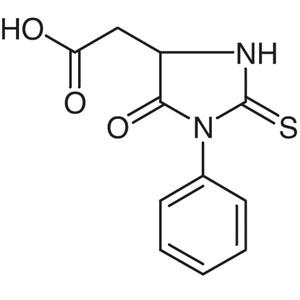
Phenylthiohydantoin-tryptophan is a chemical compound widely used in laboratory settings for its versatility in chemical reactions and molecular synthesis. As a heterocyclic building block, it plays a crucial role in organic chemistry research by enabling substitution reactions and other chemical transformations. Its unique structure makes it an essential component in the development of complex molecules, particularly in pharmaceutical and biochemical studies. This compound is commonly utilized as a starting material for the synthesis of biologically active compounds, contributing to the advancement of drug discovery and molecular analysis.
One of the key properties that make Phenylthiohydantoin-tryptophan a preferred choice is its chemical stability under controlled conditions. It dissolves well in organic solvents such as ethyl acetate and ethanol, which simplifies purification and synthesis processes. Additionally, its sensitivity to moisture and light requires careful handling, but this also ensures that it remains chemically inert until needed. These characteristics make it ideal for applications that demand precise control over reaction conditions and purity levels.
In Indonesian laboratories, Phenylthiohydantoin-tryptophan is frequently used in biomedical synthesis, molecular structure analysis, and new drug development. Its role in scientific research is vital for advancing chemical innovation and applying modern technologies in the field of chemistry. The compound supports various research initiatives that emphasize both academic and industrial applications, making it a valuable resource for scientists and researchers.
TCI brochures (PDF)
- Amino Acids and Peptide Synthesis Reagents 2025-08-14 · p. 22
Related TCI products
- TCI P0731 182153-75-9 Phenylthiohydantoin-arginine Hydrochloride
- TCI P0729 4333-21-5 Phenylthiohydantoin-proline
- TCI P0379 4333-20-4 Phenylthiohydantoin-valine
- TCI P0376 2010-15-3 Phenylthiohydantoin-glycine
- TCI P0368 4332-95-0 Phenylthiohydantoin-tyrosine
- TCI P0364 5624-13-5 Phenylthiohydantoin-aspartic Acid
- Molecular synthesis and drug development due to its role in creating biologically active compounds.
- Structural analysis of complex molecules through chemical reactions and spectroscopic studies.
- Biochemical research for understanding molecular interactions and enzymatic activity.
- Pharmaceutical compound development as a key intermediate in synthetic pathways.
- Analytical chemistry applications for studying reaction mechanisms and molecular behavior.
| Brand | TCI |
|---|---|
| CAS number | 5789-24-2 |
| Molecular formula | — |
| Purity | — |
| Category | Chemistry > Building Blocks > Heterocyclic Building Blocks |
| Pack sizes | — |
| Physical form | — |
| Storage | Store in a cool, dry place away from light and moisture. |
Phenylthiohydantoin-tryptophan should be stored in a cool, dry environment to maintain its chemical stability. It is recommended to keep the compound in airtight containers to prevent exposure to moisture and light, which can degrade its properties. Laboratory personnel should handle the material with care, using appropriate personal protective equipment such as gloves and safety goggles. The compound is sensitive to environmental factors, so maintaining controlled storage conditions is essential for preserving its integrity. Proper labeling and storage practices help ensure safe handling and prevent contamination during experimental procedures.
—
Product Categories
Produk Terkait
-
Phenylthiohydantoin-arginineHydrochloride TCI P0731
Regular price Rp 1.273.650,00Regular price -
Phenylthiohydantoin-proline TCI P0729
Regular price Rp 584.850,00Regular price -
Phenylthiohydantoin-valine TCI P0379
Regular price Rp 637.350,00Regular price -
Phenylthiohydantoin-glycine TCI P0376
Regular price Rp 1.115.100,00Regular price -
Phenylthiohydantoin-tyrosine TCI P0368
Regular price From Rp 505.050,00Regular price -
Phenylthiohydantoin-asparticAcid TCI P0364
Regular price From Rp 505.050,00Regular price -
Phenylthiohydantoin-norleucine TCI P0756
Regular price Rp 689.850,00Regular price -
Phenylthiohydantoin-(Nepsilon-phenylthiocarbamyl)-lysine TCI P0625
Regular price From Rp 743.400,00Regular price