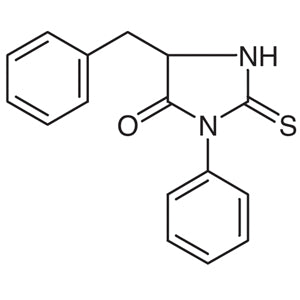
Phenylthiohydantoin-tyrosine is a chemical compound widely used in laboratory settings for the synthesis of complex molecules. This compound belongs to the category of heterocyclic building blocks, which are essential in organic chemistry for constructing diverse molecular structures. Its unique chemical structure enables it to participate in various reactions, making it a versatile tool for researchers working on advanced chemical synthesis. In the laboratory, it plays a crucial role in the development of bioactive compounds, particularly in pharmacological and biochemical studies.
The compound is valued for its high reactivity and stability under specific conditions, which makes it a preferred choice for synthetic chemists. Its ability to form new bonds with different substrates allows for the creation of a wide range of derivatives. Additionally, its participation in substitution and hydrolysis reactions enhances its utility in complex chemical transformations. These properties make it an essential component in the toolkit of any research laboratory focused on molecular design and functional group manipulation.
In Indonesian laboratories, Phenylthiohydantoin-tyrosine is commonly used in scientific research across various institutions. It is particularly favored in studies related to drug development, molecular biology, and chemical synthesis. Its reliability and effectiveness in controlled chemical environments make it a go-to material for researchers seeking precision and reproducibility in their experiments.
TCI brochures (PDF)
- Amino Acids and Peptide Synthesis Reagents 2025-08-14 · p. 22
Related TCI products
- TCI P0756 4333-22-6 Phenylthiohydantoin-norleucine
- TCI P0731 182153-75-9 Phenylthiohydantoin-arginine Hydrochloride
- TCI P0729 4333-21-5 Phenylthiohydantoin-proline
- TCI P0625 29635-94-7 Phenylthiohydantoin-(Nepsilon-phenylthiocarbamyl)-lysine
- TCI P0379 4333-20-4 Phenylthiohydantoin-valine
- TCI P0378 5789-24-2 Phenylthiohydantoin-tryptophan
- Used in pharmaceutical research for the synthesis of bioactive compounds due to its reactivity and structural versatility.
- Applied in biochemical studies to investigate enzyme mechanisms and substrate interactions through its ability to form new chemical bonds.
- Utilized in organic synthesis to create complex molecules by participating in substitution and hydrolysis reactions.
- Employed in molecular modeling and design to explore the behavior of heterocyclic structures in different chemical environments.
- Integrated into drug discovery programs to develop novel therapeutics by modifying its molecular framework for improved biological activity.
| Brand | TCI |
|---|---|
| CAS number | 4332-95-0 |
| Molecular formula | — |
| Purity | — |
| Category | Chemistry > Building Blocks > Heterocyclic Building Blocks |
| Pack sizes | Available in standard laboratory quantities |
| Physical form | Solid powder |
| Storage | Store in a cool, dry place away from light and moisture |
Phenylthiohydantoin-tyrosine should be stored in a cool, dry environment to maintain its chemical stability. It is recommended to keep the compound in airtight containers to prevent exposure to moisture and air, which may affect its reactivity. The material should be stored away from direct sunlight and sources of heat to avoid degradation. In laboratory settings, it is important to handle the compound with appropriate personal protective equipment, such as gloves and safety goggles, to ensure safe handling. Proper labeling of storage containers is essential for easy identification and safe access. Regular monitoring of storage conditions will help maintain the integrity and effectiveness of the compound for research applications.
—
Product Categories
Produk Terkait
-
Phenylthiohydantoin-norleucine TCI P0756
Regular price Rp 689.850,00Regular price -
Phenylthiohydantoin-arginineHydrochloride TCI P0731
Regular price Rp 1.273.650,00Regular price -
Phenylthiohydantoin-proline TCI P0729
Regular price Rp 584.850,00Regular price -
Phenylthiohydantoin-(Nepsilon-phenylthiocarbamyl)-lysine TCI P0625
Regular price From Rp 743.400,00Regular price -
Phenylthiohydantoin-valine TCI P0379
Regular price Rp 637.350,00Regular price -
Phenylthiohydantoin-tryptophan TCI P0378
Regular price From Rp 1.140.300,00Regular price -
Phenylthiohydantoin-glycine TCI P0376
Regular price Rp 1.115.100,00Regular price -
Phenylthiohydantoin-phenylalanine TCI P0367
Regular price From Rp 505.050,00Regular price