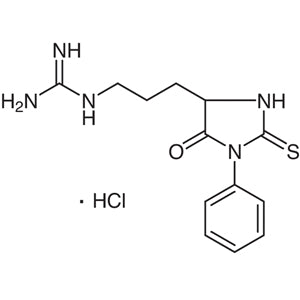
Phenylthiohydantoin-arginine Hydrochloride is a chemical compound widely used in laboratory settings for the synthesis of complex molecules. As a heterocyclic building block, it plays a crucial role in organic and biochemical research by enabling the formation of new chemical bonds through substitution reactions. This compound is particularly valuable in the development of pharmaceuticals and bioactive molecules due to its structural versatility and reactivity. Its unique chemical structure allows it to participate in a variety of synthetic pathways, making it an essential tool for researchers seeking to create compounds with specific functional groups.
The compound is known for its chemical stability and high reactivity, which are key factors in its popularity among chemists. These properties ensure that it remains effective across a range of experimental conditions, allowing for consistent results in synthetic processes. Its ability to interact with various molecules during chemical reactions enhances its utility in the creation of complex organic structures. This makes it a preferred choice for laboratories aiming to conduct precise and controlled chemical syntheses.
In Indonesian laboratories, Phenylthiohydantoin-arginine Hydrochloride is commonly used in organic chemistry, pharmaceutical research, and biochemical studies. Its availability supports the execution of experiments requiring specific structural components, facilitating the development of new drugs and bioactive compounds. The compound's role in these fields underscores its importance in advancing scientific research in Indonesia.
TCI brochures (PDF)
- Amino Acids and Peptide Synthesis Reagents 2025-08-14 · p. 23
Related TCI products
- TCI P0756 4333-22-6 Phenylthiohydantoin-norleucine
- TCI P0729 4333-21-5 Phenylthiohydantoin-proline
- TCI P0625 29635-94-7 Phenylthiohydantoin-(Nepsilon-phenylthiocarbamyl)-lysine
- TCI P0379 4333-20-4 Phenylthiohydantoin-valine
- TCI P0378 5789-24-2 Phenylthiohydantoin-tryptophan
- TCI P0376 2010-15-3 Phenylthiohydantoin-glycine
- Organic synthesis projects benefit from this compound's ability to form stable intermediates in complex molecule creation.
- Pharmaceutical research utilizes it for the development of drug candidates with specific functional groups and molecular structures.
- Biochemical experiments leverage its reactivity in enzyme-substrate interactions and molecular recognition studies.
- Structural chemistry studies employ it to explore heterocyclic ring systems and their reactivity in synthetic pathways.
- Analytical chemistry applications use it as a standard for evaluating reaction mechanisms and synthetic efficiency.
| Brand | TCI |
|---|---|
| CAS number | 182153-75-9 |
| Molecular formula | — |
| Purity | — |
| Category | Chemistry > Building Blocks > Heterocyclic Building Blocks |
| Pack sizes | Available in various quantities as per standard laboratory supply |
| Physical form | Solid powder |
| Storage | Store in a cool, dry place away from light and moisture |
Phenylthiohydantoin-arginine Hydrochloride should be stored in a cool, dry environment to maintain its chemical stability. It is recommended to keep the compound in airtight containers to prevent exposure to moisture and air, which could affect its reactivity. Proper labeling of storage containers is essential for safe handling and easy identification. In laboratory settings, it is important to follow standard safety protocols, including the use of personal protective equipment when handling the compound. Avoid direct contact with skin and eyes, and ensure adequate ventilation in the workspace to minimize any potential risks associated with its use.
—
Product Categories
Produk Terkait
-
Phenylthiohydantoin-norleucine TCI P0756
Regular price Rp 689.850,00Regular price -
Phenylthiohydantoin-proline TCI P0729
Regular price Rp 584.850,00Regular price -
Phenylthiohydantoin-(Nepsilon-phenylthiocarbamyl)-lysine TCI P0625
Regular price From Rp 743.400,00Regular price -
Phenylthiohydantoin-valine TCI P0379
Regular price Rp 637.350,00Regular price -
Phenylthiohydantoin-tryptophan TCI P0378
Regular price From Rp 1.140.300,00Regular price -
Phenylthiohydantoin-glycine TCI P0376
Regular price Rp 1.115.100,00Regular price -
Phenylthiohydantoin-tyrosine TCI P0368
Regular price From Rp 505.050,00Regular price -
Phenylthiohydantoin-phenylalanine TCI P0367
Regular price From Rp 505.050,00Regular price