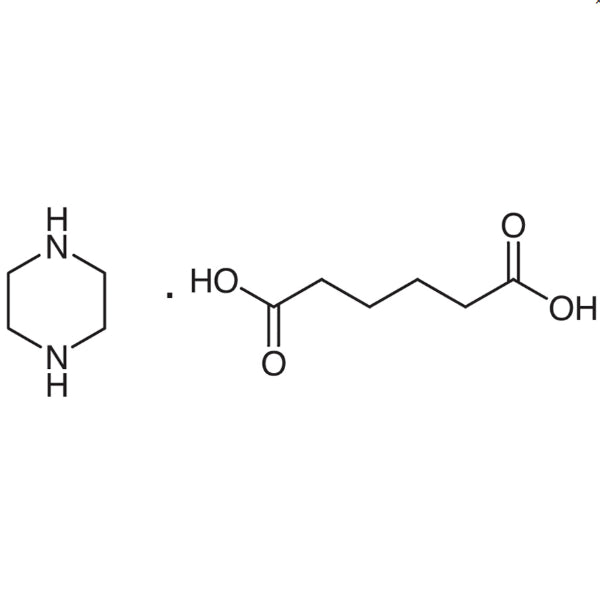
Piperazine Adipate is a chemical compound widely used as a building block in the synthesis of heterocyclic compounds. It plays a crucial role in laboratory settings, particularly in organic chemistry and pharmaceutical research, where it serves as a versatile intermediate for creating complex molecular structures. Its unique molecular structure allows it to participate in various chemical reactions, making it an essential component in the development of new compounds with diverse applications. In Indonesian laboratories, this compound is frequently utilized to support research in drug discovery, polymer synthesis, and industrial chemical production.
Piperazine Adipate is valued for its chemical stability and high reactivity, which enable it to engage in a range of reactions such as substitution, coupling, and ring closure. These properties make it a preferred choice for researchers seeking reliable and effective reagents. Its ability to undergo multiple chemical transformations without significant degradation ensures consistent results in experimental processes. Additionally, Piperazine Adipate is available in various packaging formats, making it convenient for use in both small-scale and large-scale laboratory applications.
In Indonesian laboratories, Piperazine Adipate is commonly used in organic chemistry research, especially in academic institutions and research centers. It is an important material for students and scientists working on projects related to drug development, material science, and chemical synthesis. Its availability and functional versatility make it a go-to compound for a wide range of experimental needs in the chemical and pharmaceutical industries.
TCI brochures (PDF)
- Polyamines 2025-10-21 · p. 3
- Organic synthesis in pharmaceutical research due to its ability to form complex heterocyclic structures.
- Polymer development for industrial applications because of its reactivity and structural versatility.
- Drug discovery projects where it serves as a key intermediate in the synthesis of bioactive compounds.
- Chemical research in academic laboratories for teaching and experimental purposes.
- Industrial chemical production where it is used as a building block for various chemical compounds.
| Brand | TCI |
|---|---|
| CAS number | 142-88-1 |
| Molecular formula | — |
| Purity | — |
| Category | Chemistry > Building Blocks > Heterocyclic Building Blocks |
| Pack sizes | Available in various sizes as per standard laboratory requirements |
| Physical form | Solid (exact form may vary depending on packaging) |
| Storage | Store in a cool, dry place away from moisture and direct sunlight |
Piperazine Adipate should be stored in a cool, dry environment to maintain its chemical stability and prevent degradation. It is recommended to keep it in airtight containers to avoid exposure to moisture and air, which could affect its reactivity. Suitable storage conditions include a temperature range of 15–25°C with low humidity levels. When handling, it is important to use appropriate personal protective equipment such as gloves and safety goggles to ensure safety. This compound should be kept away from incompatible materials to prevent any potential chemical reactions. Proper labeling and storage practices help ensure the safety of laboratory personnel and the integrity of the compound.
—
Produk Terkait
-
N-(2-Aminoethyl)piperazine TCI A0304
Regular price From Rp 505.050,00Regular price -
1-(o-Tolyl)piperazine TCI T3404
Regular price From Rp 1.670.550,00Regular price -
1-(2-Thiazolyl)piperazine TCI T3273
Regular price Rp 1.326.150,00Regular price -
1-(p-Tolyl)piperazine TCI T2956
Regular price From Rp 1.298.850,00Regular price -
1-(Tetrahydro-2-furoyl)piperazine TCI T2617
Regular price From Rp 769.650,00Regular price -
1-(m-Tolyl)piperazine TCI T2260
Regular price From Rp 1.431.150,00Regular price -
1,4-Bis(2-hydroxyethyl)piperazine TCI B4903
Regular price From Rp 848.400,00Regular price -
1-(tert-Butoxycarbonyl)piperazine TCI B2415
Regular price From Rp 1.696.800,00Regular price