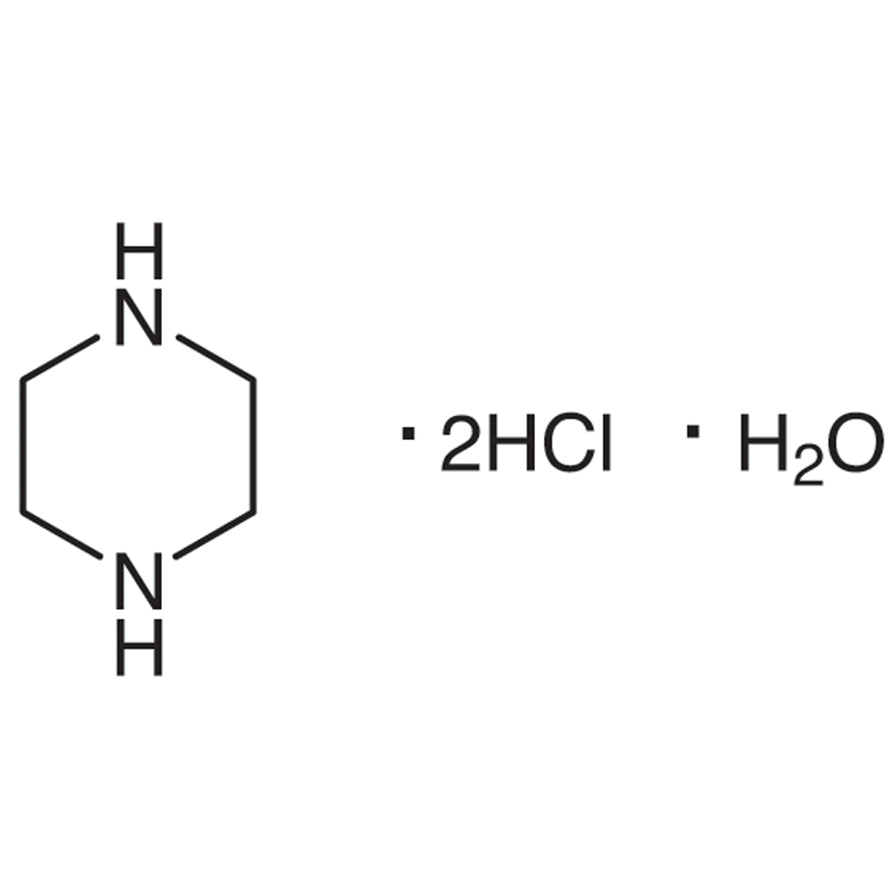
Piperazine Dihydrochloride Monohydrate is a chemical compound widely used in laboratory settings for its versatility in chemical reactions. It serves as a key building block in the synthesis of heterocyclic compounds and complex organic molecules. This compound is particularly valuable in the field of medicinal chemistry and pharmaceutical research due to its structural characteristics. The presence of two nitrogen atoms in its six-membered ring makes it a versatile intermediate for the development of bioactive compounds. Its chemical stability under normal conditions ensures reliable performance in various experimental setups.
This compound is preferred for its solubility in both organic solvents and water, which facilitates its use in a wide range of chemical processes. Its reactivity with both organic and inorganic reagents allows it to participate in diverse synthetic pathways. The presence of chloride ions in its structure enhances its reactivity in different reaction conditions, making it a valuable reagent in organic synthesis. Its compatibility with various solvents and reagents makes it a go-to choice for chemists seeking reliable and efficient chemical intermediates.
In Indonesian laboratories, Piperazine Dihydrochloride Monohydrate is commonly used in chemical research, pharmaceutical development, and material science. It is a staple in academic and industrial research settings, supporting the creation of new compounds and formulations. Its role in drug discovery and the development of agrochemicals is particularly significant. Institutions across Indonesia rely on this compound for experimental purposes, contributing to scientific advancements and innovation in various fields.
TCI brochures (PDF)
- Polyamines 2025-10-21 · p. 3
Related TCI products
- Medicinal Chemistry Research: This compound is ideal for synthesizing bioactive molecules due to its reactivity and structural versatility.
- Organic Synthesis: Its solubility in both water and organic solvents makes it suitable for a wide range of synthetic reactions.
- Pharmaceutical Development: It is frequently used in the creation of drug molecules, especially those targeting neurological and cardiovascular systems.
- Agrochemical Formulation: Its chemical stability and reactivity support the development of effective pesticides and herbicides.
- Material Science Innovation: It is used in the synthesis of functional materials, contributing to advancements in polymer and nanotechnology research.
| Brand | TCI |
|---|---|
| CAS number | 142-64-3 |
| Molecular formula | — |
| Purity | — |
| Category | Chemistry > Building Blocks > Heterocyclic Building Blocks |
| Pack sizes | Available in various quantities as per standard laboratory supply |
| Physical form | Solid, crystalline powder |
| Storage | Store in a cool, dry place away from moisture and direct sunlight |
Piperazine Dihydrochloride Monohydrate should be stored in a cool, dry environment to maintain its chemical stability. It is recommended to keep it in airtight containers to prevent moisture absorption, which could affect its reactivity and purity. The compound is generally non-hazardous under normal conditions but should be handled with care to avoid direct contact with skin or eyes. In laboratory settings, it is advisable to use appropriate personal protective equipment such as gloves and safety goggles. Proper ventilation should be ensured when working with this compound to minimize exposure to airborne particles. Its reactivity with various reagents means it should be stored separately from incompatible substances to ensure safety and effectiveness in experimental use.
—
Produk Terkait
-
1-(2-Pyrimidyl)piperazineDihydrochloride TCI P1119
Regular price Rp 2.359.350,00Regular price -
N-(2-Aminoethyl)piperazine TCI A0304
Regular price From Rp 505.050,00Regular price -
1-(o-Tolyl)piperazine TCI T3404
Regular price From Rp 1.670.550,00Regular price -
1-(2-Thiazolyl)piperazine TCI T3273
Regular price Rp 1.326.150,00Regular price -
1-(p-Tolyl)piperazine TCI T2956
Regular price From Rp 1.298.850,00Regular price -
1-(Tetrahydro-2-furoyl)piperazine TCI T2617
Regular price From Rp 769.650,00Regular price -
1-(m-Tolyl)piperazine TCI T2260
Regular price From Rp 1.431.150,00Regular price -
1,4-Bis(2-hydroxyethyl)piperazine TCI B4903
Regular price From Rp 848.400,00Regular price