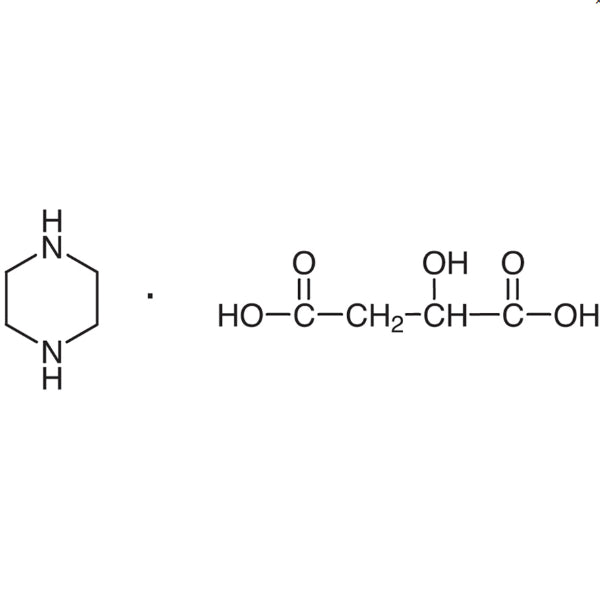
Piperazine DL-Malate TCI P0451 is a chemical compound widely used in laboratory settings for its versatility in chemical reactions and molecular synthesis. As a heterocyclic building block, it plays a crucial role in the development of complex organic molecules and pharmaceutical compounds. Its unique structure allows it to participate in various synthetic pathways, making it an essential reagent for researchers working in medicinal chemistry and organic synthesis. This compound is commonly found in academic and industrial laboratories where the creation of new chemical entities is a priority.
The chemical properties of Piperazine DL-Malate contribute to its popularity among chemists. It exhibits stability under normal laboratory conditions and is soluble in specific organic solvents such as ethylamine and acetone. These characteristics facilitate efficient mixing and reaction processes with other reagents, enhancing the reproducibility and success rate of chemical experiments. Its solubility and reactivity make it a preferred choice for those aiming to optimize synthetic procedures and achieve consistent results.
In Indonesian laboratories, Piperazine DL-Malate is extensively used in pharmaceutical research, organic chemistry, and biochemical studies. It is a key component in experiments focused on the synthesis of bioactive compounds and the evaluation of their biological activities. Its application spans across various research institutions and universities, supporting the development of new drugs and chemical materials. The compound’s reliability and effectiveness make it a staple in both academic and industrial research environments.
TCI brochures (PDF)
- Polyamines 2025-10-21 · p. 3
- Pharmaceutical synthesis of compounds requiring heterocyclic structures for specific biological activities
- Organic chemistry research involving the development of new chemical entities and functional groups
- Biochemical experiments aimed at testing the activity of synthesized molecules against biological targets
- Industrial chemical production processes requiring stable and reactive building blocks
- Academic research in medicinal chemistry focused on drug discovery and molecular design
| Brand | TCI |
|---|---|
| CAS number | 14852-14-3 |
| Molecular formula | — |
| Purity | — |
| Category | Chemistry > Building Blocks > Heterocyclic Building Blocks |
| Pack sizes | Available in various sizes as per supplier specifications |
| Physical form | Solid (as per standard product description) |
| Storage | Store in a cool, dry place away from direct sunlight |
Piperazine DL-Malate should be stored in a cool, dry environment to maintain its chemical stability. It is recommended to keep the compound in a tightly sealed container to prevent exposure to moisture and air. Suitable storage containers include glass or high-density polyethylene bottles, which are resistant to chemical degradation. Laboratory personnel should handle the compound with care, using appropriate personal protective equipment such as gloves and safety goggles. It is important to ensure that the compound is stored away from incompatible substances to avoid any potential chemical reactions. Proper labeling of storage containers is essential to ensure safe handling and prevent accidental exposure.
—
Produk Terkait
-
N-(2-Aminoethyl)piperazine TCI A0304
Regular price From Rp 505.050,00Regular price -
1-(o-Tolyl)piperazine TCI T3404
Regular price From Rp 1.670.550,00Regular price -
1-(2-Thiazolyl)piperazine TCI T3273
Regular price Rp 1.326.150,00Regular price -
1-(p-Tolyl)piperazine TCI T2956
Regular price From Rp 1.298.850,00Regular price -
1-(Tetrahydro-2-furoyl)piperazine TCI T2617
Regular price From Rp 769.650,00Regular price -
1-(m-Tolyl)piperazine TCI T2260
Regular price From Rp 1.431.150,00Regular price -
1,4-Bis(2-hydroxyethyl)piperazine TCI B4903
Regular price From Rp 848.400,00Regular price -
1-(tert-Butoxycarbonyl)piperazine TCI B2415
Regular price From Rp 1.696.800,00Regular price