

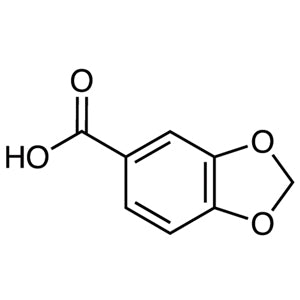
Piperonylic Acid is a chemical compound widely used in various chemical experiments and scientific research. It plays a crucial role in laboratory settings by participating in specific chemical reactions, particularly in the synthesis of aromatic compounds and their derivatives. As a foundational reagent, it is commonly utilized in the development of pharmaceutical compounds, fragrance materials, and chemical analysis reagents. Its unique molecular structure allows it to serve as a versatile tool for researchers aiming to explore chemical reactivity and molecular behavior.
The chemical properties of Piperonylic Acid make it a preferred choice for laboratory applications. It is chemically stable under certain conditions, although it is highly sensitive to high temperatures and exposure to air. The compound is colorless and possesses a distinct aroma, which facilitates its identification during analytical processes. Its resistance to degradation ensures consistent performance in experiments, making it a reliable reagent for long-term use. These characteristics contribute to its widespread adoption in both academic and industrial research environments.
In Indonesian laboratories, Piperonylic Acid is frequently used in organic synthesis experiments and chemical analysis. It is commonly found in research institutions and chemical laboratories across universities and research organizations. Its role in creating complex molecular structures and supporting analytical techniques makes it an essential component of many scientific investigations in the country.
- Organic synthesis experiments benefit from Piperonylic Acid due to its role in forming aromatic compounds and derivatives, enabling the creation of complex molecular structures.
- Chemical analysis procedures utilize Piperonylic Acid for its distinct aroma and colorless nature, aiding in the identification and characterization of compounds.
- Pharmaceutical research incorporates Piperonylic Acid in the development of new drug compounds, leveraging its reactivity in synthetic pathways.
- Aroma compound development relies on Piperonylic Acid for its contribution to the synthesis of fragrance materials used in perfumery and flavoring industries.
- Analytical chemistry applications use Piperonylic Acid as a reference standard for testing and quantifying other chemical substances in laboratory settings.
| Brand | TCI |
|---|---|
| CAS number | 94-53-1 |
| Molecular formula | — |
| Purity | — |
| Category | TCI |
| Pack sizes | Available in various quantities as per standard laboratory supply practices |
| Physical form | Solid or liquid, depending on the specific product variant |
| Storage | Store in a cool, dry place away from direct sunlight and moisture |
Piperonylic Acid should be stored in a cool, dry environment to maintain its chemical stability. It is recommended to keep it in airtight containers to prevent exposure to air and moisture, which can affect its integrity. Due to its sensitivity to high temperatures, it should be stored away from heat sources and direct sunlight. Laboratory personnel should handle the compound with care, using appropriate personal protective equipment such as gloves and safety goggles. Proper ventilation is essential when working with Piperonylic Acid to minimize inhalation risks. Regular monitoring of storage conditions ensures the compound remains safe and effective for use in scientific research.
—
Produk Terkait
-
Piperonylacetone TCI P1089
Regular price Rp 2.227.050,00Regular price -
Piperonylonitrile TCI P1074
Regular price From Rp 903.000,00Regular price -
Piperonylamine TCI P1057
Regular price Rp 2.545.200,00Regular price -
1-Piperonylpiperazine TCI P1041
Regular price From Rp 1.140.300,00Regular price


