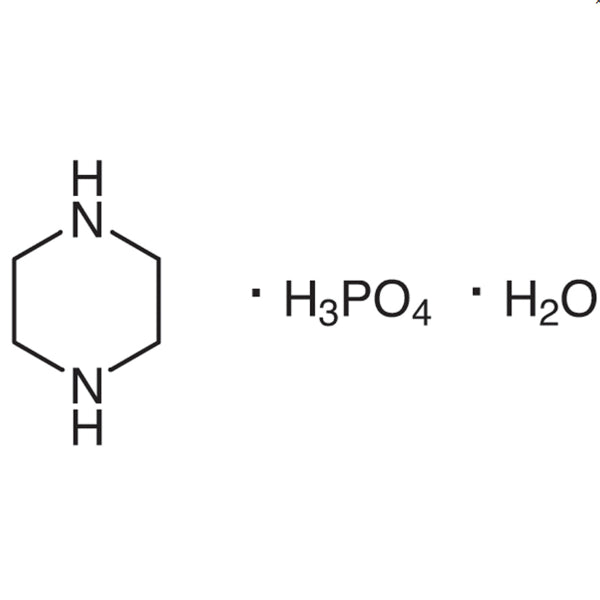
Piperazine Phosphate Monohydrate (TCI P0492) is a chemical compound widely used in laboratory settings for its versatility in chemical reactions and organic synthesis. As a phosphate salt of piperazine, it plays a crucial role in various synthetic processes where phosphate functionality is required. Its heterocyclic structure contributes to its reactivity, making it an essential component in both research and industrial applications. This compound is particularly valued for its ability to participate in reactions that involve phosphate groups, offering stability and reactivity under controlled laboratory conditions.
The compound is known for its high solubility in water and its reactivity towards a variety of reagents, which makes it a preferred choice for synthetic chemists. Its monohydrate form ensures ease of handling and storage, as it does not contain excess water that could lead to degradation. The chemical stability of Piperazine Phosphate Monohydrate under specific conditions further enhances its utility in laboratory environments. These properties make it a reliable and efficient reagent for a wide range of chemical processes.
In Indonesian laboratories, Piperazine Phosphate Monohydrate is commonly used in chemical research, especially in organic synthesis and analytical chemistry. It is a key reagent in the development of complex compounds and is frequently utilized in academic and research institutions. Its availability and reliability have made it a standard material in many laboratory workflows, supporting both teaching and advanced research activities.
TCI brochures (PDF)
- Polyamines 2025-10-21 · p. 3
- Organic synthesis where phosphate functionality is required for the formation of complex molecules.
- Catalytic reactions that benefit from the reactivity of phosphate groups in heterocyclic compounds.
- Analytical chemistry applications involving the detection and quantification of phosphate-containing compounds.
- Research in pharmaceutical development, where Piperazine Phosphate Monohydrate is used as a building block for drug synthesis.
- Educational settings where students learn about heterocyclic chemistry and its applications in laboratory practice.
| Brand | TCI |
|---|---|
| CAS number | 18534-18-4 |
| Molecular formula | — |
| Purity | — |
| Category | Chemistry > Building Blocks > Heterocyclic Building Blocks |
| Pack sizes | Available in various quantities as per supplier specifications |
| Physical form | Monohydrate powder |
| Storage | Store in a cool, dry place away from moisture and direct sunlight |
Piperazine Phosphate Monohydrate should be stored in a cool, dry environment to maintain its chemical stability. It is recommended to keep it in a sealed container to prevent exposure to moisture, which could affect its integrity. The compound is generally stable under normal laboratory conditions but should be handled with care to avoid contamination. It is advisable to store it away from incompatible substances such as strong acids or bases. Proper labeling and storage conditions ensure the safety and effectiveness of the material in laboratory use. Always follow standard chemical handling procedures to minimize risks associated with its reactivity.
—
Produk Terkait
-
N-(2-Aminoethyl)piperazine TCI A0304
Regular price Rp 557.550,00Regular priceRp 405.300,00Sale price Rp 557.550,00 -
1-(o-Tolyl)piperazine TCI T3404
Regular price Rp 1.723.050,00Regular priceRp 1.220.100,00Sale price Rp 1.723.050,00 -
1-(2-Thiazolyl)piperazine TCI T3273
Regular price Rp 1.378.650,00Regular priceRp 979.650,00Sale price Rp 1.378.650,00 -
1-(p-Tolyl)piperazine TCI T2956
Regular price Rp 1.351.350,00Regular priceRp 960.750,00Sale price Rp 1.351.350,00 -
1-(Tetrahydro-2-furoyl)piperazine TCI T2617
Regular price Rp 822.150,00Regular priceRp 590.100,00Sale price Rp 822.150,00 -
1-(m-Tolyl)piperazine TCI T2260
Regular price Rp 1.483.650,00Regular priceRp 1.053.150,00Sale price Rp 1.483.650,00 -
1,4-Bis(2-hydroxyethyl)piperazine TCI B4903
Regular price Rp 900.900,00Regular priceRp 645.750,00Sale price Rp 900.900,00 -
1-(tert-Butoxycarbonyl)piperazine TCI B2415
Regular price Rp 1.749.300,00Regular priceRp 1.239.000,00Sale price Rp 1.749.300,00