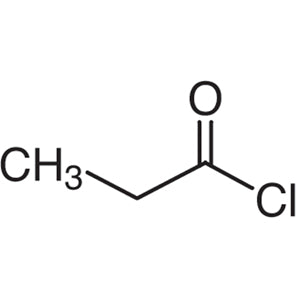
Propionyl Chloride (TCI P0516), with CAS number 79-03-8, is a chemical compound widely used in laboratory settings for its reactivity and versatility. It serves as a fundamental building block in organic synthesis, particularly in the creation of esters and other functional groups. Its simple chemical structure makes it an essential reagent for chemists working on both basic and applied research. This compound is commonly found in chemical laboratories across Indonesia, where it supports a wide range of experimental processes and scientific investigations.
Propionyl Chloride is known for its high reactivity, primarily due to the presence of the chloro group, which readily participates in nucleophilic substitution reactions. Its ability to react with various organic compounds makes it a preferred choice for chemists aiming to achieve high efficiency and speed in their experiments. The compound also exhibits a high boiling point, which is important for maintaining reaction conditions during synthesis. Its corrosive nature requires careful handling, but this reactivity is precisely what makes it valuable in laboratory applications.
In Indonesian laboratories, Propionyl Chloride is extensively used in both academic and industrial research settings. It is particularly relevant for universities, research institutions, and pharmaceutical companies that require reliable and effective chemical reagents for their work. Its role in the synthesis of esters and other organic compounds is critical for advancing chemical research and development in the region.
- High Reactivity Ester Synthesis: Propionyl Chloride is ideal for ester synthesis due to its reactivity and ability to form ester bonds efficiently.
- Nucleophilic Substitution Reactions: Its chloro group makes it a suitable reagent for nucleophilic substitution, enabling the formation of various organic compounds.
- Organic Chemistry Research: It is widely used in research settings for the development of new compounds and the study of chemical reactions.
- Pharmaceutical Development: Its role in synthesizing organic compounds makes it valuable in the pharmaceutical industry for drug development.
- Educational Purposes: It is commonly used in academic laboratories to teach fundamental organic chemistry concepts and reaction mechanisms.
| Brand | TCI |
|---|---|
| CAS number | 79-03-8 |
| Molecular formula | — |
| Purity | — |
| Category | Chemistry > Building Blocks > Non-Heterocyclic Building Blocks |
| Pack sizes | Available in various sizes as per supplier specifications |
| Physical form | Liquid |
| Storage | Store in a cool, dry place away from moisture and direct sunlight |
Propionyl Chloride should be stored in a cool, dry location, away from moisture and direct sunlight. It is recommended to use airtight containers made of materials resistant to chemical corrosion, such as glass or high-density polyethylene. Due to its corrosive nature, it is essential to handle this compound with appropriate personal protective equipment, including gloves, goggles, and a lab coat. In laboratory settings, it should be kept in a well-ventilated area to prevent inhalation of vapors. Always ensure that spill containment measures are in place to minimize exposure and maintain a safe working environment.
—
Produk Terkait
-
TCI B5774 5,10-Bis(4,4,5,5-tetramethyl-1,3,2-dioxaborolan-2-yl)naphtho[1,2-c:5,6-c']bis([1,2,5]oxadiazole)
Regular price Rp 10.255.350,00Regular price -
Dihydroiodide TCI B6569
Regular price From Rp 1.936.200,00Regular price -
Trifluoromethanesulfonate TCI B7003
Regular price From Rp 1.936.200,00Regular price
![5,10-Bis(4,4,5,5-tetramethyl-1,3,2-dioxaborolan-2-yl)naphtho[1,2-c:5,6-c']bis([1,2,5]oxadiazole) - TCI B5774 - AMI Scientific](http://amiscientific.com/cdn/shop/files/TCI2510B5774.jpg?v=1769180228&width=533)