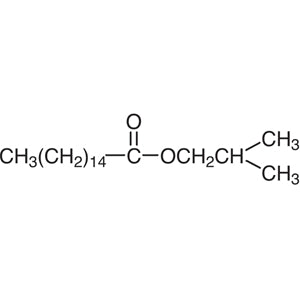
Isobutyl Palmitate (TCI P0651), with CAS number 110-34-9, is a chemical compound widely utilized in laboratory settings for its versatility and stability. It belongs to the category of Chemistry > Building Blocks > Non-Heterocyclic Building Blocks, making it a fundamental component in organic synthesis. This compound is commonly used as a building block for the creation of more complex organic molecules. Its molecular structure consists of a long hydrocarbon chain and an ester group, which contributes to its functional properties. Due to its chemical stability and non-reactive nature, it is a reliable choice for various chemical reactions and experiments.
Isobutyl Palmitate is a non-polar compound with a relatively high melting point, which makes it a liquid at room temperature. These physical properties make it ideal for use in mixing and synthesis processes where a stable and non-reactive medium is required. Its non-polar nature allows it to be compatible with a variety of solvents and reagents, enhancing its utility in laboratory applications. Additionally, it does not contain harmful or toxic substances, ensuring a safe working environment. This combination of chemical stability and physical properties makes it a preferred choice for laboratory use.
In Indonesian laboratories, Isobutyl Palmitate is frequently used in research and development activities, particularly in the fields of pharmacy and cosmetics. It is often employed as a raw material in the synthesis of various compounds, contributing to the advancement of scientific studies. Its neutral and stable nature also makes it suitable for experiments requiring materials that do not degrade easily. As a result, it plays a significant role in supporting scientific research and innovation in the region.
- Organic synthesis applications benefit from Isobutyl Palmitate due to its stability and non-reactive nature, making it a reliable building block for complex molecule creation.
- In pharmaceutical research, it is used as a raw material for the development of new drug compounds, providing a stable and safe medium for chemical reactions.
- Cosmetic formulation processes utilize Isobutyl Palmitate for its non-polar properties, allowing it to blend well with other ingredients and enhance product stability.
- It is suitable for use in analytical chemistry experiments where a stable and inert substance is required to avoid unwanted chemical interactions.
- In material science research, Isobutyl Palmitate is employed as a component in the synthesis of polymers and other advanced materials due to its structural versatility.
| Brand | TCI |
|---|---|
| CAS number | 110-34-9 |
| Molecular formula | — |
| Purity | — |
| Category | Chemistry > Building Blocks > Non-Heterocyclic Building Blocks |
| Pack sizes | Available in various quantities as per standard laboratory supply |
| Physical form | Liquid at room temperature |
| Storage | Store in a cool, dry place away from direct sunlight and heat sources |
Isobutyl Palmitate should be stored in a cool, dry environment, away from direct sunlight and heat sources to maintain its stability and prevent degradation. It is recommended to use airtight containers made of materials that do not react with the compound, such as glass or high-density polyethylene. Since it is a non-polar substance, it does not absorb moisture easily, but proper sealing is still essential to prevent contamination. In laboratory settings, it is important to handle the compound with care, using appropriate personal protective equipment such as gloves and safety goggles. Due to its non-toxic nature, it is generally safe to handle, but standard laboratory safety protocols should still be followed to ensure a secure working environment.
—
Produk Terkait
-
TCI B5774 5,10-Bis(4,4,5,5-tetramethyl-1,3,2-dioxaborolan-2-yl)naphtho[1,2-c:5,6-c']bis([1,2,5]oxadiazole)
Regular price Rp 10.255.350,00Regular price -
Dihydroiodide TCI B6569
Regular price From Rp 1.936.200,00Regular price -
Trifluoromethanesulfonate TCI B7003
Regular price From Rp 1.936.200,00Regular price
![5,10-Bis(4,4,5,5-tetramethyl-1,3,2-dioxaborolan-2-yl)naphtho[1,2-c:5,6-c']bis([1,2,5]oxadiazole) - TCI B5774 - AMI Scientific](http://amiscientific.com/cdn/shop/files/TCI2510B5774.jpg?v=1769180228&width=533)