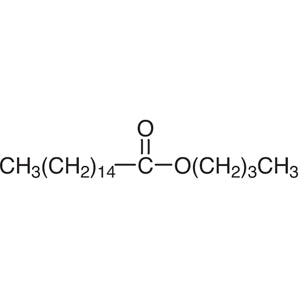
Butyl Palmitate from TCI is an ester made from palmitic acid, a saturated sixteen-carbon fatty acid, and n-butanol. It belongs to the fatty acid ester family, which is common in cosmetic formulations, lubricants, and plasticizers. In the laboratory, butyl palmitate is used as a non-heterocyclic building block, a reference material in lipid analysis, and a model compound for studying the behaviour of long-chain esters. Its simple, well-defined structure makes it useful for both fundamental and applied oleochemical research.
Researchers choose butyl palmitate because it is hydrophobic, has a lower viscosity than triglycerides, and is fairly chemically stable under normal storage conditions. Its long alkyl chain gives it good lubricating and emollient properties, and its ester group can still be hydrolysed or transesterified when an experiment calls for it. These traits make it a good comparison compound in biodiesel studies, research on phase-change thermal storage materials, and topical formulation work. When the compound serves as a chromatographic standard, the defined purity of a reagent supplier matters a great deal.
Indonesia is a major producer of palm oil and its derivatives, so palmitic acid esters are especially relevant to local research. University laboratories, oleochemical research centres, and industrial quality control units often work with fatty acid esters to characterise palm-based products, develop biodiesel, and formulate personal care products. Butyl palmitate from a trusted reagent brand gives these laboratories a consistent reference compound. That helps when they compare analytical results, validate methods, and run reproducible synthesis or formulation experiments.
- Lipid and fatty acid ester analysis: butyl palmitate is a well-defined reference compound, which helps laboratories identify and compare long-chain esters in chromatographic and spectroscopic methods.
- Biodiesel research: it is a fatty acid ester derived from palmitic acid, so it makes a relevant comparison compound when studying the properties and behaviour of palm-based biodiesel components.
- Phase-change thermal storage studies: its long saturated alkyl chain and defined structure make it suitable for research on ester-based materials that store and release heat through phase transitions.
- Cosmetic and topical formulation development: its emollient character, hydrophobicity, and lower viscosity than triglycerides make it a useful model ingredient for formulation and texture studies.
- Organic synthesis as a non-heterocyclic building block: its ester group can be hydrolysed or transesterified, so researchers can use it as a starting material or model substrate in ester chemistry.
| Brand | TCI (product code P0649) |
|---|---|
| CAS number | 111-06-8 |
| Molecular formula | — |
| Purity | — |
| Category | Chemistry > Building Blocks > Non-Heterocyclic Building Blocks |
| Pack sizes | see the available options on the product page |
| Physical form | refer to the manufacturer's product documentation |
| Storage | keep tightly closed in a cool, dry place away from strong oxidizing agents |
Store butyl palmitate in its original, tightly sealed container in a cool, dry, well-ventilated area, away from direct sunlight, heat sources, and strong oxidizing agents. Glass or other chemically compatible containers work best if the material needs to be transferred, and every container should be clearly labelled. Wear standard laboratory protective equipment when handling it, including safety glasses, gloves, and a lab coat. Avoid contact with skin and eyes, and do not breathe in vapours or mists. Work in a well-ventilated area or under a fume hood when heating the material. Follow the manufacturer's Safety Data Sheet and local regulations for safe handling, spill cleanup, and disposal.
—
Produk Terkait
-
TCI B5774 5,10-Bis(4,4,5,5-tetramethyl-1,3,2-dioxaborolan-2-yl)naphtho[1,2-c:5,6-c']bis([1,2,5]oxadiazole)
Regular price Rp 10.255.350,00Regular price -
Dihydroiodide TCI B6569
Regular price From Rp 1.936.200,00Regular price -
Trifluoromethanesulfonate TCI B7003
Regular price From Rp 1.936.200,00Regular price
![5,10-Bis(4,4,5,5-tetramethyl-1,3,2-dioxaborolan-2-yl)naphtho[1,2-c:5,6-c']bis([1,2,5]oxadiazole) - TCI B5774 - AMI Scientific](http://amiscientific.com/cdn/shop/files/TCI2510B5774.jpg?v=1769180228&width=533)