


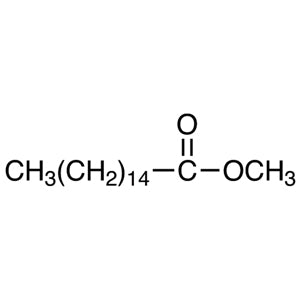
Methyl Palmitate from TCI (product code P0006) is the methyl ester of palmitic acid, a saturated sixteen-carbon fatty acid (C16:0) found widely in vegetable oils and animal fats. It belongs to the fatty acid methyl esters (FAME), the derivative form of fatty acids most often used in lipid analysis. In the laboratory, methyl palmitate serves as a reference standard, a model compound for lipid research, and a comparison compound when researchers need to confirm peak identity in a chromatogram or validate a fatty acid analysis method.
Researchers choose methyl palmitate because its structure is simple and well characterised. The ester group makes it more volatile than free palmitic acid, so it suits gas chromatography without extra sample treatment. Its saturated chain also makes it more resistant to oxidation than esters of unsaturated fatty acids, which allows longer storage and more consistent analytical results. TCI documents the quality of its reagents with a certificate of analysis. This documentation helps researchers support their data, especially when they build calibration curves and report quantitative results.
In Indonesia, methyl palmitate is especially relevant because palmitic acid is a major fatty acid in palm oil, one of the country's most important commodities. Quality control laboratories, university research groups, and agro-industrial testing facilities use it as a reference when profiling the fatty acids of oils and fats. Laboratories that work on biodiesel, which is made up of fatty acid methyl esters, also use it to check composition and confirm that their chromatographic methods perform reliably.
TCI brochures (PDF)
- Lipids 2025-12-17 · p. 9
- Gas chromatography reference standard: the compound is volatile and well characterised, so it gives a dependable retention marker for identifying the C16:0 peak in fatty acid methyl ester profiles.
- Fatty acid profiling of oils and fats: it helps analysts identify and quantify palmitic acid in palm oil, other vegetable oils, and animal fats after the samples are converted to methyl esters.
- Analytical method validation: its simple, stable structure makes it a good test compound for checking linearity, repeatability, and recovery in fatty acid analysis procedures.
- Biodiesel composition testing: biodiesel is made up of fatty acid methyl esters, so methyl palmitate works as a comparison compound when laboratories characterise fuel composition.
- Lipid research model compound: its saturated chain resists oxidation, so it gives researchers a consistent model substrate for studies of lipid behaviour, metabolism, and chemical reactivity.
| Brand | TCI (product code P0006) |
|---|---|
| CAS number | 112-39-0 |
| Molecular formula | — |
| Purity | — |
| Category | Life Science > Biochemicals and Reagents > Lipids |
| Pack sizes | please refer to the pack options listed on this product page |
| Physical form | please refer to the TCI certificate of analysis and product documentation |
| Storage | follow the storage conditions stated on the TCI label and safety data sheet |
Keep Methyl Palmitate in its original, tightly closed container in a cool, dry, well-ventilated area, away from direct sunlight, heat sources, and strong oxidising agents. Store it under the conditions given on the TCI label and safety data sheet. When you prepare standard solutions, use clean glassware and suitable solvents, and label each solution with its preparation date. Wear standard laboratory protective equipment, including gloves, safety glasses, and a lab coat. Avoid inhaling dust or vapour, and avoid contact with skin and eyes. Handle the material in a well-ventilated area or a fume hood, and dispose of waste according to local regulations and your institution's procedures.
—
Produk Terkait
-
HexadecylPalmitate TCI P1077
Regular price From Rp 769.650,00Regular priceRp 537.600,00Sale price From Rp 769.650,00 -
VinylPalmitate(stabilizedwithMEHQ) TCI P0848
Regular price From Rp 1.724.100,00Regular priceRp 1.205.400,00Sale price From Rp 1.724.100,00 -
PentaerythritolTetrastearate(containspalmitate) TCI P0739
Regular price From Rp 1.298.850,00Regular priceRp 908.250,00Sale price From Rp 1.298.850,00 -
IsobutylPalmitate TCI P0651
Regular price Rp 1.008.000,00Regular priceRp 704.550,00Sale price Rp 1.008.000,00 -
ButylPalmitate TCI P0649
Regular price Rp 2.757.300,00Regular priceRp 1.927.800,00Sale price Rp 2.757.300,00 -
SodiumPalmitate TCI P0007
Regular price From Rp 1.538.250,00Regular priceRp 1.075.200,00Sale price From Rp 1.538.250,00 -
IsopropylPalmitate TCI P0005
Regular price From Rp 505.050,00Regular priceRp 352.800,00Sale price From Rp 505.050,00 -
EthylPalmitate TCI P0003
Regular price From Rp 1.087.800,00Regular priceRp 760.200,00Sale price From Rp 1.087.800,00


