
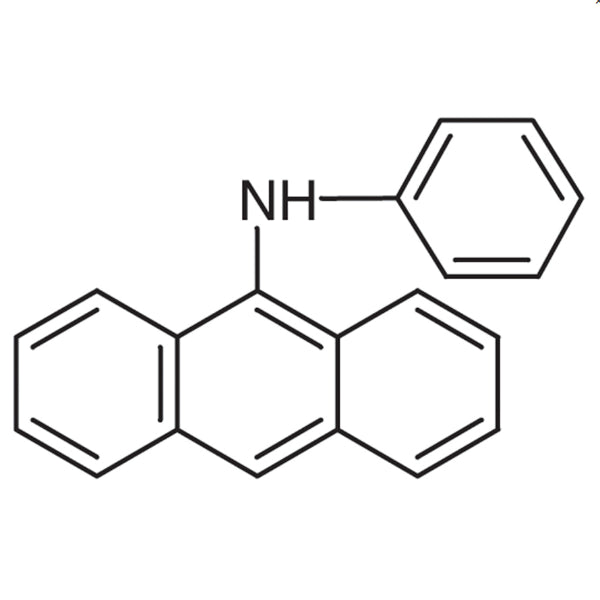
TCI P1496 N-Phenyl-9-anthramine (CAS 15424-38-1) is an anthracene derivative with a phenylamino group at the 9-position of its three-ring aromatic framework. TCI lists it under Small Molecule Semiconductor Building Blocks within its Materials Science range. It is supplied as a starting material or structural component for building functional organic materials. Its large anthracene core, combined with an aromatic amine group, makes it of interest to researchers who develop optoelectronic materials and study how molecular structure affects electronic behaviour.
Researchers choose this compound mainly for the extended conjugated π-electron system of anthracene, together with the amine nitrogen atom, which can act as an electron-donating group. Frameworks of this kind are commonly studied for their photophysical properties, fluorescence and charge transport. The hydrogen atom on the secondary amine also leaves room for further modification, such as arylation, so the molecule can be built into larger and more complex structures. Batch-specific properties should be checked in the manufacturer's documentation, including the certificate of analysis and the safety data sheet.
In Indonesian laboratories, this product is relevant to research groups in materials chemistry, physical organic chemistry and photonics at universities and research institutions. Typical work includes synthesising new organic semiconductor candidates, characterising absorption and emission behaviour, and exploring structure–property relationships in conjugated molecules. It also suits graduate and doctoral projects on organic electronics, where a well-defined aromatic amine building block helps make synthetic routes and spectroscopic comparisons between related derivatives more reproducible.
TCI brochures (PDF)
- Building Blocks for Organic Semiconductor 2026-03-24 · p. 30
Related TCI products
- TCI T3367 19606-98-5 N,N,N'-Triphenyl-1,4-phenylenediamine
- TCI T2891 167218-30-6 N,N,N'-Triphenylbenzidine
- TCI T2201 634-43-5 N-(p-Tolyl)-1-naphthylamine
- TCI T2065 644-16-6 N-(p-Tolyl)-2-naphthylamine
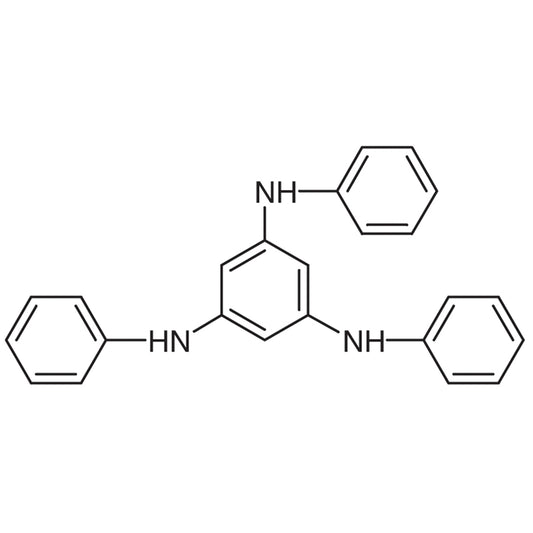
- TCI T1831 102664-66-4 N,N',N''-Triphenyl-1,3,5-benzenetriamine
- TCI B5047 446242-37-1 N-(4-Biphenylyl)-1-naphthylamine
- Organic semiconductor synthesis: its anthracene core and aromatic amine group make it a useful building block for assembling small-molecule materials with charge-transport potential.
- Photophysical and fluorescence studies: the extended conjugated π-system of anthracene makes the compound a good subject for examining absorption, emission and related excited-state behaviour.
- Donor–acceptor molecular design: the amine nitrogen can act as an electron-donating group, which helps researchers build push–pull structures for optoelectronic property studies.
- Further functionalisation by arylation: the hydrogen on the secondary amine can be modified, so researchers can extend the molecule into larger, more elaborate conjugated architectures.
- Structure–property relationship research: as a defined anthracene-amine framework, it gives a reliable reference point when comparing how substituents change electronic and optical behaviour.
| Brand | TCI (product code P1496) |
|---|---|
| CAS number | 15424-38-1 |
| Molecular formula | — |
| Purity | — |
| Category | Materials Science > Material Building Blocks > Small Molecule Semiconductor Building Blocks |
| Pack sizes | available in TCI's standard pack sizes for this product code |
| Physical form | — |
| Storage | follow the conditions on the label and in the manufacturer's safety data sheet |
- Chemical name: N-Phenyl-9-anthramine
Keep N-Phenyl-9-anthramine in its original, tightly closed manufacturer's container, in a cool, dry and well-ventilated place away from direct light, heat and incompatible substances such as strong oxidising agents. If a portion is transferred, use clean, dry, clearly labelled glass containers with secure closures. Handle the material in a fume hood or well-ventilated area and wear appropriate personal protective equipment, including gloves, safety glasses and a lab coat. Avoid creating dust and avoid contact with skin, eyes and clothing. Always check the manufacturer's label and safety data sheet for batch-specific storage requirements, hazard information and disposal guidance before use.
—
Produk Terkait
-
N,N,N'-Triphenyl-1,4-phenylenediamine TCI T3367
Regular price From Rp 1.686.000,00Regular priceRp 1.148.000,00Sale price From Rp 1.686.000,00 -
N,N,N'-Triphenylbenzidine TCI T2891
Regular price From Rp 2.386.000,00Regular priceRp 1.639.000,00Sale price From Rp 2.386.000,00 -
N-(p-Tolyl)-1-naphthylamine TCI T2201
Regular price Rp 4.332.000,00Regular priceRp 2.948.000,00Sale price Rp 4.332.000,00 -
N-(p-Tolyl)-2-naphthylamine TCI T2065
Regular price Rp 2.310.000,00Regular priceRp 1.571.000,00Sale price Rp 2.310.000,00 -
N,N',N''-Triphenyl-1,3,5-benzenetriamine TCI T1831
Regular price From Rp 3.527.000,00Regular priceRp 2.415.000,00Sale price From Rp 3.527.000,00 -
N-(4-Biphenylyl)-1-naphthylamine TCI B5047
Regular price From Rp 1.635.000,00Regular priceRp 1.112.000,00Sale price From Rp 1.635.000,00 -
4-Bromodiphenylamine TCI B3949
Regular price From Rp 1.350.000,00Regular priceRp 918.000,00Sale price From Rp 1.350.000,00 -
Bis(4-iodophenyl)amine TCI B2685
Regular price Rp 2.725.000,00Regular priceRp 1.853.000,00Sale price Rp 2.725.000,00