

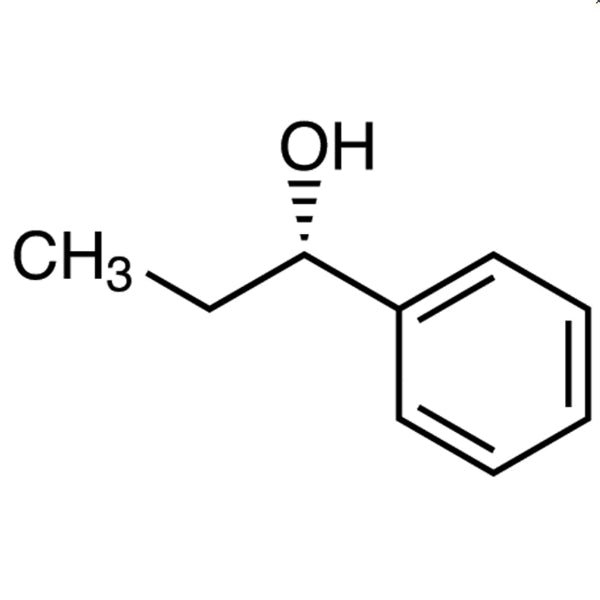
(S)-(-)-1-Phenyl-1-propanol from TCI (product code P1931, CAS 613-87-6) is the (S)-enantiomer of 1-phenyl-1-propanol. It is a chiral secondary benzylic alcohol whose stereogenic centre is the carbon atom that carries the hydroxyl group. As a chiral building block, it gives chemists a defined spatial configuration to use when assembling optically active molecules. In the laboratory it also serves as a chiral reference standard and as a comparison product in research on the asymmetric reduction of aromatic ketones, where the stereochemical outcome has to be confirmed.
The compound's key feature is its (S)-configuration with a negative sign of optical rotation, making it the mirror image of the (R)-enantiomer. Because each enantiomer is available separately, researchers can assign each enantiomer's peak in chiral chromatography with certainty rather than by assumption. The hydroxyl group is versatile for derivatization, so the molecule can be converted into a range of downstream intermediates. The phenyl ring absorbs UV light, which makes reaction monitoring and quantitative analysis easier. TCI's consistent quality also means measurements can be compared reliably from one experiment to the next.
In Indonesian laboratories, this material is widely needed in asymmetric synthesis research, where it serves both as a starting chiral fragment and as an authentic reference for checking stereochemical results. It is also important in biocatalyst screening programmes that use local microorganisms, where research groups test microbial strains for their ability to reduce aromatic ketones enantioselectively. In this work, an authentic sample of the (S)-enantiomer lets researchers confirm product identity and estimate enantiomeric excess accurately during routine chromatographic analysis.
TCI brochures (PDF)
- Chiral Building Blocks 2025-04-14 · p. 9
Related TCI products
- TCI B4117 85483-97-2 (S)-(+)-1-Benzyloxy-2-propanol
- TCI P1930 1565-74-8 (R)-(+)-1-Phenyl-1-propanol
- TCI M2408 26550-55-0 (S)-(+)-1-Methoxy-2-propanol
- TCI M2166 4984-22-9 (R)-(-)-1-Methoxy-2-propanol
- TCI C2424 100306-34-1 (S)-(-)-3-Chloro-1-phenyl-1-propanol
- TCI C2423 100306-33-0 (R)-(+)-3-Chloro-1-phenyl-1-propanol
- Chiral building block in asymmetric synthesis: its defined (S)-configuration at the hydroxyl-bearing carbon gives chemists a ready stereocentre for building optically active target molecules.
- Chiral reference standard for chromatography: used alongside the separately available (R)-enantiomer, it allows each peak in a chiral separation to be assigned with certainty rather than by assumption.
- Comparison product in asymmetric ketone reduction studies: it is the expected (S)-product of reducing the corresponding aromatic ketone, so it serves as an authentic sample for confirming identity and stereochemical outcome.
- Biocatalyst screening with local microorganisms: researchers testing microbial strains for enantioselective reduction can use it to identify the (S)-product and estimate the enantiomeric excess each strain achieves.
- Derivatization and reaction monitoring: the versatile hydroxyl group allows further chemical modification, and the UV-absorbing phenyl ring makes reaction progress easy to follow and quantify.
| Brand | TCI (product code P1931) |
|---|---|
| CAS number | 613-87-6 |
| Molecular formula | — |
| Purity | — |
| Category | Chemistry > Asymmetric Synthesis > Chiral Building Blocks |
| Pack sizes | available in the pack sizes offered by TCI; please confirm when ordering |
| Physical form | — |
| Storage | keep tightly closed in a cool, dry, well-ventilated place, following the label and Safety Data Sheet |
- Stereochemistry: (S)-enantiomer, negative sign of optical rotation
Keep (S)-(-)-1-Phenyl-1-propanol in its original, tightly closed container, away from heat, ignition sources, direct sunlight, and strong oxidizing agents. Store it in a cool, dry, well-ventilated area, and follow any specific temperature guidance on the TCI label or Safety Data Sheet. To protect its enantiomeric integrity, avoid cross-contamination with the (R)-enantiomer by using clean, dedicated glassware and syringes. Handle it in a fume hood while wearing safety glasses, gloves, and a laboratory coat. Avoid contact with skin and eyes, and avoid breathing vapours. Dispose of waste according to local regulations.
—
Produk Terkait
-
(S)-(+)-1-Benzyloxy-2-propanol TCI B4117
Regular price From Rp 1.618.050,00Regular priceRp 1.146.600,00Sale price From Rp 1.618.050,00 -
(R)-(+)-1-Phenyl-1-propanol TCI P1930
Regular price Rp 4.797.450,00Regular priceRp 3.354.750,00Sale price Rp 4.797.450,00 -
(S)-(+)-1-Methoxy-2-propanol TCI M2408
Regular price Rp 2.623.950,00Regular priceRp 1.850.100,00Sale price Rp 2.623.950,00 -
(R)-(-)-1-Methoxy-2-propanol TCI M2166
Regular price From Rp 1.008.000,00Regular priceRp 720.300,00Sale price From Rp 1.008.000,00 -
(S)-(-)-3-Chloro-1-phenyl-1-propanol TCI C2424
Regular price Rp 1.696.800,00Regular priceRp 1.186.500,00Sale price Rp 1.696.800,00 -
(R)-(+)-3-Chloro-1-phenyl-1-propanol TCI C2423
Regular price Rp 1.326.150,00Regular priceRp 927.150,00Sale price Rp 1.326.150,00 -
(S)-3-(Methylamino)-1-(2-thienyl)-1-propanol TCI M2157
Regular price From Rp 1.749.300,00Regular priceRp 1.239.000,00Sale price From Rp 1.749.300,00 -
3-[3-(Trifluoromethyl)phenyl]-1-propanol TCI T3095
Regular price From Rp 823.200,00Regular priceRp 575.400,00Sale price From Rp 823.200,00


