

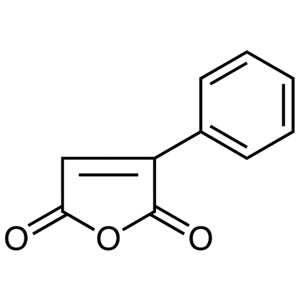
Phenylmaleic Anhydride (PMA), also known as TCI P2096 with CAS number 36122-35-7, is a versatile chemical compound widely used in laboratory settings for its reactivity and functional group versatility. As a building block in organic synthesis, PMA plays a crucial role in the development of complex molecules by participating in various chemical reactions. Its anhydride functionality makes it suitable for reactions such as esterification, amidation, and the Diels-Alder reaction, which are fundamental in organic chemistry. This compound is particularly valued for its ability to form stable intermediates and its compatibility with a wide range of reagents.
PMA is characterized by its stable molecular structure and high reactivity, making it a preferred choice for synthetic chemists. Its ability to act as an electron donor contributes to its effectiveness in redox reactions. Additionally, PMA exhibits relatively high melting and boiling points, which facilitate purification processes like distillation and crystallization. These physical properties ensure that it remains stable under various experimental conditions, enhancing its reliability in laboratory applications. The compound’s chemical inertness and predictable behavior further support its use in controlled chemical environments.
In Indonesian laboratories, PMA is commonly employed in organic chemistry research, especially in the synthesis of pharmaceuticals, polymers, and industrial chemicals. Its availability and cost-effectiveness make it a practical choice for both academic and industrial research. The compound is often used in educational settings to teach fundamental organic reactions and synthesis techniques, supporting the development of skilled chemists in the region.
- Organic synthesis is a key application where PMA is used to create complex molecules due to its reactivity and functional group versatility.
- Esterification reactions benefit from PMA's anhydride functionality, allowing for the formation of ester compounds with high yields.
- Amidation processes utilize PMA as a reactive intermediate, enabling the synthesis of amide derivatives in controlled environments.
- Diels-Alder reactions require the presence of anhydride groups, making PMA an essential component in such cycloaddition reactions.
- Pharmaceutical research often incorporates PMA in the development of new drug compounds due to its structural adaptability and synthetic utility.
| Brand | TCI |
|---|---|
| CAS number | 36122-35-7 |
| Molecular formula | — |
| Purity | — |
| Category | Chemistry > Building Blocks > Non-Heterocyclic Building Blocks |
| Pack sizes | Available in various quantities as per standard laboratory supply |
| Physical form | Solid |
| Storage | Store in a cool, dry place away from moisture and direct sunlight |
Phenylmaleic Anhydride should be stored in a cool, dry environment to maintain its stability and prevent degradation. It is recommended to keep the compound in a sealed container to minimize exposure to moisture and air, which can affect its reactivity. Suitable storage containers include glass or high-density polyethylene (HDPE) bottles with airtight lids. In laboratory settings, PMA should be handled with care, using appropriate personal protective equipment such as gloves and safety goggles. It is important to ensure that the compound is stored away from incompatible materials, such as strong bases or reducing agents, to avoid unwanted chemical reactions. Proper labeling of storage containers is also essential for safety and traceability.
—
Produk Terkait
-
N-Phenylmaleimide TCI P0900
Regular price From Rp 505.050,00Regular price -
ValericAnhydride TCI V0006
Regular price From Rp 875.700,00Regular price -
3-BromophthalicAnhydride TCI B4061
Regular price From Rp 1.246.350,00Regular price -
Bicyclo[2.2.2]oct-5-ene-2,3-dicarboxylicAnhydride TCI B3038
Regular price Rp 3.605.700,00Regular price -
ButylsuccinicAnhydride TCI B2742
Regular price From Rp 5.274.150,00Regular price -
4-BromophthalicAnhydride TCI B1693
Regular price From Rp 2.386.650,00Regular price -
2-Buten-1-ylsuccinicAnhydride TCI B1613
Regular price From Rp 2.439.150,00Regular price -
BehenicAnhydride TCI B1531
Regular price From Rp 1.776.600,00Regular price


![6708-37-8 Bicyclo[2.2.2]oct-5-ene-2,3-dicarboxylic Anhydride - AMI Scientific](http://amiscientific.com/cdn/shop/files/TCI2510B3038.jpg?v=1767089273&width=533)


