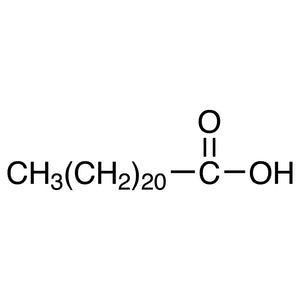
Behenic Anhydride (BCA), also known as TCI B1531 with CAS number 55726-23-3, is a chemical compound widely used in laboratory settings for its versatile reactivity. It belongs to the category of Chemistry > Building Blocks > Non-Heterocyclic Building Blocks, making it a fundamental component in organic synthesis. As an anhydride, BCA plays a crucial role in forming esters and amides by reacting with alcohols and amines. Its ability to participate in various chemical reactions makes it an essential tool for researchers and chemists.
One of the key properties that make BCA a preferred choice is its chemical stability under controlled conditions. It is typically available in solid form, white in color, and has a distinct odor. Despite its stability, BCA is highly reactive towards water and moisture, which requires careful handling. Its reactivity and versatility make it suitable for a wide range of applications in both academic and industrial research. The compound’s ability to build complex molecular structures further enhances its value in chemical synthesis.
In Indonesian laboratories, Behenic Anhydride is commonly used in chemical research, material development, and the production of industrial chemicals. It is frequently employed in polymer-related studies, pharmaceutical research, and cosmetic formulation. Its availability in various packaging options allows for easy use in different experimental scales, making it a reliable choice for both small-scale and large-scale applications.
- Organic synthesis is a primary application where BCA is used to create esters and amides, contributing to the development of new compounds.
- Polymer research benefits from BCA’s ability to form complex molecular structures, aiding in the creation of advanced materials.
- Pharmaceutical development utilizes BCA for its reactivity with amines and alcohols, enabling the synthesis of drug-related compounds.
- Cosmetic formulation relies on BCA’s chemical properties to create stable and functional ingredients for personal care products.
- Industrial chemical production employs BCA due to its versatility in forming various chemical bonds, supporting the creation of specialized products.
| Brand | TCI |
|---|---|
| CAS number | 55726-23-3 |
| Molecular formula | — |
| Purity | — |
| Category | Chemistry > Building Blocks > Non-Heterocyclic Building Blocks |
| Pack sizes | Available in various sizes for different experimental needs |
| Physical form | Solid, white in color |
| Storage | Should be stored in a dry, cool place away from moisture and water |
Behenic Anhydride should be stored in a dry, cool environment to prevent moisture-induced reactions. It is recommended to use airtight containers to minimize exposure to humidity and air. Due to its reactivity with water, it should be kept away from any sources of moisture, including humid environments. Laboratory personnel should wear appropriate personal protective equipment, such as gloves and goggles, when handling this compound. Proper ventilation is also essential to manage any potential vapors. The compound should not be stored near incompatible materials, such as strong acids or bases, to ensure safety in the laboratory setting.
—
Produk Terkait
-
BehenicAcid TCI B1747
Regular price Rp 4.028.850,00Regular priceRp 2.832.900,00Sale price Rp 4.028.850,00 -
BehenicAcid TCI B1248
Regular price From Rp 848.400,00Regular priceRp 609.000,00Sale price From Rp 848.400,00 -
BehenicAcid TCI D0963
Regular price From Rp 530.250,00Regular priceRp 386.400,00Sale price From Rp 530.250,00 -
ValericAnhydride TCI V0006
Regular price From Rp 928.200,00Regular priceRp 664.650,00Sale price From Rp 928.200,00 -
3-BromophthalicAnhydride TCI B4061
Regular price From Rp 1.246.350,00Regular priceRp 871.500,00Sale price From Rp 1.246.350,00 -
Bicyclo[2.2.2]oct-5-ene-2,3-dicarboxylicAnhydride TCI B3038
Regular price Rp 3.605.700,00Regular priceRp 2.521.050,00Sale price Rp 3.605.700,00 -
ButylsuccinicAnhydride TCI B2742
Regular price From Rp 5.274.150,00Regular priceRp 3.687.600,00Sale price From Rp 5.274.150,00 -
4-BromophthalicAnhydride TCI B1693
Regular price From Rp 2.386.650,00Regular priceRp 1.668.450,00Sale price From Rp 2.386.650,00